


























Views
Downloads


Essential Earth Day Poem Worksheet | Grade 1-2
Paste this activity's link or code into your existing LMS (Google Classroom, Canvas, Teams, Schoology, Moodle, etc.).
Students can open and work on the activity right away, with no student login required.
You'll still be able to track student progress and results from your teacher account.
This Grade 1 and Grade 2 Earth Day worksheet helps students build foundational reading skills through poetry and environmental science themes. Students practice identifying key details within a short text to answer comprehension questions while developing a personal connection to environmental stewardship. It provides a structured way to celebrate the holiday while maintaining academic rigor.
At a Glance
- Grade: 1-2 · Subject: ELA Reading
- Standard:
CCSS.ELA-LITERACY.RL.1.1— Ask and answer questions about key details in a text- Skill Focus: Poetry comprehension and stewardship
- Format: 3 pages · 5 tasks · Answer key included · PDF
- Best For: Earth Day morning work or sub plans
- Time: 15–20 minutes
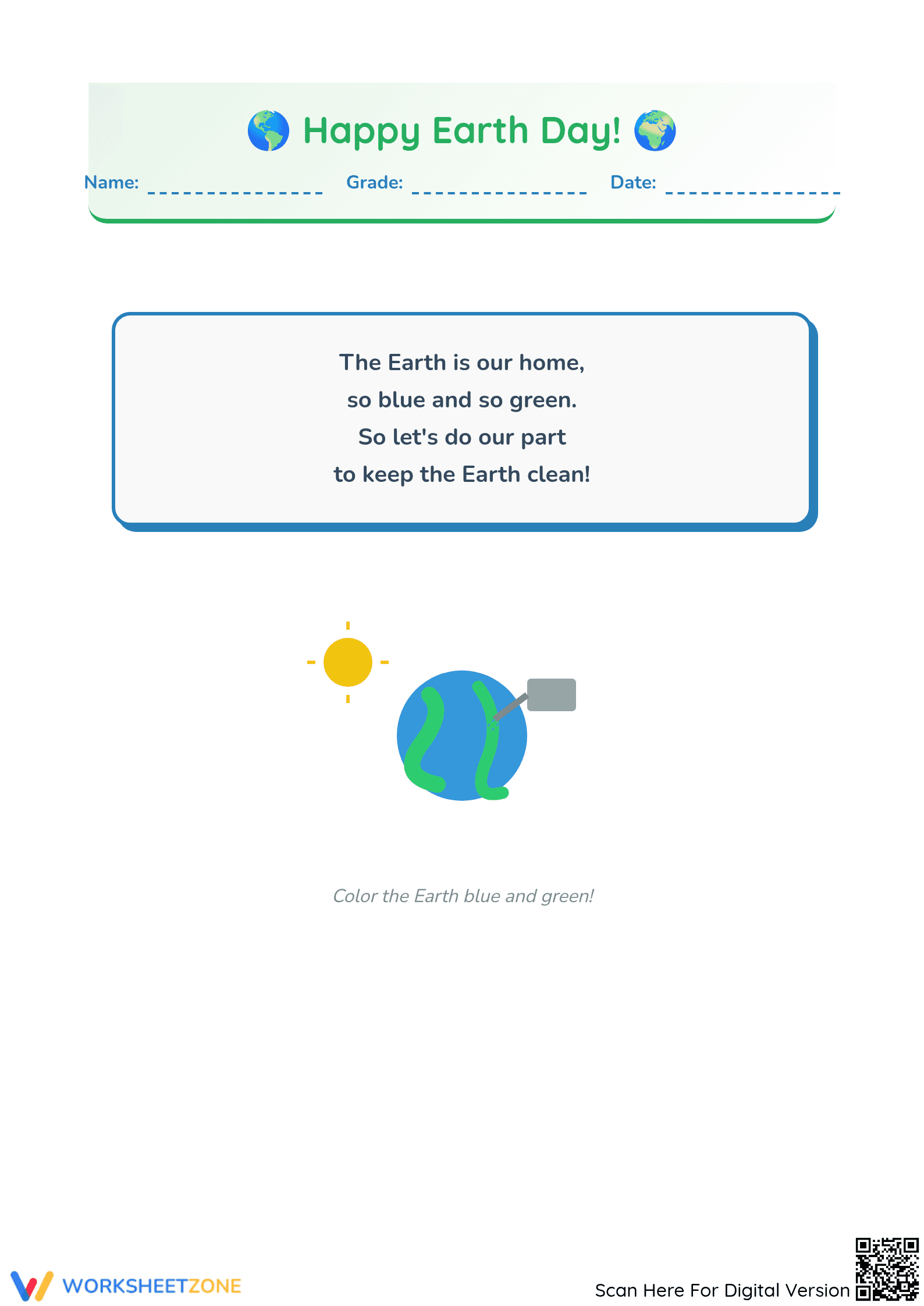
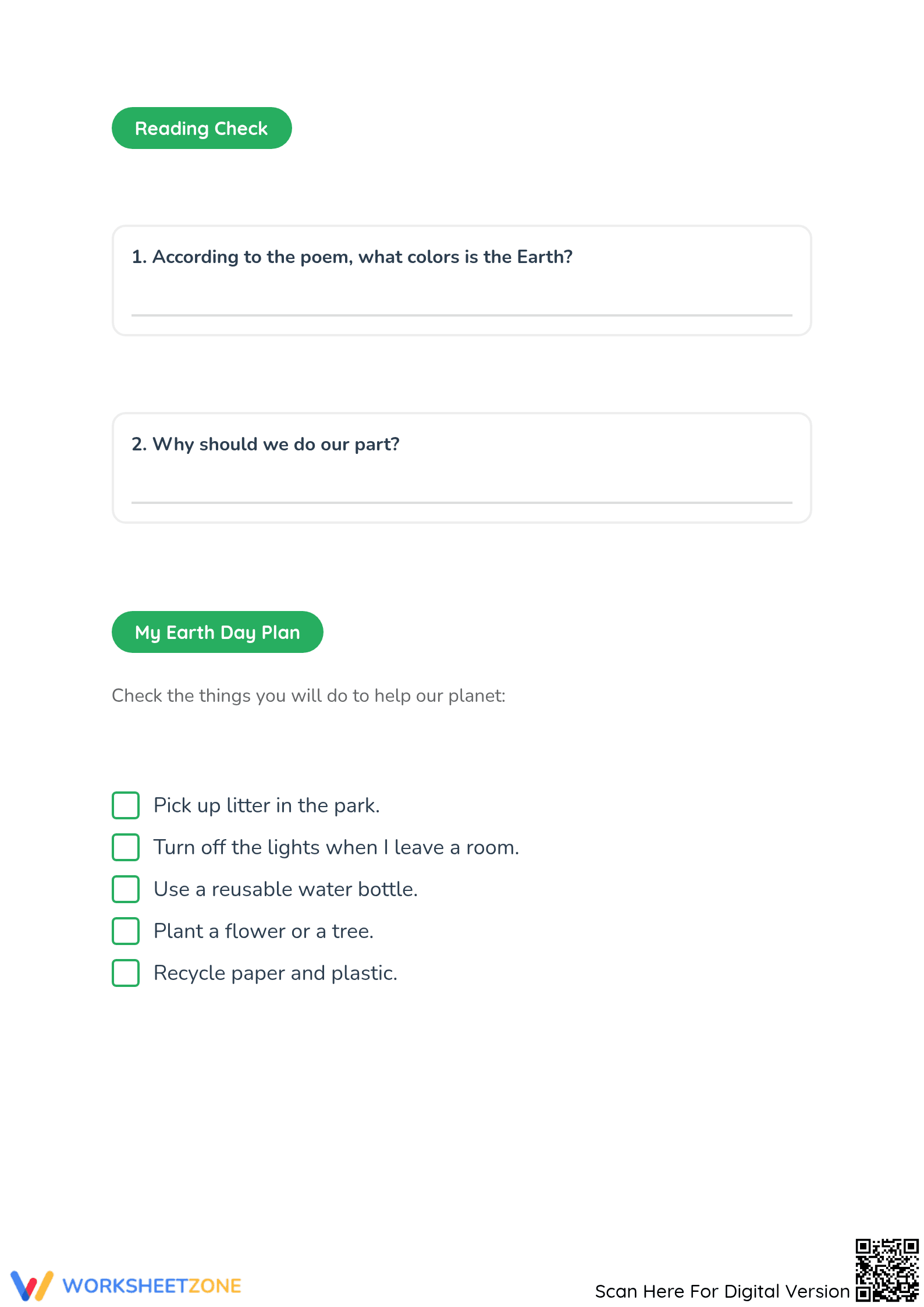
The three-page PDF includes a central four-line poem designed for early readers. The first page features the text alongside a coloring prompt to engage visual learners. The second page contains a Reading Check with two open-ended response lines and a My Earth Day Plan checklist featuring five actionable items like recycling and planting trees. The final page provides a dedicated creative space for students to illustrate their own Happy Earth.
The zero-prep workflow is designed for maximum efficiency in busy primary classrooms. First, select the three-page PDF and print enough copies for your roster in under 30 seconds. Second, distribute the packets as a standalone literacy center or holiday activity. Finally, use the included answer key to quickly check comprehension responses or facilitate a whole-class discussion on the environmental checklist. This resource is ideal for emergency sub plans or transition periods during Earth Week.
This resource aligns with `CCSS.ELA-LITERACY.RL.1.1`: "Ask and answer questions about key details in a text." By requiring students to identify specific colors and themes mentioned in the poem, the worksheet reinforces evidence-based reading. It also supports `CCSS.ELA-LITERACY.RL.2.1` for second-grade learners. Both standard codes can be copied directly into lesson plans, IEP goals, or district curriculum mapping tools.
Use this worksheet during a whole-group literacy block as a shared reading exercise. Read the poem aloud twice, then have students underline the key details before moving to the comprehension page. Alternatively, use it as a formative assessment to observe how well students can transfer information from a short text to a written response. Completion typically takes 15 to 20 minutes depending on the depth of the drawing task.
This activity is tailored for first and second-grade students who are beginning to explore different reading genres. It is particularly effective for English Language Learners (ELLs) due to the visual support and simple sentence structures. Pair this worksheet with a non-fiction picture book about recycling or a classroom anchor chart on "Ways to Help the Earth" to create a comprehensive holiday lesson.
Research from Fisher & Frey (2014) emphasizes that integrating short, thematic texts like poems into primary literacy instruction helps students develop the ability to synthesize information across different formats. This worksheet specifically targets CCSS.ELA-LITERACY.RL.1.1 by asking students to answer questions about key details, a foundational skill for reading mastery. By combining a 4-line poem with a 5-item actionable checklist, the resource bridges the gap between reading comprehension and real-world application. Studies in the RAND AIRS 2024 report suggest that high-quality, printable materials that include both text and creative expression increase student engagement in early elementary settings. This 3-page resource provides the necessary scaffolding for Grade 1 and Grade 2 learners to demonstrate their understanding of environmental themes while practicing essential ELA skills. It serves as a reliable tool for teachers seeking to meet standards while celebrating seasonal events.


