


























Views
Downloads

Printable Candy Counting Worksheet | Grade K Math
Paste this activity's link or code into your existing LMS (Google Classroom, Canvas, Teams, Schoology, Moodle, etc.).
Students can open and work on the activity right away, with no student login required.
You'll still be able to track student progress and results from your teacher account.
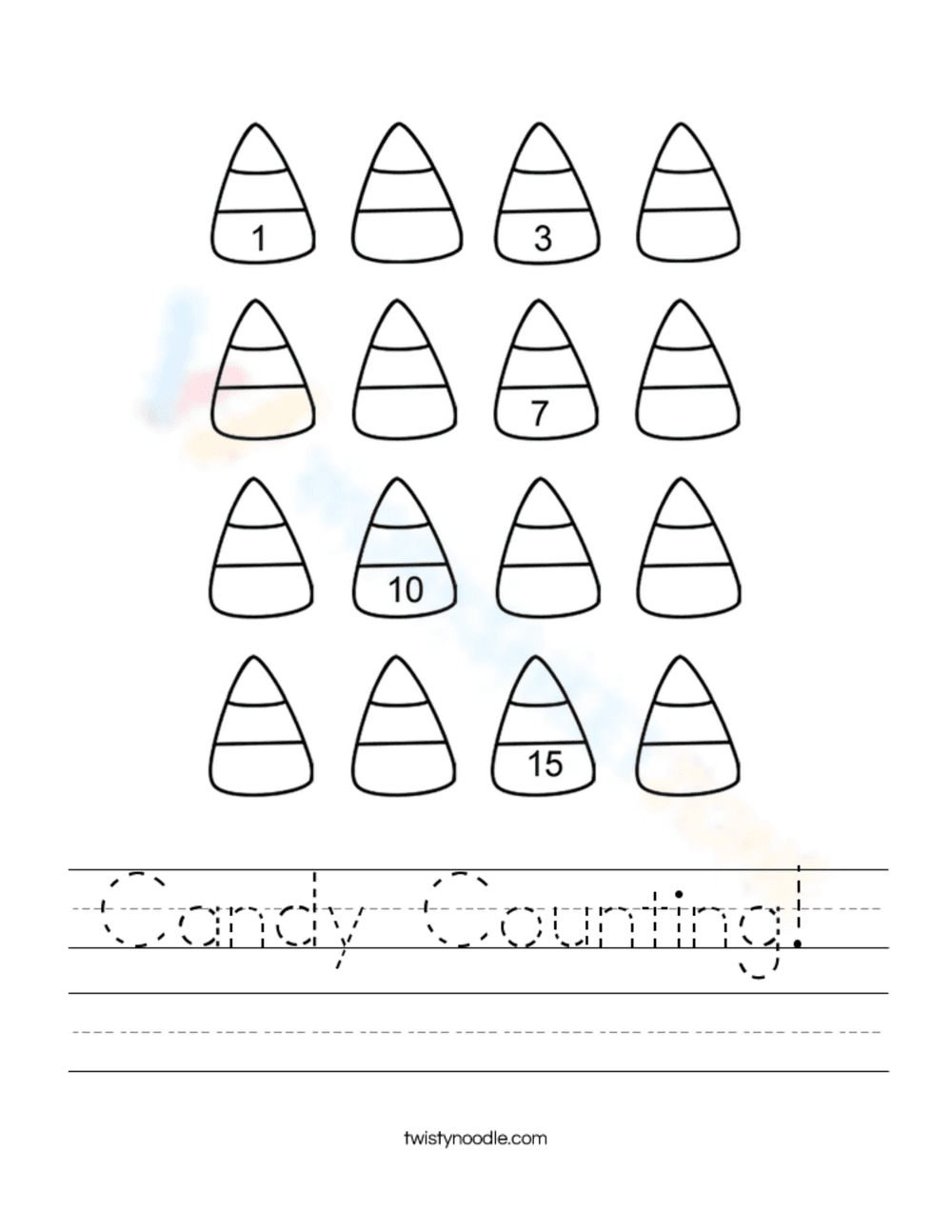
This engaging candy corn worksheet helps early learners master counting sequences and number writing. Students practice counting forward by filling in missing numbers up to sixteen, reinforcing their understanding of numerical order. The activity concludes with a handwriting exercise, making it an excellent dual-purpose resource for developing fine motor skills.
At a Glance
- Grade: K · Subject: Math
- Standard:
CCSS.MATH.CONTENT.K.CC.A.2— Count forward beginning from a given number- Skill Focus: Counting sequence and number writing
- Format: 1 page · 12 problems · Answer key included · PDF
- Best For: Morning work or math centers
- Time: 10–15 minutes
Inside this single-page resource, educators will find a visually appealing grid of sixteen candy corn shapes. Five of the shapes contain starting numbers, while the remaining eleven require students to write the correct missing numbers in the sequence. Below the counting activity, a tracing section features the phrase "Candy Counting!" on primary writing lines to support letter formation and handwriting practice. A complete answer key is provided for quick grading.
Enjoy a streamlined zero-prep workflow:
- Print (1 minute): Simply download the PDF and print the required number of copies.
- Distribute (1 minute): Hand out the worksheets during morning routines, math centers, or as an independent practice activity.
- Review (1 minute): Use the included answer key to quickly check student work or project it on a smartboard for self-correction.
With less than two minutes of total teacher prep time, this resource is highly suitable for emergency sub plans or last-minute schedule changes.
This activity is directly aligned to CCSS.MATH.CONTENT.K.CC.A.2, requiring students to count forward beginning from a given number within the known sequence. It also supports CCSS.MATH.CONTENT.K.CC.A.3 by having students write numbers from 0 to 20. Both standard codes can be copied directly into lesson plans, IEP goals, or district curriculum mapping tools.
Use this worksheet as morning work to activate mathematical thinking. Alternatively, it serves as an excellent independent station during math centers after direct instruction on the number line. As a formative assessment observation tip, watch how students approach the blank spaces; note whether they need to recount from one each time or if they can successfully count on from the previous given number. Expected completion time ranges from ten to fifteen minutes.
This resource is primarily designed for Kindergarten and early first-grade students developing their foundational numeracy skills. For differentiation, teachers can provide a physical number line or hundreds chart to students who need additional scaffolding. This worksheet pairs naturally with hands-on counting manipulatives or a direct instruction lesson on sequential ordering.
Developing fluency in number sequences is a critical milestone in early childhood mathematics. According to a 2024 report by EdReports, instructional materials that integrate visual models with sequential counting tasks significantly improve young learners' ability to internalize numerical order. This worksheet directly supports CCSS.MATH.CONTENT.K.CC.A.2 by requiring students to count forward beginning from a given number, moving them beyond rote memorization starting from one. By combining this cognitive task with fine motor handwriting practice, the activity addresses multiple developmental domains simultaneously. Consistent practice with missing-number formats helps solidify the mental number line, a foundational concept necessary for later addition and subtraction skills. Educators can rely on this targeted, standards-aligned practice to build mathematical confidence and ensure students are meeting essential grade-level benchmarks effectively.


