


























Views
Downloads



Camping Adventure Printable Worksheet | Grade 1-3 ELA
Paste this activity's link or code into your existing LMS (Google Classroom, Canvas, Teams, Schoology, Moodle, etc.).
Students can open and work on the activity right away, with no student login required.
You'll still be able to track student progress and results from your teacher account.
This Grade 1-3 reading comprehension worksheet uses a seasonal camping theme to build essential literacy skills. Students engage with a short informational text before demonstrating understanding through multiple-choice questions, sentence completion, and creative expression. It provides a structured yet fun way to assess reading fluency and detail recall.
At a Glance
- Grade: 1-3 · Subject: ELA
- Standard:
CCSS.ELA-LITERACY.RI.1.1— Ask and answer questions about key details in a text- Skill Focus: Reading Comprehension
- Format: 4 pages · 9 problems · Answer key included · PDF
- Best For: Literacy centers and seasonal sub plans
- Time: 20–30 minutes
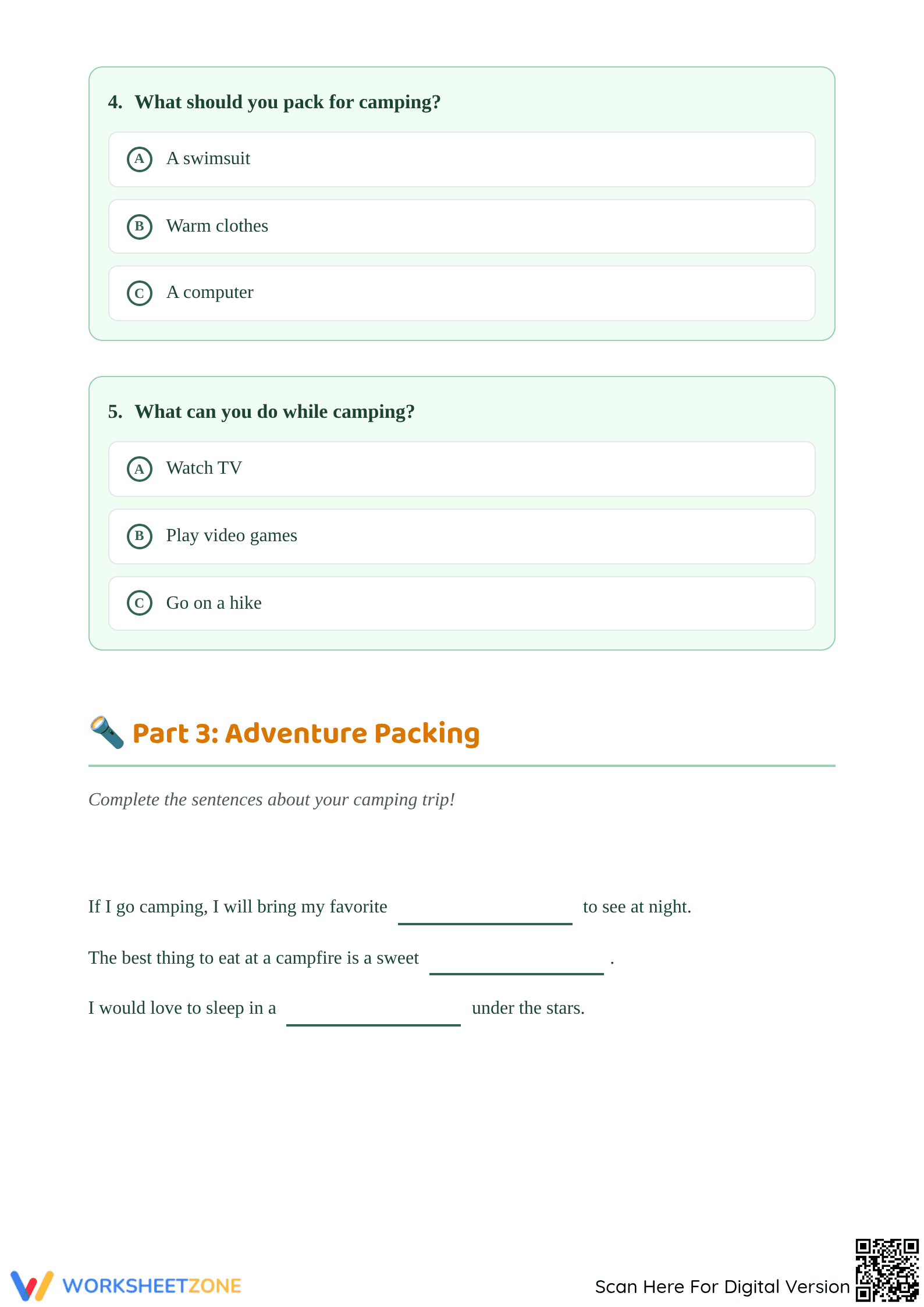
This 4-page packet includes a short reading passage with a "3-read" tracking system where students color a star for each repetition. It features 5 multiple-choice questions focused on explicit text details, 3 sentence completion prompts for vocabulary application, and a creative drawing space for synthesis. A full answer key is provided for quick grading.
Zero-Prep Workflow
- Print: Select the 4-page PDF and print enough copies for your class in under 30 seconds.
- Distribute: Hand out the packets during independent reading time or as a morning work activity.
- Review: Use the included answer key to grade or have students self-correct their work in about 2 minutes.
Total teacher prep time is under 2 minutes, making this an ideal resource for busy mornings or unexpected substitute teacher needs.
Standards Alignment
This resource is primarily aligned with CCSS.ELA-LITERACY.RI.1.1, which requires students to ask and answer questions about key details in a text. It also supports vocabulary development through sentence completion tasks. Both standard codes can be copied directly into lesson plans, IEP goals, or district curriculum mapping tools.
How to Use It
Use this worksheet as a formative assessment after a unit on informational text or as a standalone seasonal activity. It works well in literacy centers where students can practice independent reading. Expected completion time is 20 to 30 minutes depending on the student's reading level and drawing detail.
Who It's For
Designed for students in Grades 1 through 3, this resource is particularly effective for early readers needing scaffolded comprehension practice. It pairs naturally with a classroom anchor chart about "Wh- questions" or a read-aloud book about outdoor adventures and nature exploration.
According to Fisher & Frey (2014), the gradual release of responsibility is most effective when students are provided with clear, scaffolded tasks that move from guided reading to independent application. This worksheet follows that model by providing a short text for repeated reading followed by explicit comprehension checks. By aligning with CCSS.ELA-LITERACY.RI.1.1, the resource ensures that students are practicing the foundational skill of extracting key details from informational text, a prerequisite for higher-order analysis. Research from the NAEP indicates that early exposure to varied text structures, including seasonal and thematic content, improves student engagement and long-term retention of vocabulary. This 4-page packet offers 9 distinct tasks that allow for both objective assessment and creative synthesis, providing a comprehensive view of student mastery. The inclusion of a "3-read" star system encourages the habit of close reading, which is a critical component of literacy development in the primary grades.


