




























Views
Downloads



Building A Class Project: Essential Grade 3 ELA Worksheet

Paste this activity's link or code into your existing LMS (Google Classroom, Canvas, Teams, Schoology, Moodle, etc.).
Students can open and work on the activity right away, with no student login required.
You'll still be able to track student progress and results from your teacher account.
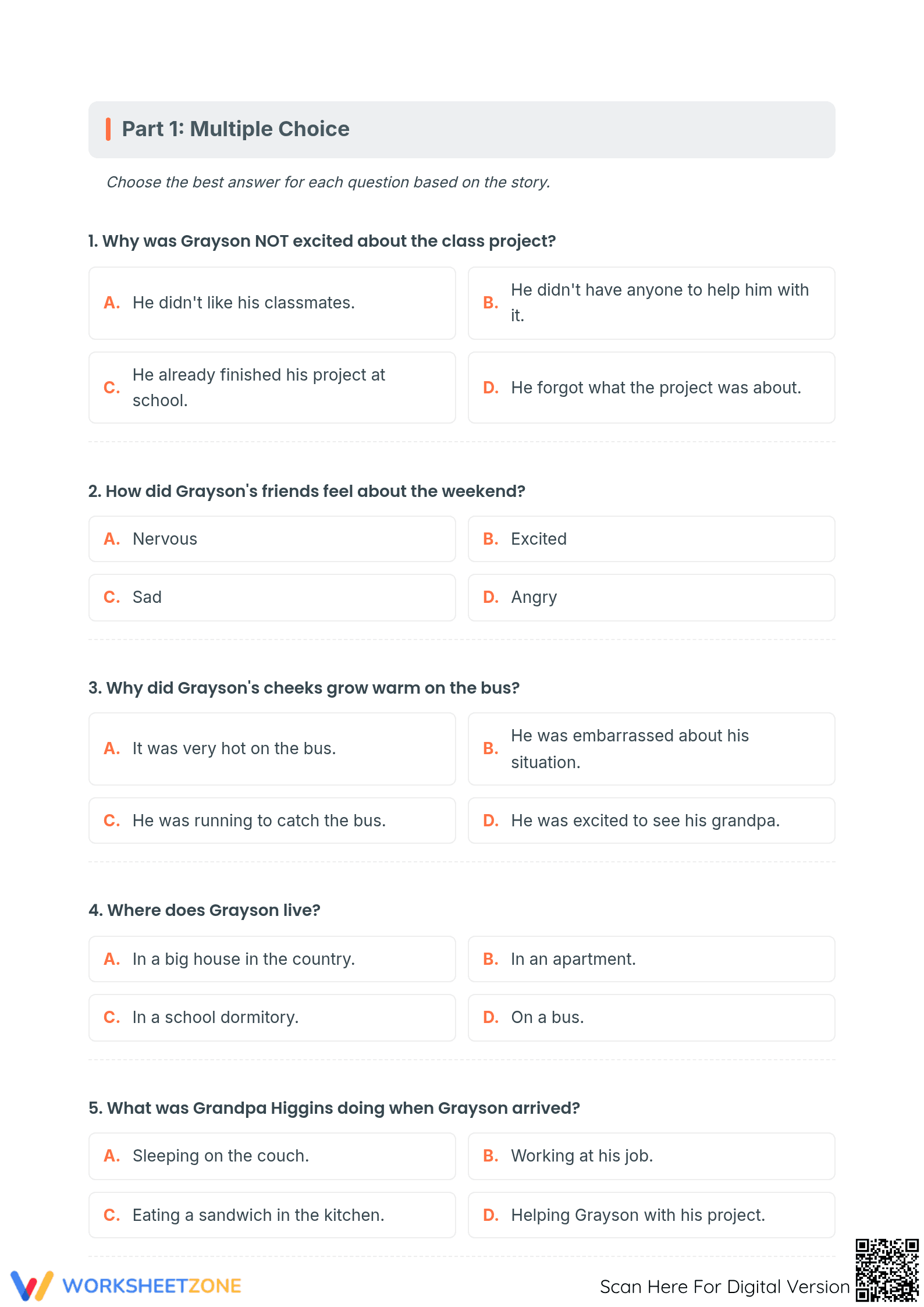
This Reading Comprehension worksheet centered on the story "Building A Class Project" helps students develop critical inference and text-evidence skills. By analyzing Grayson's emotional journey and his interaction with his grandfather, learners practice identifying character motivations and vocabulary in context. Students demonstrate mastery through a mix of multiple-choice and short-answer responses.
At a Glance
- Grade: 3 · Subject: English Language Arts (ELA)
- Standard:
CCSS.ELA-LITERACY.RL.3.1— Ask and answer questions to demonstrate understanding of a text using explicit evidence.- Skill Focus: Reading Comprehension & Character Analysis
- Format: 4 pages · 10 problems · Answer key included · PDF
- Best For: Independent practice or literacy centers
- Time: 25–35 minutes
The resource contains a structured four-page PDF including a multi-paragraph narrative text followed by three distinct assessment sections. It features five multiple-choice questions focusing on literal comprehension, three short-answer prompts requiring complete sentences for inference, and two vocabulary tasks centered on word meaning in context. A comprehensive answer key is provided for immediate grading.
Zero-Prep Workflow
- Print: Print the four-page packet for each student in less than 1 minute.
- Distribute: Hand out materials and instruct students to read the story "Building A Class Project" independently (10–15 minutes).
- Review: Allow students to complete the three-part assessment, then review the answers as a class using the provided key (15 minutes).
This sequence requires zero teacher setup, making it an ideal choice for substitute lesson plans or unexpected literacy block gaps.
Standards Alignment
The primary standard addressed is CCSS.ELA-LITERACY.RL.3.1, which requires students to ask and answer questions to demonstrate understanding of a text, referring explicitly to the text as the basis for the answers. The worksheet also supports CCSS.ELA-LITERACY.RL.3.3 by asking students to describe characters in a story and explain how their actions contribute to the sequence of events. Both standard codes can be copied directly into lesson plans, IEP goals, or district curriculum mapping tools.
How to Use It
Use this worksheet during the independent practice phase of a gradual release model following a lesson on making inferences. Teachers can observe how students handle the transition from multiple-choice to open-ended short answers, specifically watching if they return to the text to justify their answers in Part 2. It serves as an excellent formative assessment for identifying students who struggle with emotional nuances in character-driven narratives. Completion typically takes 30 minutes.
Who It's For
This resource is designed for Grade 3 students but is highly effective for Grade 4 and 5 students needing additional practice with textual evidence. It is particularly useful for students who benefit from clear section headers and scaffolded question types. Pair this worksheet with a character trait anchor chart or a short reading passage on family dynamics to deepen the instructional impact.
The "Building A Class Project" worksheet leverages the CCSS.ELA-LITERACY.RL.3.1 standard to provide a rigorous yet accessible practice environment for elementary learners. According to Fisher & Frey (2014) regarding the gradual release of responsibility, structured practice that combines multiple question formats—such as the multiple-choice, short-answer, and vocabulary tasks included here—is essential for moving students toward independent reading mastery. Research indicates that when students engage with character-centered narratives that mirror real-world social challenges, their engagement and retention of comprehension strategies significantly improve. This worksheet provides exactly 10 high-quality tasks that challenge students to synthesize information rather than merely recall facts. By integrating inference-based vocabulary work, the resource ensures a holistic approach to literacy development. Educators can confidently integrate this tool into their curriculum, knowing it meets the evidence-based standards required for modern ELA instruction and measurable student progress in reading comprehension.


