




























Views
Downloads
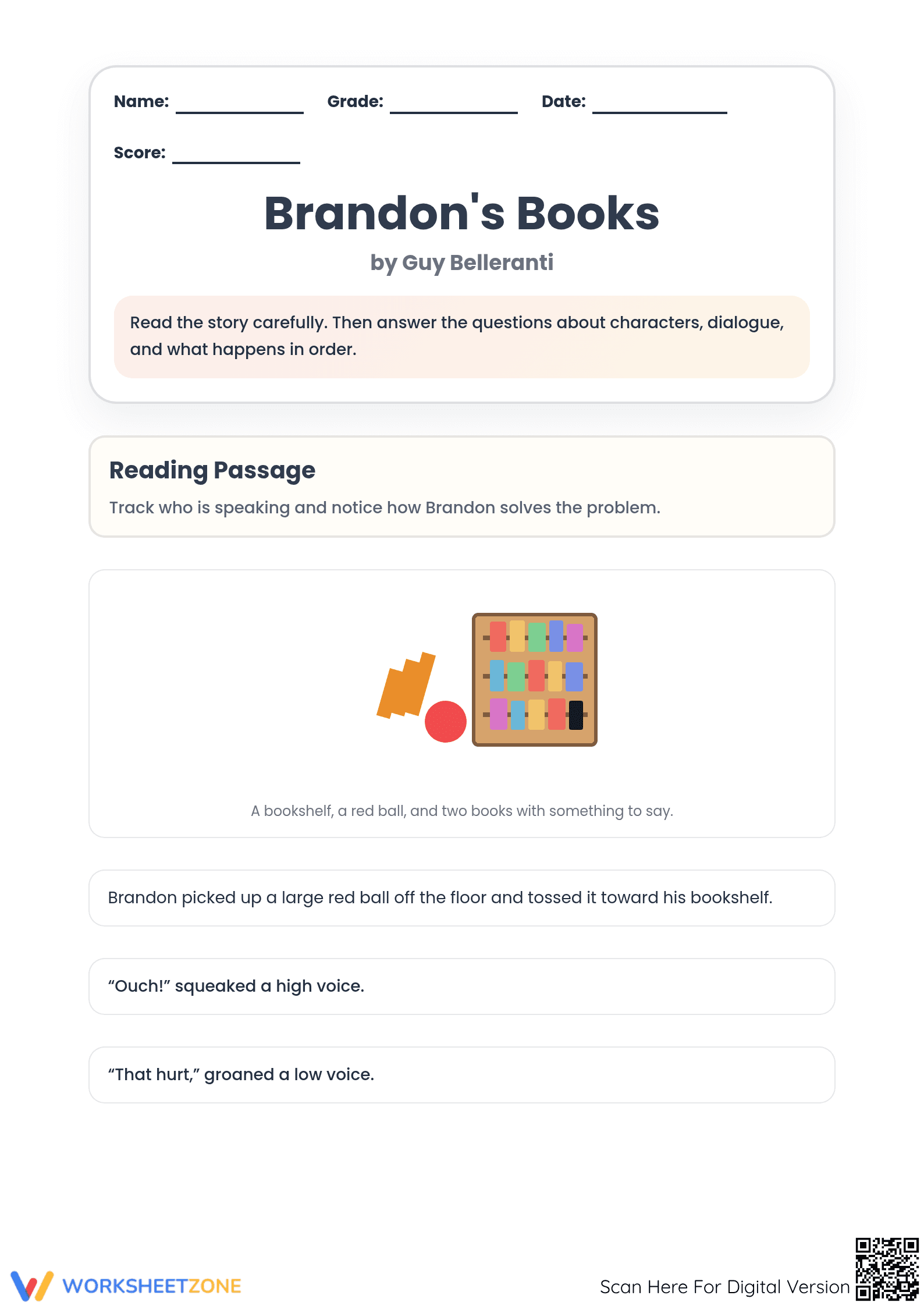



Printable Brandon’s Books Worksheet | Grade 2 Reading

Paste this activity's link or code into your existing LMS (Google Classroom, Canvas, Teams, Schoology, Moodle, etc.).
Students can open and work on the activity right away, with no student login required.
You'll still be able to track student progress and results from your teacher account.
Reading comprehension is a foundational skill that requires consistent, focused practice to master. This comprehensive four-page worksheet, featuring the engaging story "Brandon’s Books" by Guy Belleranti, is specifically designed to help students sharpen their ability to track characters, identify dialogue, and understand plot sequencing through a structured narrative approach.
At a Glance
- Grade: 2 · Subject: ELA Literature
- Standard:
CCSS.ELA-LITERACY.RL.2.1— Ask and answer such questions as who, what, where, when, why, and how- Skill Focus: Character Analysis & Story Sequencing
- Format: 4 pages · 8 problems · Answer key included · PDF
- Best For: Independent reading practice or formative assessment
- Time: 20–30 minutes
What’s Inside: The packet contains a multi-page illustrated reading passage followed by a detailed "Comprehension Check." The assessment portion includes a strategic mix of five open-ended short-answer questions and three multiple-choice questions. A dedicated sequencing task requires students to order plot points, while the final question focuses on character trait inference. A full answer key is provided for immediate feedback.
Skill Progression
- Guided Practice: Students begin by reading an illustrated text that uses clear dialogue tags and distinct character voices (high vs. low) to help them identify who is speaking.
- Supported Practice: Five literal comprehension questions guide students back into the text to locate specific evidence regarding setting, character actions, and physical descriptions.
- Independent Practice: The final three tasks require students to independently synthesize the story by sequencing events and inferring Brandon’s internal state based on his concluding actions.
This structure follows the gradual-release model, moving from identifying explicit details to performing higher-order synthesis and sequencing tasks.
Standards Alignment
The primary alignment for this resource is `CCSS.ELA-LITERACY.RL.2.1`: "Ask and answer such questions as who, what, where, when, why, and how to demonstrate understanding of key details in a text." The sequencing component also supports `CCSS.ELA-LITERACY.RL.2.5`, requiring students to understand the beginning, middle, and end of a story. Both standard codes can be copied directly into lesson plans, IEP goals, or district curriculum mapping tools.
How to Use It
This worksheet is ideal for use during the independent practice phase of a direct instruction lesson on character dialogue or story elements. Teachers can use the open-ended responses as a formative-assessment tool by observing whether students quote directly from the text or paraphrase. It is expected to take between 20 and 30 minutes to complete, making it a perfect fit for ELA centers or small-group instruction.
Who It's For
This resource is designed for Grade 2 students but is also appropriate for Grade 3 students needing additional support with sequencing or Grade 1 students ready for longer narratives. It pairs naturally with an anchor chart on "Five Finger Retelling" or a direct instruction lesson on identifying speakers in a story. For differentiated instruction, teachers might provide sentence frames for the open-ended questions.
According to the RAND AIRS 2024 report on literacy outcomes, repeated exposure to structured narrative sequencing tasks significantly improves a student's ability to maintain mental models of complex texts. This Brandon’s Books worksheet addresses CCSS.ELA-LITERACY.RL.2.1 by requiring students to answer literal and inferential questions about character interactions and plot development. By moving from simple identification of voices to the more complex task of ordering events, students build the cognitive stamina required for higher-grade reading demands. The inclusion of multiple-choice and short-answer formats ensures that students practice the varied task types they will encounter in standardized assessments, making it a citation-ready resource for evidence-based ELA instruction and progress monitoring.


