


























Views
Downloads
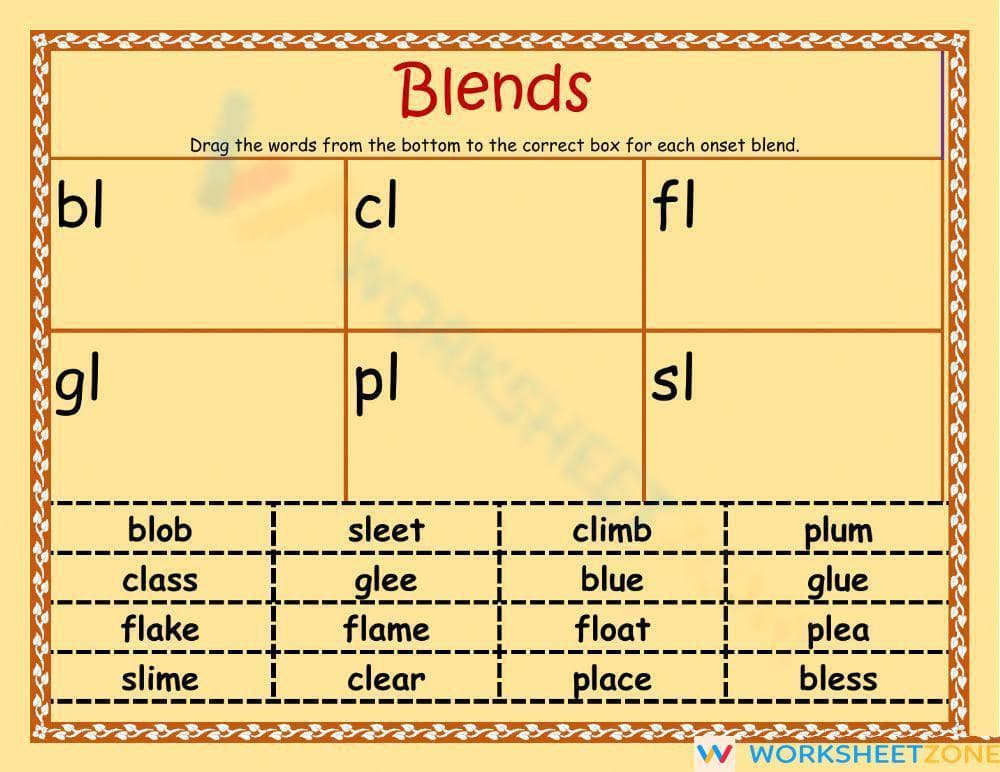

Essential L-Blends Phonics Worksheet | Grade 1-3
Paste this activity's link or code into your existing LMS (Google Classroom, Canvas, Teams, Schoology, Moodle, etc.).
Students can open and work on the activity right away, with no student login required.
You'll still be able to track student progress and results from your teacher account.
This Grade 1 phonics worksheet helps students master beginning L-blends through active categorization. By sorting sixteen different words into the correct onset blend boxes, learners strengthen their phonological awareness and decoding speed. This essential practice ensures students can accurately identify and produce consonant blends, a critical milestone for early reading fluency and spelling accuracy.
At a Glance
- Grade: 1 · Subject: English Language Arts
- Standard:
CCSS.ELA-LITERACY.RF.1.2.B— Orally produce single-syllable words by blending sounds including consonant blends- Skill Focus: Beginning L-Blends (bl, cl, fl, gl, pl, sl)
- Format: 1 page · 16 problems · Answer key included · PDF
- Best For: Phonics centers and independent practice sessions
- Time: 10–15 minutes
What's Inside
This focused one-page resource features a clean, organized grid dedicated to six common L-blends. Students are presented with a word bank containing sixteen terms such as "blob," "climb," and "sleet." The layout is designed for high readability, allowing students to focus entirely on the phonetic task of matching each onset blend to its corresponding category without visual clutter.
Zero-Prep Workflow
- Print: Generate the single-page PDF in seconds.
- Distribute: Hand out to students for immediate engagement.
- Review: Use the included answer key for rapid checking.
Our zero-prep workflow allows teachers to integrate this resource into their phonics block in under two minutes. Because the instructions are self-explanatory, this worksheet is an ideal choice for emergency sub plans or morning work that require no teacher intervention.
Standards Alignment
This activity is aligned with `CCSS.ELA-LITERACY.RF.1.2.B`, which requires students to orally produce single-syllable words by blending sounds, specifically consonant blends. It also supports RF.1.3 standards for decoding regularly spelled one-syllable words. Both standard codes can be copied directly into lesson plans, IEP goals, or district curriculum mapping tools to track student progress in foundational literacy skills.
How to Use It
Use this worksheet as a formative assessment after introducing L-blends during direct instruction. Observe students as they sort to identify those who may struggle with specific clusters like 'pl' or 'sl'. Alternatively, use it as a quick exit ticket to gauge whole-class mastery before moving on to R-blends or S-blends in the next literacy cycle.
Who It's For
This resource is tailored for first-grade students, but also provides excellent remedial support for second graders or advanced kindergarten learners. It pairs naturally with pocket chart sorts, decodable readers focusing on blends, or anchor charts that visualize l-blend word families. The repetitive sorting action provides the necessary kinesthetic engagement for diverse learners to internalize these phonetic patterns.
Consistent practice with consonant blends is a cornerstone of effective early literacy instruction. Research from the RAND AIRS 2024 report emphasizes that systematic phonics instruction, including the explicit teaching of onset blends like 'bl' and 'cl', significantly improves word recognition and decoding proficiency in primary grades. This worksheet targets CCSS.ELA-LITERACY.RF.1.2.B by providing structured opportunities for students to analyze word structures and categorize them based on initial phonemes. By engaging with sixteen varied examples across six distinct blend categories, students move beyond rote memorization toward a functional understanding of phonetic construction. Educational analysts at EdReports 2024 highlight that materials promoting this type of active phoneme manipulation are essential for building the orthographic mapping skills required for long-term reading success. This resource offers a high-utility, research-backed method for reinforcing foundational skills in any phonics-based curriculum, ensuring students develop the accuracy needed for advanced text engagement.


