




























Views
Downloads

Bird Life Cycle Worksheet | Essential Grade 3 Science

Paste this activity's link or code into your existing LMS (Google Classroom, Canvas, Teams, Schoology, Moodle, etc.).
Students can open and work on the activity right away, with no student login required.
You'll still be able to track student progress and results from your teacher account.
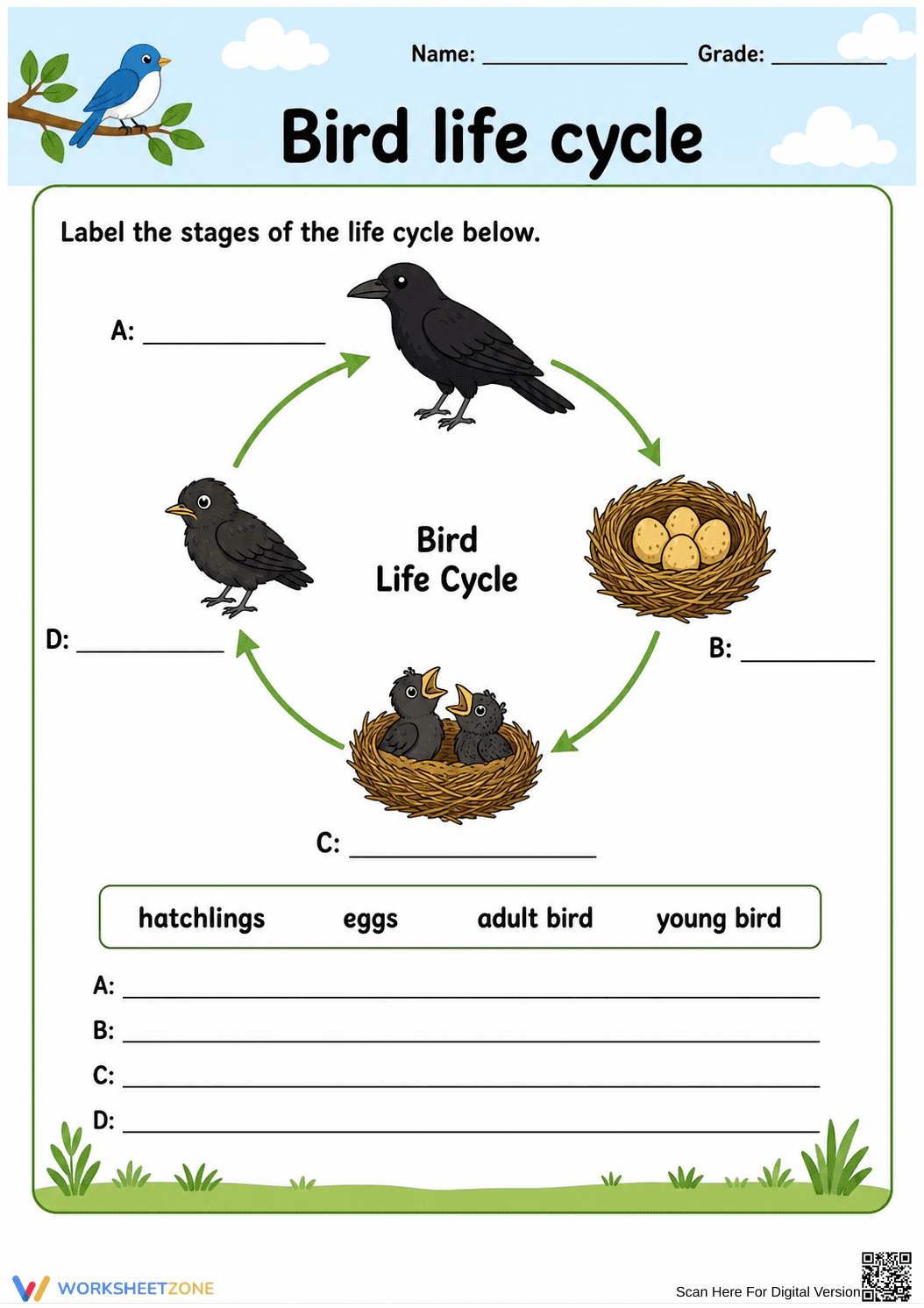
This Bird Life Cycle worksheet provides a clear, visual framework for students to master the chronological stages of avian development. By identifying and labeling the progression from eggs to adult birds, learners build a concrete understanding of biological growth patterns. This resource is designed to simplify scientific concepts into an accessible format that ensures student success.
At a Glance
- Grade: 3 · Subject: Science
- Standard:
3-LS1-1— Develop models to describe that organisms have unique and diverse life cycles- Skill Focus: Life cycle sequencing and labeling
- Format: 1 page · 4 problems · Answer key included · PDF
- Best For: Independent practice or science centers
- Time: 10–15 minutes
The worksheet features a central circular diagram illustrating the four primary stages of a bird's life. Students are provided with a clear word bank containing the terms hatchlings, eggs, adult bird, and young bird. The layout includes two ways to respond: labeling the diagram directly and a secondary list at the bottom for reinforced writing practice.
This resource is designed for a seamless, zero-prep classroom workflow. Teachers can print the single-page PDF in seconds. Distribution is efficient as the instructions are self-explanatory and require no lengthy verbal introduction. Reviewing the completed work is fast using the included answer key, allowing for immediate feedback. Total teacher preparation time is under 2 minutes, making it an ideal choice for sub plans.
This worksheet is aligned with the Next Generation Science Standard `3-LS1-1`. This standard emphasizes that students should develop models to describe that organisms have unique life cycles but share common stages like birth and growth. By focusing on the bird, students gain evidence needed for broader scientific generalizations. This standard code can be copied directly into lesson plans, IEP goals, or curriculum mapping tools.
Use this worksheet as a formative assessment after a lesson on animal life cycles. It works well in a science rotation station where students work independently. To use it as a formative tool, observe whether students can correctly sequence the hatchling and young bird stages, as these are frequently confused. Completion typically ranges from 10 to 15 minutes depending on student writing speed.
This resource is tailored for elementary students in Grade 3, though it is effective for English Language Learners (ELL) who need visual support for science vocabulary. It pairs naturally with a classroom anchor chart showing various animal life cycles. The inclusion of a word bank provides necessary scaffolding for students who are still developing their spelling and fine motor skills.
The 3-LS1-1 standard requires students to develop models describing that organisms have unique and diverse life cycles but all have in common birth, growth, reproduction, and death. This Bird Life Cycle worksheet provides a foundational visual model for Grade 3 students to identify these specific developmental milestones. By utilizing a word bank to label stages such as hatchlings and adult birds, students engage in scientific vocabulary acquisition and structural sequencing. According to the RAND AIRS 2024 report on elementary science instruction, high-quality visual aids and labeling tasks significantly improve retention of biological sequences in early learners. This resource serves as a scaffolded entry point for more complex life cycle comparisons. Educators can use this worksheet to verify student understanding of chronological biological progression before moving to comparative studies of different species. The clear layout ensures that students focus on the scientific content without cognitive overload.


