


























Views
Downloads


Free Printable Letter B Beginning Sounds Worksheet
Paste this activity's link or code into your existing LMS (Google Classroom, Canvas, Teams, Schoology, Moodle, etc.).
Students can open and work on the activity right away, with no student login required.
You'll still be able to track student progress and results from your teacher account.
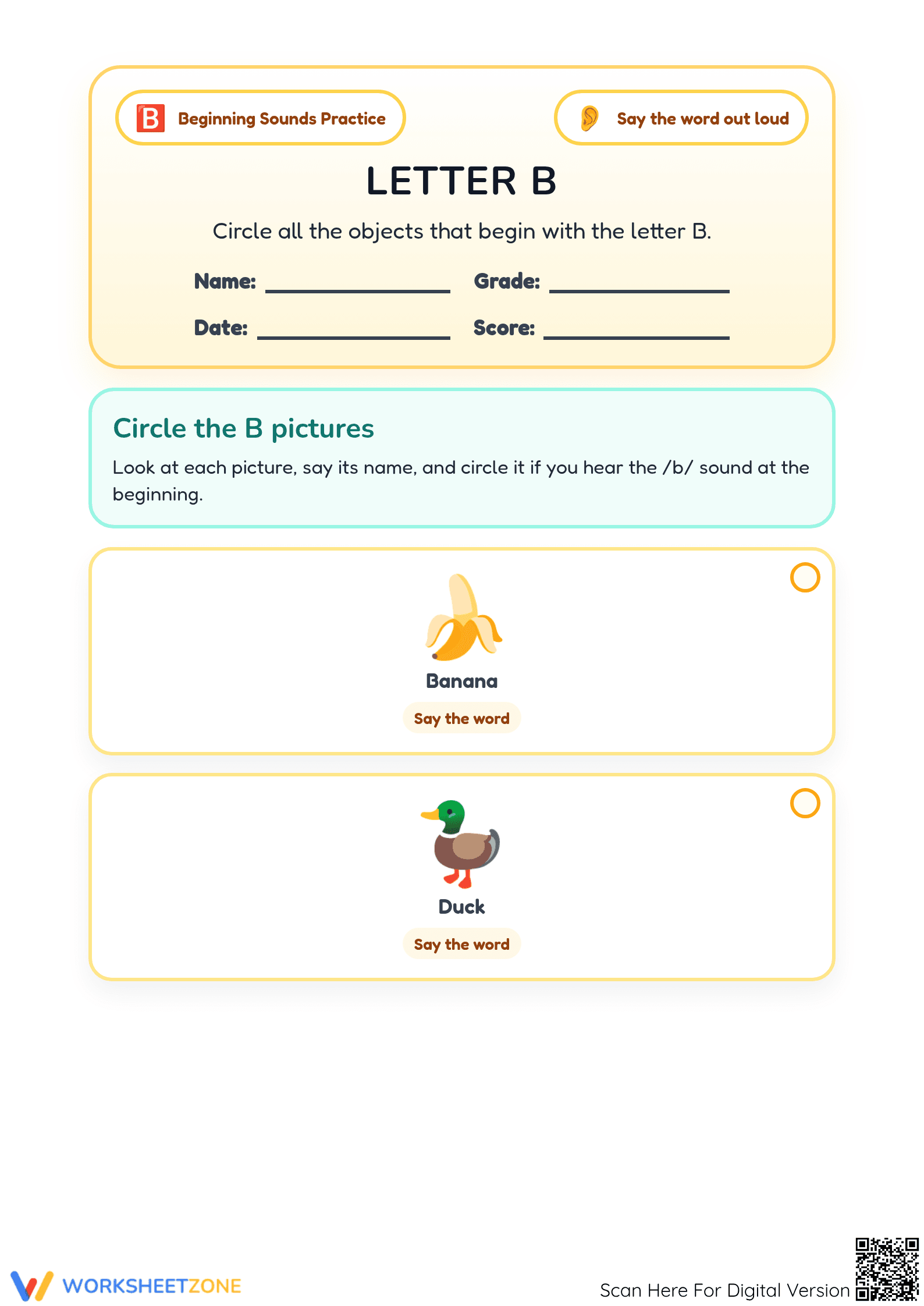
This Letter B beginning sounds worksheet helps preschool and kindergarten students master initial consonant recognition through auditory and visual identification. By saying words aloud and selecting corresponding images, learners build the foundational phonemic awareness necessary for early literacy success. This printable packet ensures students can confidently isolate the /b/ sound in common objects.
At a Glance
- Grade: Preschool · Subject: ELA
- Standard:
CCSS.ELA-LITERACY.RF.K.3.A— Produce the primary sound for each consonant, specifically the letter B- Skill Focus: Initial Consonant Recognition
- Format: 3 pages · 12 problems · Answer key included · PDF
- Best For: Independent phonics practice and centers
- Time: 10–15 minutes
This comprehensive three-page packet features 12 unique identification tasks designed for young learners. Each page presents a series of high-quality illustrations including a banana, ball, bee, and butterfly. Students are prompted to "Say the word out loud" to reinforce the auditory component before circling the correct images. The layout includes clear instructions, name and date fields, and a score box for easy progress monitoring.
The design of this resource prioritizes teacher efficiency with a three-step zero-prep workflow. First, print the PDF packet (0.5 minutes). Second, distribute the worksheets during your phonics block or morning warm-up (0.5 minutes). Finally, review completed work using the included answer key (1 minute). This under-two-minute setup makes it an ideal choice for emergency sub plans or last-minute literacy centers.
This resource is aligned to `CCSS.ELA-LITERACY.RF.K.3.A`, which requires students to demonstrate basic knowledge of one-to-one letter-sound correspondences by producing the primary sound for each consonant. By focusing exclusively on the /b/ sound, the worksheet provides the targeted repetition needed to move from recognition to automaticity. Both standard codes can be copied directly into lesson plans, IEP goals, or district curriculum mapping tools.
Use this worksheet during the "You Do" phase of a gradual release lesson on the letter B. After introducing the letter and its sound through an anchor chart, assign these pages to verify individual student understanding. Alternatively, use the first page as a formative assessment check before moving on to other letters. Observe students as they "say the word" to ensure they are accurately producing the /b/ phoneme before circling.
This resource is tailored for preschool and kindergarten students who are beginning their phonics journey. It is particularly effective for English Language Learners who benefit from the clear visual cues paired with vocabulary words. Pair this worksheet with a letter B picture book or a tactile sand-writing activity to create a multi-sensory learning experience that accommodates various learning styles and levels of readiness.
According to the RAND AIRS 2024 report on early childhood literacy, systematic phonics instruction in the preschool years significantly predicts later reading achievement by establishing strong phonemic boundaries. This Letter B worksheet applies these evidence-based principles by requiring students to isolate the initial /b/ phoneme in a controlled set of 12 problems. By emphasizing the "say it aloud" strategy, the resource aligns with research emphasizing the critical link between speech production and orthographic mapping. The use of clear, high-frequency vocabulary such as "ball" and "bee" ensures that the cognitive load remains focused on sound isolation rather than word decoding. This standards-aligned tool provides the necessary scaffolded practice to meet `CCSS.ELA-LITERACY.RF.K.3.A` benchmarks for consonant-sound correspondence. It serves as a reliable asset for educators seeking to implement high-leverage teaching practices within a zero-prep, classroom-ready format that prioritizes student engagement and measurable outcomes in early ELA instruction.


