


























Views
Downloads
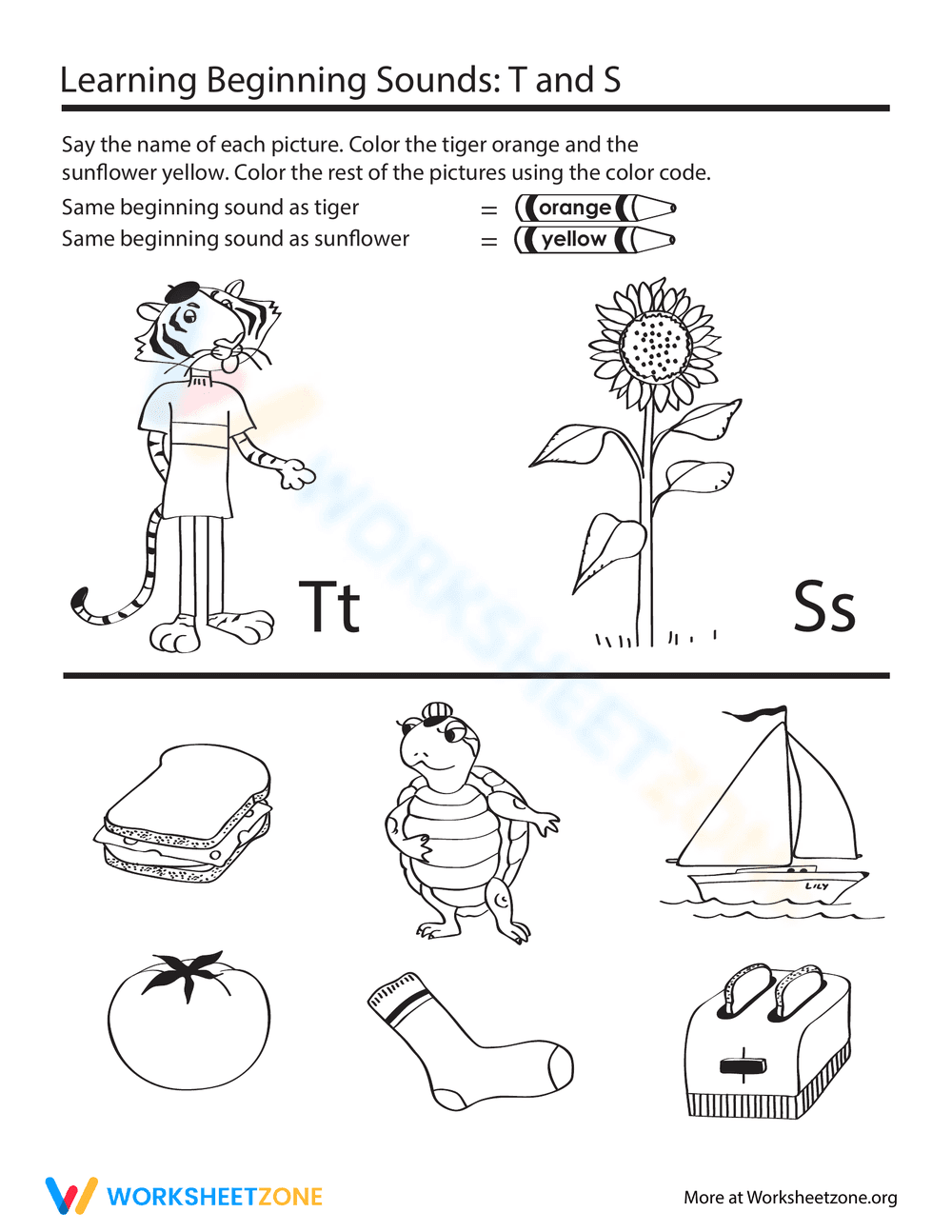

Beginning Sounds T and S: Printable Kindergarten Worksheet
Paste this activity's link or code into your existing LMS (Google Classroom, Canvas, Teams, Schoology, Moodle, etc.).
Students can open and work on the activity right away, with no student login required.
You'll still be able to track student progress and results from your teacher account.
This printable phonics worksheet helps early learners master beginning sounds for the letters T and S through an engaging coloring activity. Students practice letter-sound correspondence by naming common objects and coloring them based on their initial consonant sound. This targeted practice builds essential phonemic awareness and fine motor skills.
At a Glance
- Grade: Kindergarten · Subject: ELA Phonics
- Standard:
RF.K.3.A— Produce the primary sound for consonants T and S- Skill Focus: Beginning sounds T and S
- Format: 1 page · 6 problems · Coloring activity · PDF
- Best For: Independent morning work or phonics centers
- Time: 15–20 minutes
What's Inside
The worksheet features a clean, child-friendly layout with clear visual anchors: a tiger for the "T" sound and a sunflower for the "S" sound. Below these anchors, students find six distinct illustrations to identify and color: a sandwich, a turtle, a sailboat, a tomato, a sock, and a toaster. A simple color-by-code key guides their coloring choices.
Zero-Prep Workflow
This resource is designed for an immediate, zero-prep classroom workflow. First, print the single-page PDF for your class, which takes less than one minute. Next, distribute the sheets along with orange and yellow crayons, requiring about one minute of transition time. Finally, review the completed worksheets visually in under two minutes to check student understanding. The self-explanatory layout makes it an ideal choice for emergency sub plans.
Standards Alignment
This activity aligns directly with the Common Core State Standard CCSS.ELA-LITERACY.RF.K.3.A, which requires kindergarten students to demonstrate basic knowledge of one-to-one letter-sound correspondences by producing the primary sound for consonants. It also supports foundational print concepts by linking written letters to spoken sounds. Both standard codes can be copied directly into lesson plans, IEP goals, or district curriculum mapping tools.
How to Use It
Use this worksheet during direct instruction as a guided practice activity after introducing the letters T and S. Alternatively, assign it as a formative assessment during independent center rotations to monitor individual progress. While students work, observe if they vocalize the words to isolate the initial phonemes. Most kindergarten students will complete the coloring tasks within fifteen to twenty minutes.
Who It's For
This resource is tailored for preschool and kindergarten students who are developing early literacy skills. It provides excellent support for English language learners needing visual vocabulary reinforcement. Pair this worksheet with a shared reading text focusing on alliteration or an anchor chart displaying words that start with the letters T and S.
According to the Fisher & Frey (2014) framework for gradual release of responsibility, structured visual tasks help young learners bridge the gap between phonemic awareness and grapheme recognition. This worksheet targets standard CCSS.ELA-LITERACY.RF.K.3.A by prompting students to isolate the beginning sounds of T and S in familiar words. Research indicates that combining auditory pronunciation with tactile coloring tasks reinforces orthographic mapping in early childhood education. By requiring students to say each word aloud before coloring, the activity strengthens the neurological pathways connecting speech sounds to written symbols. Educators can confidently integrate this resource into systematic phonics instruction, knowing it aligns with evidence-based practices for early reading development. The simple layout ensures students focus entirely on the phonics task without cognitive overload, making it a highly reliable tool for daily formative assessment in early childhood classrooms.


