


























Views
Downloads
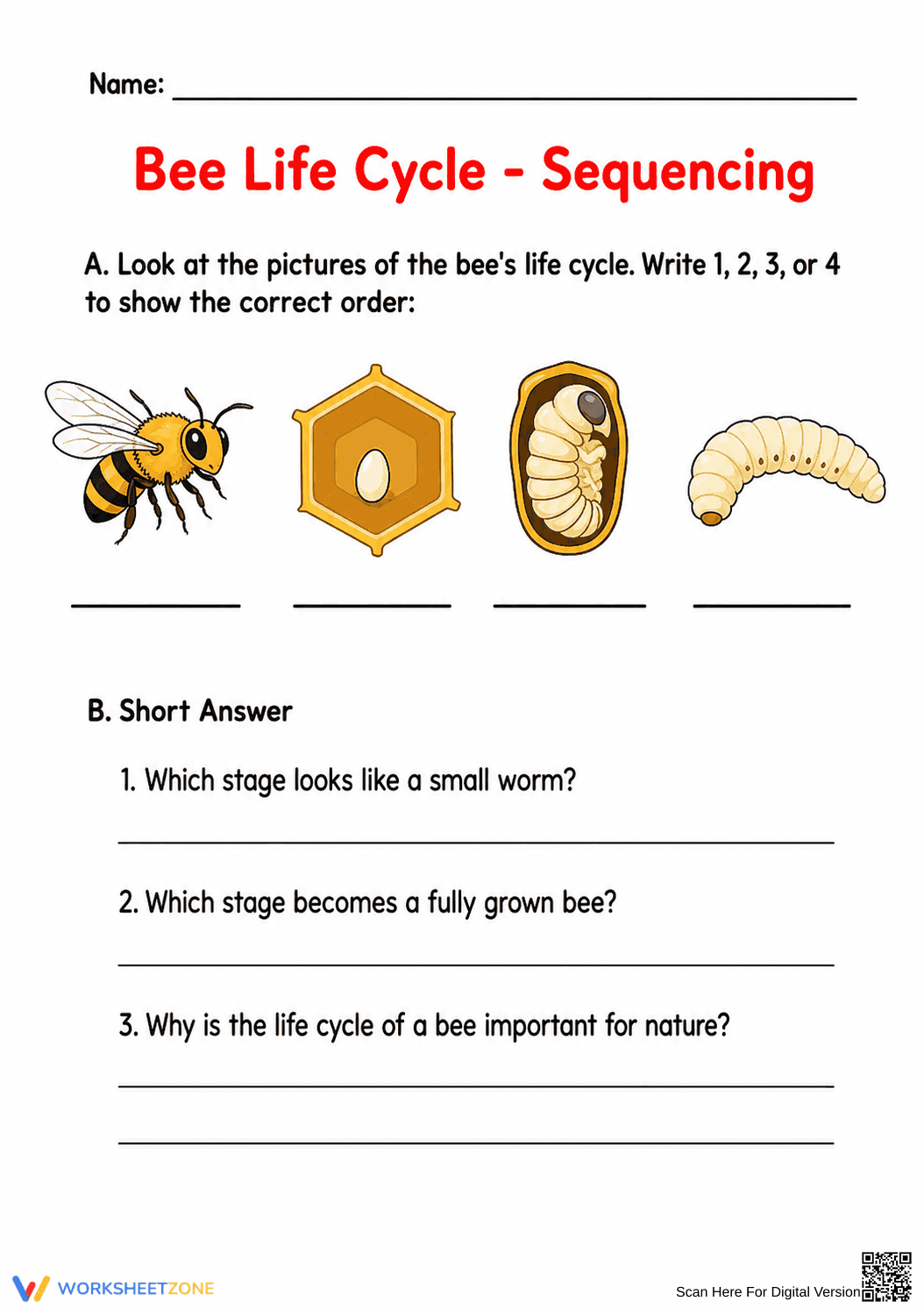

Bee Life Cycle Sequencing | Essential Grade 3 Science
Paste this activity's link or code into your existing LMS (Google Classroom, Canvas, Teams, Schoology, Moodle, etc.).
Students can open and work on the activity right away, with no student login required.
You'll still be able to track student progress and results from your teacher account.
This bee life cycle sequencing worksheet helps students master the chronological stages of insect development through visual identification and written analysis. By ordering the egg, larva, pupa, and adult stages, learners build a foundational understanding of biological growth patterns. This resource ensures students can articulate the transition between developmental phases with clarity.
At a Glance
- Grade: 2-3 · Subject: Science
- Standard:
3-LS1-1— Describe that organisms have unique and diverse life cycles with common stages- Skill Focus: Bee life cycle sequencing
- Format: 1 page · 7 problems · Answer key included · PDF
- Best For: Science centers or quick sub plans
- Time: 15–20 minutes
The worksheet features a clear, one-page layout containing two distinct sections. Part A presents four high-quality illustrations of the honeybee life cycle, requiring students to assign numerical values (1–4) to establish the correct chronological order. Part B includes three short-answer questions that prompt students to identify physical characteristics of specific stages and reflect on the ecological importance of bees.
To implement this zero-prep workflow, follow three simple steps. First, print the single-page PDF for your entire class (30 seconds). Second, distribute the worksheets as a warm-up or independent practice activity (1 minute). Third, review the sequencing and short-answer responses using the provided answer key for immediate feedback (5 minutes). Total teacher preparation time is under two minutes, making it an ideal choice for busy mornings or emergency sub plans.
This resource is aligned with 3-LS1-1: "Develop models to describe that organisms have unique and diverse life cycles but all have in common birth, growth, reproduction, and death." It also supports Grade 2 life science standards regarding plant and animal dependencies. Both standard codes can be copied directly into lesson plans, IEP goals, or district curriculum mapping tools.
Use this as a formative assessment after a lesson on pollinators. Students can work independently to demonstrate their grasp of the sequence. Alternatively, use it as a "Ticket to Leave" to gauge understanding before moving to more complex life cycle comparisons. The expected completion time for most second and third graders is 15 to 20 minutes, allowing for easy integration into a standard science block.
This activity is ideal for second and third-grade students exploring life science. It provides necessary scaffolding for English Language Learners through visual cues while challenging advanced learners with open-ended questions. It pairs naturally with a classroom observation of a pollinator garden or a non-fiction text about honeybee colonies to provide a comprehensive learning experience.
The 3-LS1-1 standard requires students to develop models describing the unique yet common patterns of birth, growth, and death across diverse organisms. This bee life cycle sequencing worksheet provides the necessary scaffolding for students to internalize these biological sequences. According to Fisher & Frey (2014), the use of visual sequencing combined with short-answer justification supports the gradual release of responsibility, moving students from basic identification to conceptual explanation. By engaging with the four distinct stages of the honeybee, learners develop the schema required to compare life cycles across different species, a core competency in elementary life science. This resource serves as a critical bridge between observation and scientific communication, ensuring that students not only recognize the stages but also understand their functional roles within an ecosystem. The inclusion of written prompts encourages higher-order thinking, transforming a simple ordering task into a comprehensive evidence-based assessment of student mastery.


