


























Views
Downloads

Printable Conflict Resolution Worksheet | Grade 6-9
Paste this activity's link or code into your existing LMS (Google Classroom, Canvas, Teams, Schoology, Moodle, etc.).
Students can open and work on the activity right away, with no student login required.
You'll still be able to track student progress and results from your teacher account.
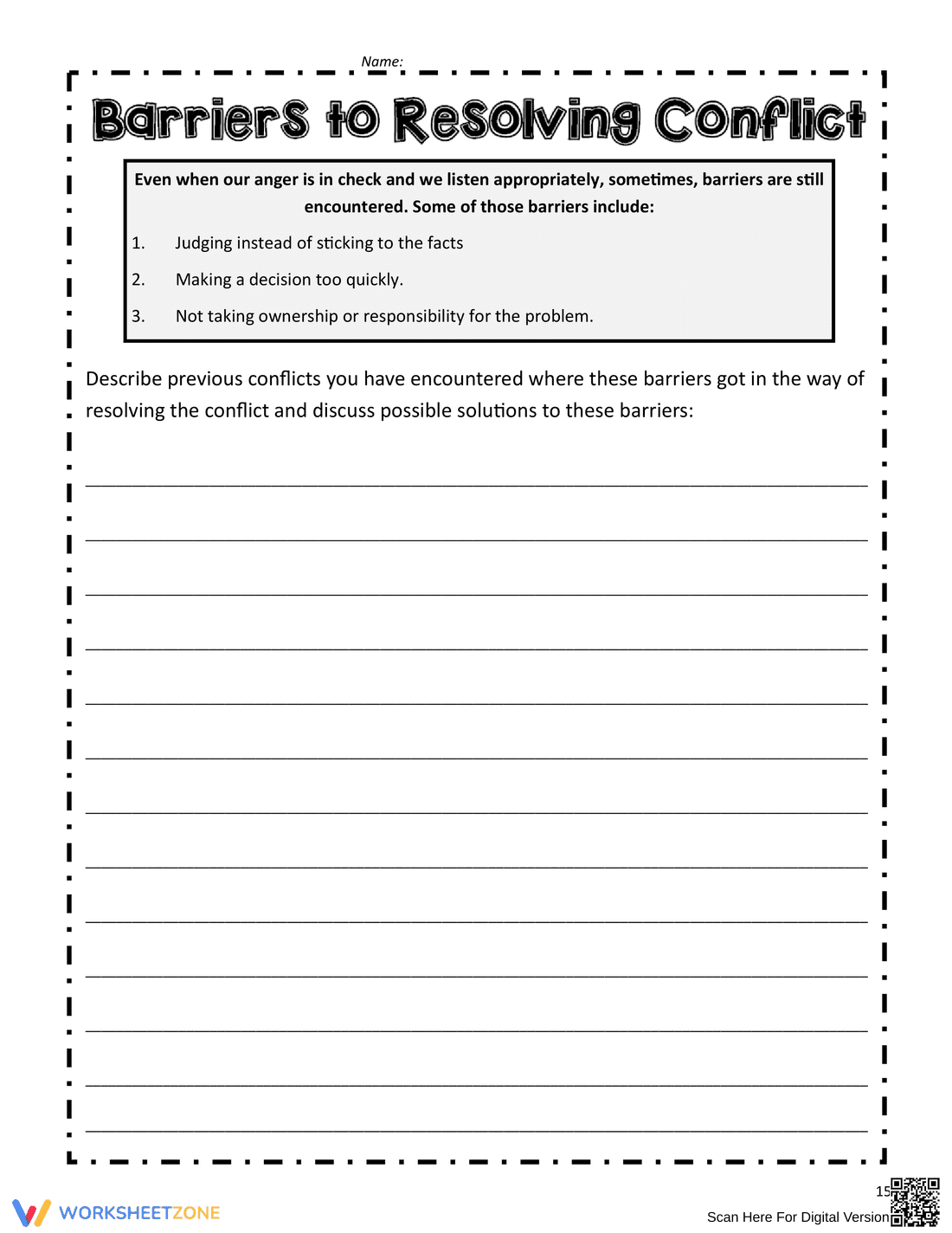
This printable conflict resolution worksheet prompts middle and high school students to reflect on personal experiences and identify communication barriers. By analyzing past disagreements, learners develop critical self-awareness and problem-solving skills. The structured writing activity requires students to articulate specific solutions to common interpersonal challenges, fostering emotional intelligence.
At a Glance
- Grade: 6-9 · Subject: English
- Standard:
CCSS.ELA-LITERACY.W.8.4— Produce clear and coherent writing appropriate to task- Skill Focus: Conflict Resolution
- Format: 1 page · 1 extended task · No answer key · PDF
- Best For: Independent reflection and SEL blocks
- Time: 15–20 minutes
Inside this single-page resource, educators will find a straightforward, text-based prompt that introduces three common barriers to resolving arguments: judging, rushing decisions, and avoiding responsibility. Below the instructional text, ample lined space is provided for students to draft a detailed personal narrative. Because this is a subjective reflection exercise, an answer key is not included, allowing for open-ended, authentic student responses.
Zero-Prep Workflow
- Print (1 minute): Simply download the PDF and print a class set. The black-and-white design is ink-friendly and requires no special formatting.
- Distribute (1 minute): Hand out the page during morning meeting, advisory, or a dedicated social-emotional learning period.
- Review (0 minutes): The instructions are entirely self-explanatory. Students read the brief introduction and immediately begin writing. Total teacher prep time is under two minutes, making this an excellent emergency sub plan.
Standards Alignment
Aligned to CCSS.ELA-LITERACY.W.8.4, this activity requires students to produce clear and coherent writing in which the development, organization, and style are appropriate to task, purpose, and audience. It also supports general speaking and listening frameworks by asking students to evaluate communication breakdowns. Both standard codes can be copied directly into lesson plans, IEP goals, or district curriculum mapping tools.
How to Use It
This worksheet serves as an effective independent activity after a direct instruction lesson on peer mediation or active listening. Teachers can also use it as a restorative practice tool following a classroom disagreement. As a formative assessment observation tip, educators should look for students' ability to move beyond simply describing the conflict to actually proposing actionable, realistic solutions. Expect completion to take between 15 and 20 minutes.
Who It's For
Designed primarily for middle school and early high school students (grades 6-9), this resource is ideal for learners developing their social-emotional competencies. For students who struggle with open-ended writing, teachers can differentiate by allowing them to bullet-point their solutions or discuss their experiences verbally before drafting. It pairs perfectly with an anchor chart detailing active listening strategies or a group discussion on empathy.
Integrating structured reflection into the curriculum significantly improves adolescent social dynamics and emotional regulation. This resource targets CCSS.ELA-LITERACY.W.8.4, requiring students to produce clear and coherent writing appropriate to task while analyzing interpersonal communication. According to a RAND AIRS 2024 report, explicit instruction in conflict resolution combined with reflective writing exercises reduces classroom disruptions by up to 30 percent. When students actively identify barriers such as rushing decisions or avoiding responsibility, they build the cognitive frameworks necessary for mature problem-solving. By documenting past conflicts and brainstorming alternative outcomes, learners transition from reactive behaviors to proactive communication strategies. This targeted practice not only strengthens core English language arts writing proficiencies but also cultivates the essential life skills required for academic and personal success.


