


























Views
Downloads

Back To School Would You Rather | Essential Grade 1-3
Paste this activity's link or code into your existing LMS (Google Classroom, Canvas, Teams, Schoology, Moodle, etc.).
Students can open and work on the activity right away, with no student login required.
You'll still be able to track student progress and results from your teacher account.
This Back to School Would You Rather worksheet facilitates immediate student engagement through oral language and critical thinking. By presenting students with binary choices, the activity encourages them to articulate preferences and justify their reasoning. It serves as a high-interest icebreaker that builds classroom community while practicing foundational communication skills during the first week of school.
At a Glance
- Grade: 1-3 · Subject: ELA / Speaking & Listening
- Standard:
CCSS.ELA-LITERACY.SL.2.1— Participate in collaborative conversations with diverse partners about grade-level topics- Skill Focus: Decision-making and oral justification
- Format: 1 page · 6 problems · Answer key N/A · PDF
- Best For: First-week icebreakers and morning meetings
- Time: 15–20 minutes
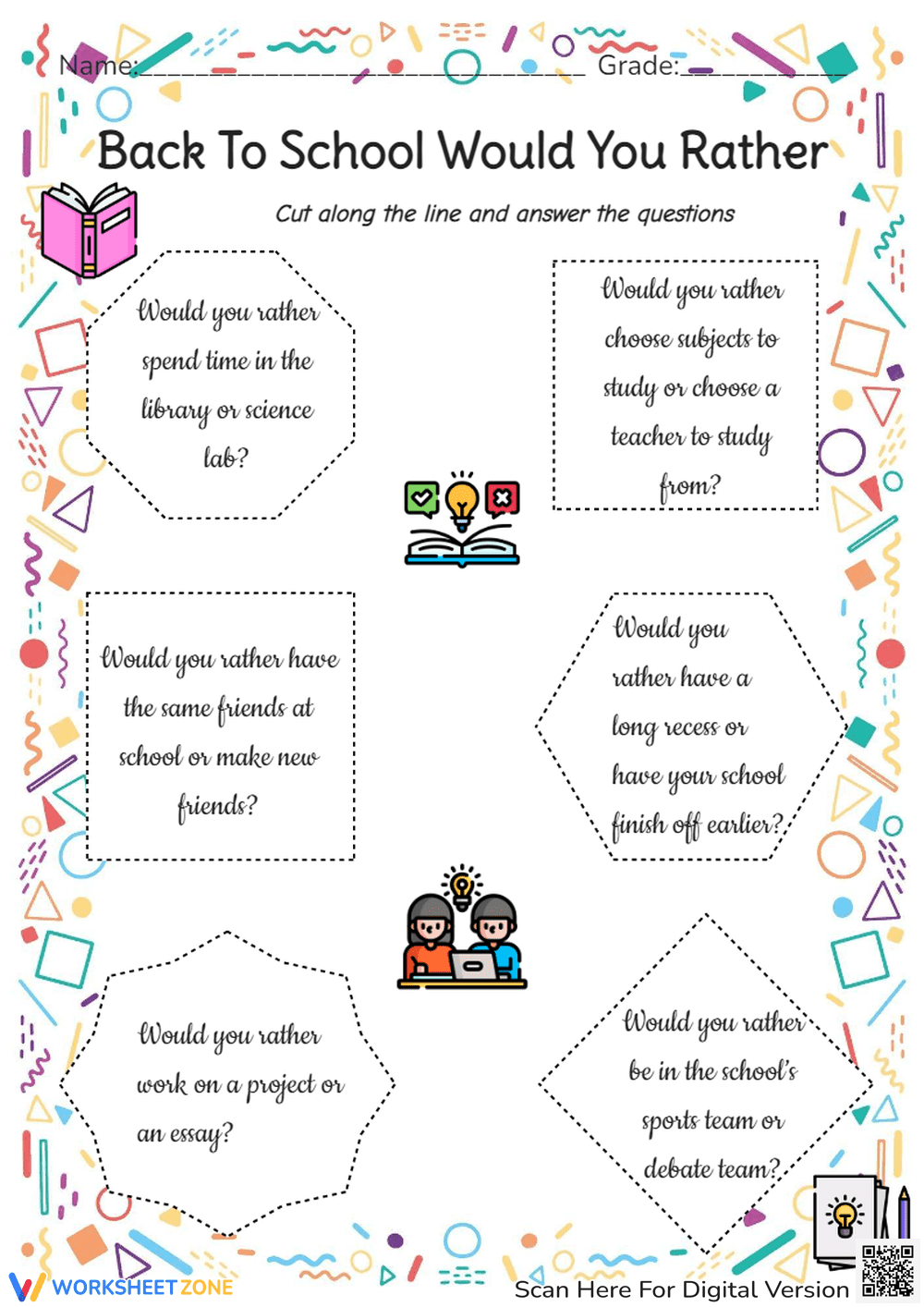
This single-page PDF features six distinct "Would You Rather" prompts housed within various geometric borders, including octagons and stars. The layout includes a "cut along the line" instruction, allowing the worksheet to double as a fine-motor craft activity. Prompts cover school-themed dilemmas such as choosing between the library and the science lab, or deciding between a long recess and an early dismissal.
Zero-Prep Workflow
- Print: Select the single-page PDF and print enough copies for your roster (30 seconds).
- Distribute: Hand out the sheets along with scissors and pencils for the cutting and writing component (1 minute).
- Review: Facilitate a "Four Corners" style game or a pair-share session where students explain their choices (15 minutes).
This resource requires zero teacher preparation and functions perfectly as an emergency sub plan or a transition activity.
Standards Alignment
The primary standard addressed is `CCSS.ELA-LITERACY.SL.2.1`, which requires students to participate in collaborative conversations with diverse partners about grade-level topics and texts. By choosing between two options and explaining "why," students practice building on others' talk and asking for clarification. Both standard codes can be copied directly into lesson plans, IEP goals, or district curriculum mapping tools.
How to Use It
Use this as a "Morning Meeting" activity where students stand on different sides of the rug based on their choice. Alternatively, use it as a formative assessment for opinion writing; have students select one prompt and write a three-sentence paragraph defending their choice. This allows you to observe their ability to provide reasons and use transition words in a low-stakes environment. Expected completion time is 15 to 20 minutes.
Who It's For
This resource is designed for students in Grades 1, 2, and 3, including English Language Learners who benefit from the structured sentence frames inherent in "Would you rather..." questions. It pairs naturally with a classroom anchor chart on "Accountable Talk" or a read-aloud book about starting a new school year.
Research from Fisher & Frey (2014) emphasizes that oral language is the bedrock of literacy development, particularly for early elementary learners. This worksheet leverages the "Would You Rather" format to lower the affective filter, allowing students to practice the CCSS.ELA-LITERACY.SL.2.1 standard in a socially engaging context. By requiring students to make a definitive choice between two school-related scenarios, the activity promotes cognitive flexibility and the ability to provide evidence for a personal stance. According to the RAND AIRS 2024 report, high-engagement activities that incorporate movement or choice significantly improve student retention of classroom norms during the back-to-school transition. This printable provides a structured yet flexible framework for teachers to assess student speaking and listening readiness while fostering a positive classroom culture through shared decision-making and peer-to-peer dialogue.


