


























Views
Downloads
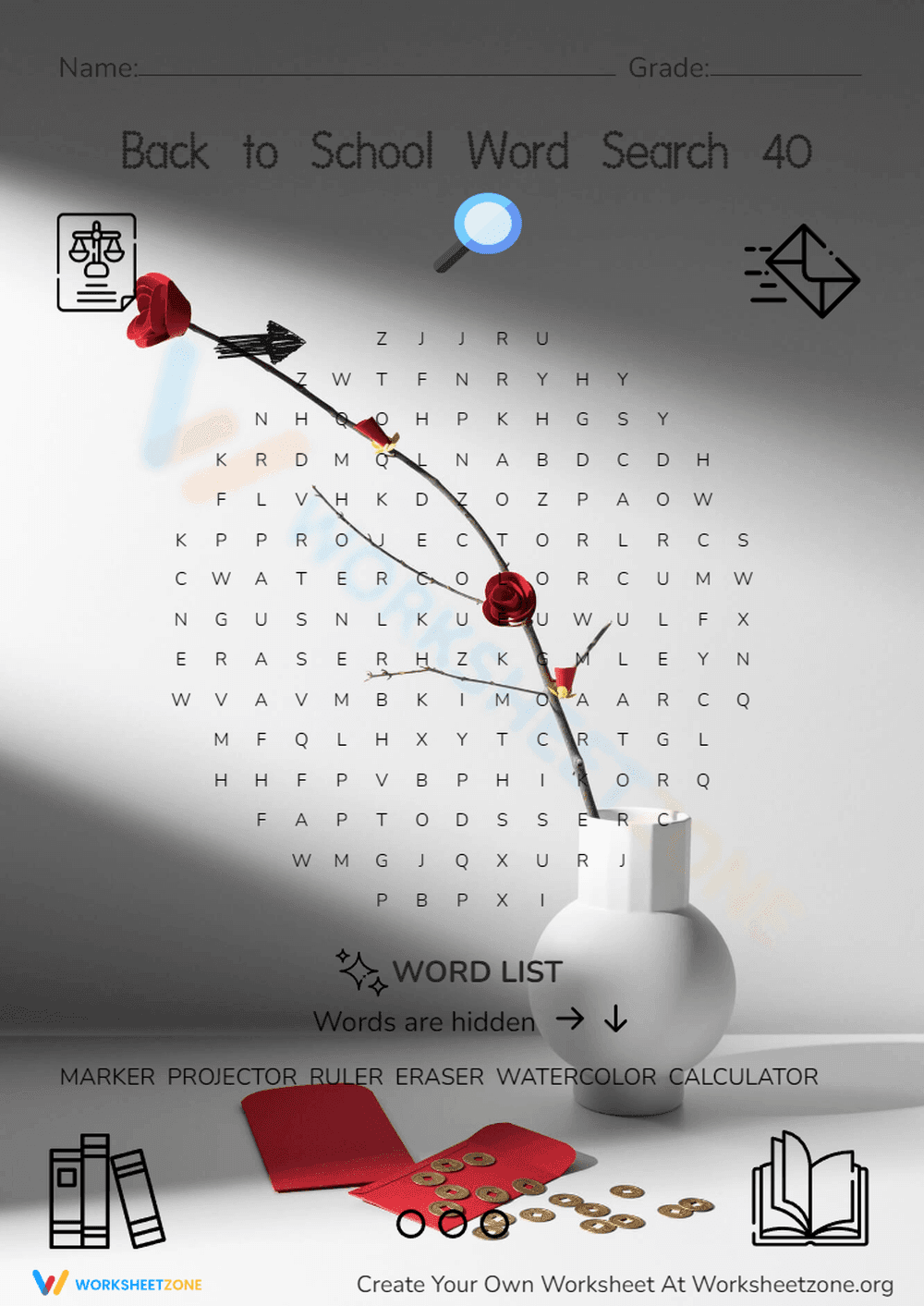

Printable Back to School Word Search | Grade 1-3
Paste this activity's link or code into your existing LMS (Google Classroom, Canvas, Teams, Schoology, Moodle, etc.).
Students can open and work on the activity right away, with no student login required.
You'll still be able to track student progress and results from your teacher account.
This printable vocabulary worksheet helps early elementary students identify common classroom items through an engaging word search puzzle. Students reinforce spelling and word recognition by locating six school-themed terms hidden horizontally and vertically. It provides an independent activity that builds familiarity with school environment vocabulary.
At a Glance
- Grade: Grade 2 · Subject: English Language Arts
- Standard:
CCSS.ELA-LITERACY.L.2.6— Use acquired words and phrases related to classroom objects- Skill Focus: Word recognition and spelling
- Format: 1 page · 6 problems · Answer key not included · PDF
- Best For: Morning work or early finishers
- Time: 10–15 minutes
This single-page PDF features a grid of letters containing six hidden vocabulary words: marker, projector, ruler, eraser, watercolor, and calculator. A clear word list at the bottom guides students, while thematic icons decorate the page to maintain engagement. The layout uses large, readable fonts suitable for young learners.
This resource requires zero teacher preparation. First, print the single-page PDF document, which takes less than one minute. Second, distribute the sheets to students along with pencils or highlighters, taking about one minute. Finally, review the completed puzzles individually or as a whole class by having students read the found words aloud, requiring only two minutes of check-in time. This efficient workflow makes the activity an excellent option for emergency sub plans or transition periods.
This activity aligns directly with the Common Core State Standard `CCSS.ELA-LITERACY.L.2.6`, which requires students to acquire and use conversational, general academic, and domain-specific words. By identifying terms like "calculator" and "projector," students expand their functional school vocabulary. Additionally, it supports spelling development under `CCSS.ELA-LITERACY.RF.2.3` by reinforcing word patterns. Both standard codes can be copied directly into lesson plans, IEP goals, or district curriculum mapping tools.
Use this worksheet during the first week of school as an introductory icebreaker or morning work activity to ease students into the academic routine. Alternatively, assign it as a quiet, independent task after direct instruction on school rules and materials to assess vocabulary familiarity. Teachers can observe student scanning strategies to identify who struggles with letter tracking, providing a quick formative assessment. The puzzle typically takes 10 to 15 minutes to complete.
This worksheet is designed for students in grades 1, 2, and 3 who are developing reading fluency and vocabulary. It offers scaffolded support for English language learners by focusing on concrete, high-frequency classroom nouns. Pair this activity with a read-aloud book about starting school or a physical classroom scavenger hunt to reinforce the vocabulary in a real-world context.
This vocabulary worksheet aligns with `CCSS.ELA-LITERACY.L.2.6` to support early word recognition and spelling. Research from the ScienceDirect TpT Analysis (2024) emphasizes that structured word puzzles reinforce orthographic mapping by forcing students to focus on letter sequences and spelling patterns. By searching for specific terms like "watercolor" and "eraser," young learners build cognitive connections between spoken vocabulary and written forms. This active engagement helps transition words from temporary recognition to long-term memory storage. The single-page format provides a low-stakes environment for students to practice visual scanning and attention to detail, which are critical sub-skills for reading comprehension. Educators can confidently integrate this puzzle into their early elementary curriculum to support foundational literacy goals and vocabulary acquisition.


