


























Views
Downloads
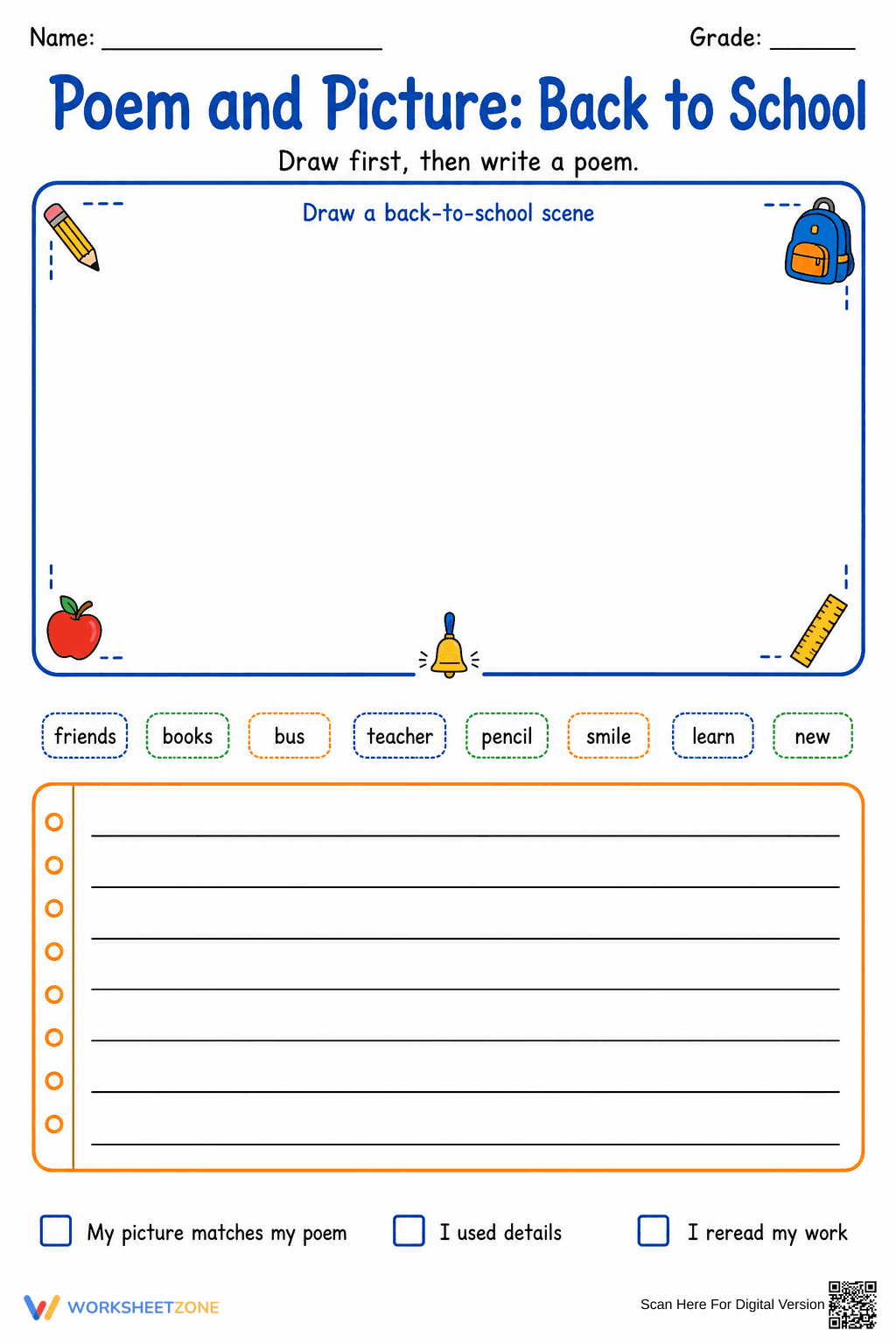

Back to School Poem & Picture | Essential Grade 2 Writing
Paste this activity's link or code into your existing LMS (Google Classroom, Canvas, Teams, Schoology, Moodle, etc.).
Students can open and work on the activity right away, with no student login required.
You'll still be able to track student progress and results from your teacher account.
This Grade 2 creative writing worksheet helps students express their first-day feelings through poetry and art. By combining visual storytelling with structured writing lines, students produce a personalized back-to-school keepsake while practicing descriptive language. It provides a low-stakes entry point for assessing early-year writing stamina and vocabulary usage.
At a Glance
- Grade: 2 · Subject: ELA
- Standard:
CCSS.ELA-LITERACY.W.2.3— Write narratives to recount a well-elaborated event or short sequence of events- Skill Focus: Poetry and Descriptive Writing
- Format: 1 page · 4 tasks · Self-checklist included · PDF
- Best For: First week of school icebreaker
- Time: 20–30 minutes
The worksheet features a large framed drawing area for a back-to-school scene, followed by an 8-line notebook-style poem frame. To support emerging writers, a word bank includes 8 thematic terms like "teacher," "bus," and "smile." A three-point self-reflection checklist at the bottom encourages students to check for detail and alignment between their art and text.
Zero-Prep Workflow
- Print: Open the PDF and print one copy per student (30 seconds).
- Distribute: Hand out the sheets and explain the "draw first, then write" sequence to help students brainstorm visually (1 minute).
- Review: Use the built-in checklist to provide immediate verbal feedback as students finish their work (1 minute per student).
Total teacher preparation time is under 2 minutes, making this an ideal sub plan or morning work activity.
Standards Alignment
This resource aligns with `CCSS.ELA-LITERACY.W.2.3`, which requires students to write narratives that include details to describe actions, thoughts, and feelings. It also supports `CCSS.ELA-LITERACY.L.2.1` through the application of grammar and spelling in a creative context. Both standard codes can be copied directly into lesson plans, IEP goals, or district curriculum mapping tools.
How to Use It
Use this as a "Morning Work" activity during the first week of school to keep students engaged while you handle administrative tasks. It also serves as an excellent formative assessment for writing; observe how students utilize the word bank to gauge their comfort with thematic vocabulary. Completion typically takes 20 to 30 minutes depending on drawing detail.
Who It's For
This worksheet is designed for Grade 2 students but is easily adaptable for Grade 1 or Grade 3 learners. It is particularly helpful for English Language Learners (ELLs) who benefit from the visual scaffolding of the drawing box and the provided word bank. Pair this with a read-aloud of a classic back-to-school picture book or an anchor chart about sensory details.
According to Fisher & Frey (2014), the integration of visual representation with writing tasks significantly enhances the cognitive processing of new vocabulary and concepts for primary-grade students. This worksheet utilizes that dual-coding approach by requiring a "draw first" sequence, which serves as a pre-writing brainstorm. By aligning with CCSS.ELA-LITERACY.W.2.3, the activity ensures that creative expression remains grounded in rigorous narrative standards. The inclusion of a self-checklist mirrors NAEP recommendations for developing metacognitive awareness in early writers. Teachers can use the 8-word bank to scaffold the transition from drawing to drafting, ensuring that students of varying ability levels can produce a complete poem. This structured yet open-ended format is a proven method for reducing writing anxiety during the transition back to the classroom environment.


