


























Views
Downloads

Back to School Bingo Card | Essential Printable Activity
Paste this activity's link or code into your existing LMS (Google Classroom, Canvas, Teams, Schoology, Moodle, etc.).
Students can open and work on the activity right away, with no student login required.
You'll still be able to track student progress and results from your teacher account.
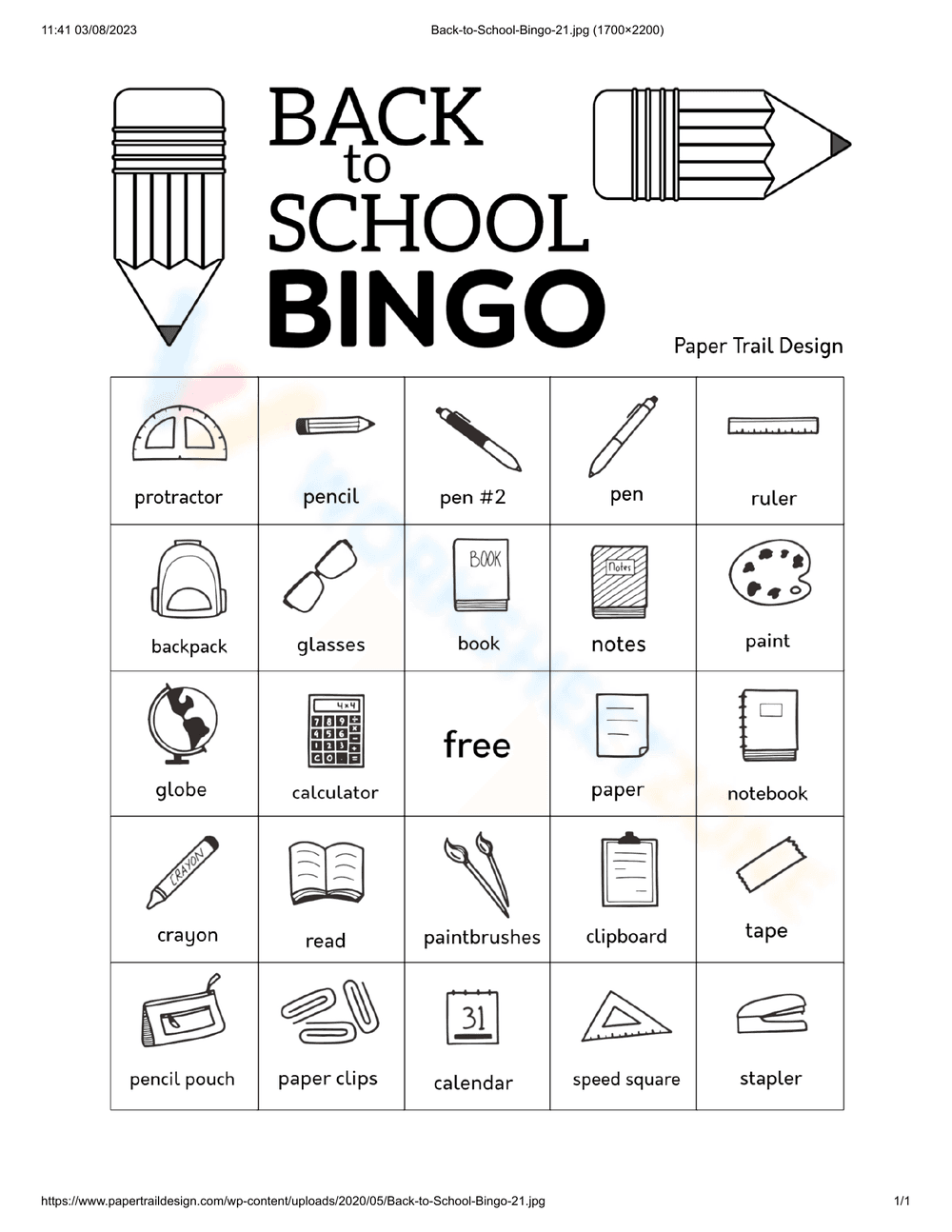
This Back to School Bingo card helps elementary students identify common classroom supplies while building social communication skills. By matching visual icons with printed labels, learners reinforce essential vocabulary during the first week of school. It serves as an effective icebreaker that encourages peer interaction and familiarity with the learning environment.
At a Glance
- Grade: 1-5 · Subject: English Language Arts
- Standard:
CCSS.ELA-LITERACY.SL.1.1— Participate in collaborative conversations with diverse partners about grade-level topics- Skill Focus: School supply vocabulary
- Format: 1 page · 25 squares · No answer key needed · PDF
- Best For: First-week icebreaker and vocabulary building
- Time: 15–20 minutes
The worksheet features a 5x5 grid containing 24 unique school-themed illustrations and one "free" center space. Each square includes a clear black-and-white icon—such as a protractor, clipboard, or speed square—paired with its corresponding English noun. This visual-textual pairing supports early readers and English Language Learners in identifying tools they will use throughout the academic year.
Zero-Prep Workflow
- Print: Generate copies for the entire class in under 30 seconds.
- Distribute: Hand out cards and explain the bingo rules, such as finding a classmate who has the item (2 minutes).
- Review: Discuss the vocabulary terms as a group to ensure pronunciation and usage mastery (5 minutes).
Total teacher preparation time is under 2 minutes, making this an ideal filler for transition periods or unexpected sub plans.
Standards Alignment
This activity aligns with `CCSS.ELA-LITERACY.SL.1.1`, which requires students to participate in collaborative conversations and follow agreed-upon rules for discussion. By engaging in a game format, students practice listening and speaking within a structured social context. Both standard codes can be copied directly into lesson plans, IEP goals, or district curriculum mapping tools.
How to Use It
Use this card as a "Scavenger Hunt Bingo" where students must find the physical object in the classroom before marking the square. This movement-based approach helps kinesthetic learners. Alternatively, use it as a formative assessment to check if students can identify specialized tools like a "speed square" or "protractor" before starting a math unit. Expected completion time ranges from 15 to 20 minutes.
Who It's For
This worksheet is designed for students in grades 1 through 5, including those in Special Education or ESL programs who benefit from high-contrast visual aids. It pairs naturally with a classroom tour anchor chart or a "Meet the Teacher" night activity. The simple design allows students to color the icons after the game is finished, extending the engagement.
Research from Fisher & Frey (2014) emphasizes that purposeful play and social interaction are critical for vocabulary acquisition in the elementary years. This bingo activity utilizes the CCSS.ELA-LITERACY.SL.1.1 standard to bridge the gap between social language and academic terminology. By providing 25 distinct visual cues, the worksheet reduces the cognitive load for students while they practice identifying 24 specific classroom objects. Studies from the NAEP suggest that early exposure to academic vocabulary in a low-stakes environment improves long-term retention and student confidence. This resource provides a structured yet flexible framework for teachers to facilitate these essential early-year interactions without requiring extensive preparation or additional materials. Furthermore, the integration of visual icons alongside printed text supports dual-coding theory, which enhances the ability of young learners to retrieve information during future classroom tasks and discussions.


