


























Views
Downloads

Back to School Bingo Card | Printable Grade 1-5 Activity
Paste this activity's link or code into your existing LMS (Google Classroom, Canvas, Teams, Schoology, Moodle, etc.).
Students can open and work on the activity right away, with no student login required.
You'll still be able to track student progress and results from your teacher account.
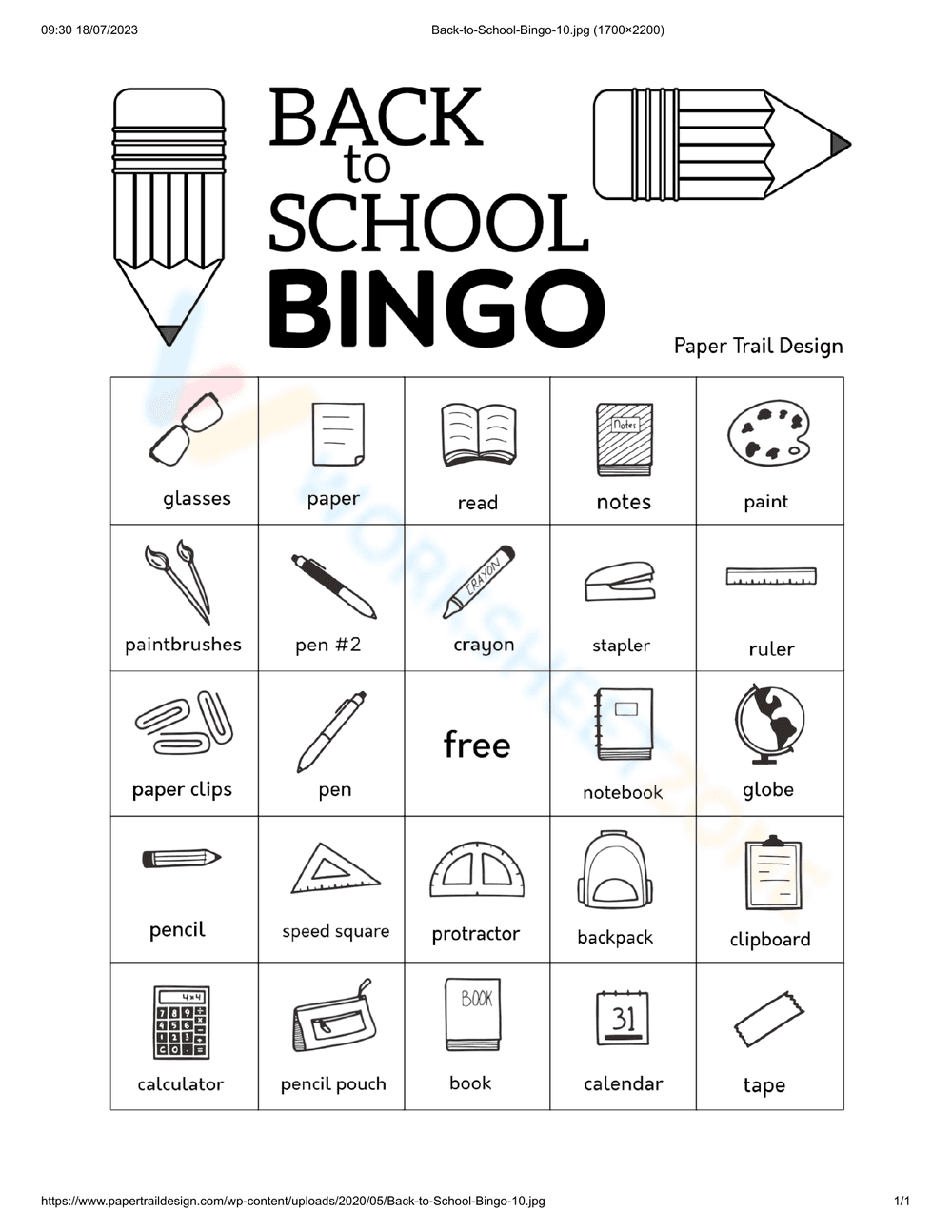
This Back to School Bingo card provides an engaging way for students to build essential school-related vocabulary while practicing active listening and social interaction. By identifying common classroom objects like protractors and clipboards, learners develop familiarity with their new environment. It serves as a perfect icebreaker to ease transition anxiety and foster a positive classroom community from day one.
At a Glance
- Grade: 1-5 · Subject: ELA / Seasonal
- Standard:
CCSS.ELA-LITERACY.SL.1.1— Participate in collaborative conversations with diverse partners about grade-level topics- Skill Focus: School Vocabulary & Social Interaction
- Format: 1 page · 25 spaces · No-prep · PDF
- Best For: First week icebreaker and community building
- Time: 15–20 minutes
This single-page PDF features a 5x5 bingo grid containing 24 unique school-themed illustrations and text labels, plus a central "free" space. Visual cues include items ranging from pencils to protractors. The clear line art is designed for easy printing and allows students to color icons as they play, making it a multi-sensory experience for younger learners.
The workflow for this activity is designed for maximum efficiency during the busy first week of school. First, print the required number of copies for your class (30 seconds). Second, distribute the cards along with markers or crayons (1 minute). Third, call out the items or describe their functions to facilitate the game (15 minutes). Total teacher preparation time is under 2 minutes, making it an ideal emergency sub plan or transition activity.
The primary standard addressed is CCSS.ELA-LITERACY.SL.1.1, which focuses on participating in collaborative conversations and following agreed-upon rules for discussion. By engaging in a group game, students practice turn-taking and listening skills. Additionally, it supports vocabulary reinforcement. Both standard codes can be copied directly into lesson plans, IEP goals, or district curriculum mapping tools.
Use this during the first morning as a low-stakes way to introduce students. As you call items, ask students to point to where that object is in your classroom, turning the game into a scavenger hunt. This formative observation helps assess who can follow oral directions and identify objects within 20 minutes of the first bell.
This resource is ideal for elementary students in Grades 1 through 5, including English Language Learners (ELL) who benefit from the direct pairing of images and text. It works well as a whole-class activity or a small-group center. Pair this bingo card with a classroom tour to solidify the connection between the worksheet icons and the physical learning space.
According to the Fisher & Frey (2014) framework for intentional interest-building, low-stakes social activities like this Back to School Bingo card are vital for establishing the social-emotional floor of a classroom. By focusing on CCSS.ELA-LITERACY.SL.1.1, the activity moves beyond mere entertainment to provide structured practice in collaborative listening and vocabulary acquisition. Research from the RAND AIRS 2024 report suggests that visual-verbal pairing in early elementary resources significantly improves retention of academic terminology for diverse learners. This 1-page printable ensures that students feel successful immediately, reducing the affective filter during the critical first week of instruction. By incorporating 24 distinct school-related terms, the worksheet provides a broad enough scope to challenge older students while remaining accessible to younger learners through its clear iconographic support.


