


























Views
Downloads
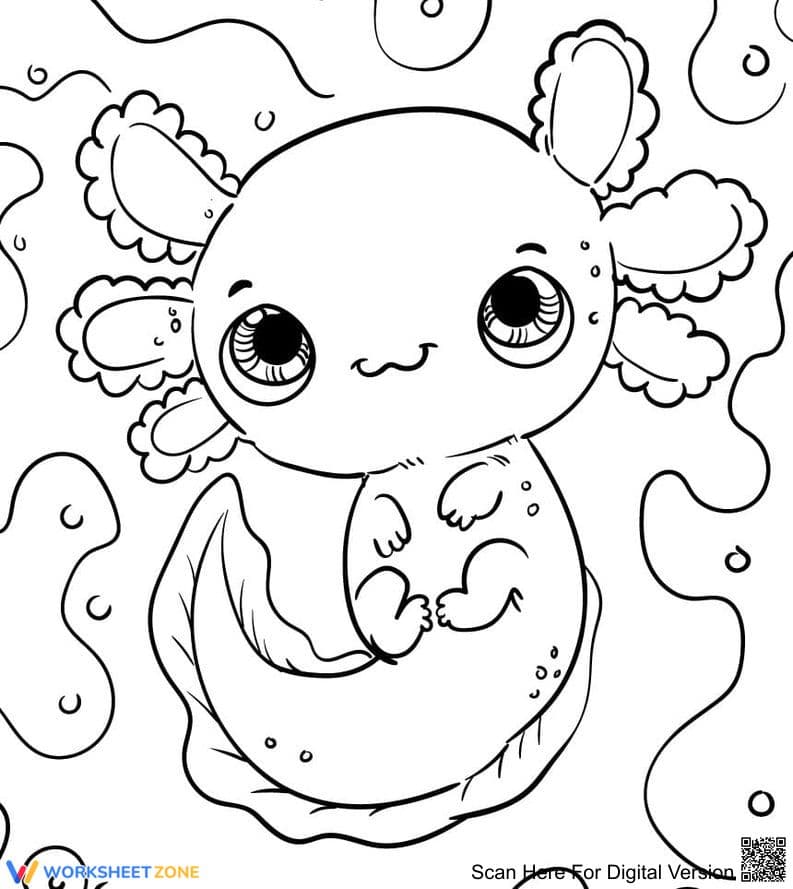

Baby Axolotl Coloring Page | Essential Grade K-5 Art
Paste this activity's link or code into your existing LMS (Google Classroom, Canvas, Teams, Schoology, Moodle, etc.).
Students can open and work on the activity right away, with no student login required.
You'll still be able to track student progress and results from your teacher account.
This baby axolotl coloring page provides a delightful creative outlet for students in Preschool through Grade 5. By engaging with this high-interest aquatic creature, learners develop essential hand-eye coordination and fine motor control. It serves as a perfect supplement to science units on amphibians or as a calming mindfulness activity during transitions.
At a Glance
- Grade: K-5 · Subject: Arts & English
- Standard:
CCSS.ELA-LITERACY.SL.K.5— Add drawings or visual displays to descriptions to provide detail- Skill Focus: Fine motor development
- Format: 1 page · 1 task · No answer key needed · PDF
- Best For: Early finishers and mindfulness breaks
- Time: 15–20 minutes
Inside this resource, you will find one high-resolution, printable page featuring a large, cute baby axolotl. The bold outlines are specifically designed to help younger students practice staying within the lines, while the whimsical background elements allow older students to experiment with shading and color blending. No complex setup or additional materials are required beyond standard coloring tools.
The zero-prep workflow for this worksheet is designed for maximum efficiency. First, print the single-page PDF in about 30 seconds. Second, distribute the sheets to your students along with crayons, markers, or colored pencils. Third, allow students to work independently while you facilitate small groups or manage administrative tasks. Total teacher preparation time is under 2 minutes, making it an ideal sub plan addition.
This activity aligns with `CCSS.ELA-LITERACY.SL.K.5`, which encourages students to use visual displays to enhance their descriptions and provide additional detail. While primarily an artistic task, it supports the development of the pincer grasp necessary for early writing standards. Both standard codes can be copied directly into lesson plans, IEP goals, or district curriculum mapping tools.
Use this worksheet as a hook before a science lesson on Mexican water habitats or as a reward for completing a reading assessment. For a formative assessment, observe how students choose colors and handle their writing utensils; this can provide insight into their grip strength and focus levels. Expect students to spend 15 to 20 minutes on this activity depending on their age.
This resource is ideal for general education classrooms, special education settings focusing on occupational therapy goals, and homeschool environments. It pairs naturally with an informational text about axolotls or a video clip showing these unique salamanders in their natural habitat to provide context for the coloring task and encourage student curiosity.
According to the RAND AIRS 2024 report, integrating creative arts into the primary curriculum significantly boosts student engagement and supports the development of executive function. This baby axolotl coloring page addresses the CCSS.ELA-LITERACY.SL.K.5 standard by allowing students to create visual representations that can later be used to anchor oral or written descriptions. Research from Fisher & Frey (2014) emphasizes that non-linguistic representations, such as drawings and colored diagrams, help students internalize new vocabulary and concepts more effectively than text alone. By providing a low-stakes, high-interest subject like the axolotl, educators can foster a positive classroom climate while simultaneously working on the physical mechanics of writing. This printable resource is a practical tool for teachers looking to balance academic rigor with the developmental necessity of play and artistic expression in the early elementary years.


