




























Views
Downloads

Magnetic Attraction Worksheet | Grade 5-9 Essential

Paste this activity's link or code into your existing LMS (Google Classroom, Canvas, Teams, Schoology, Moodle, etc.).
Students can open and work on the activity right away, with no student login required.
You'll still be able to track student progress and results from your teacher account.
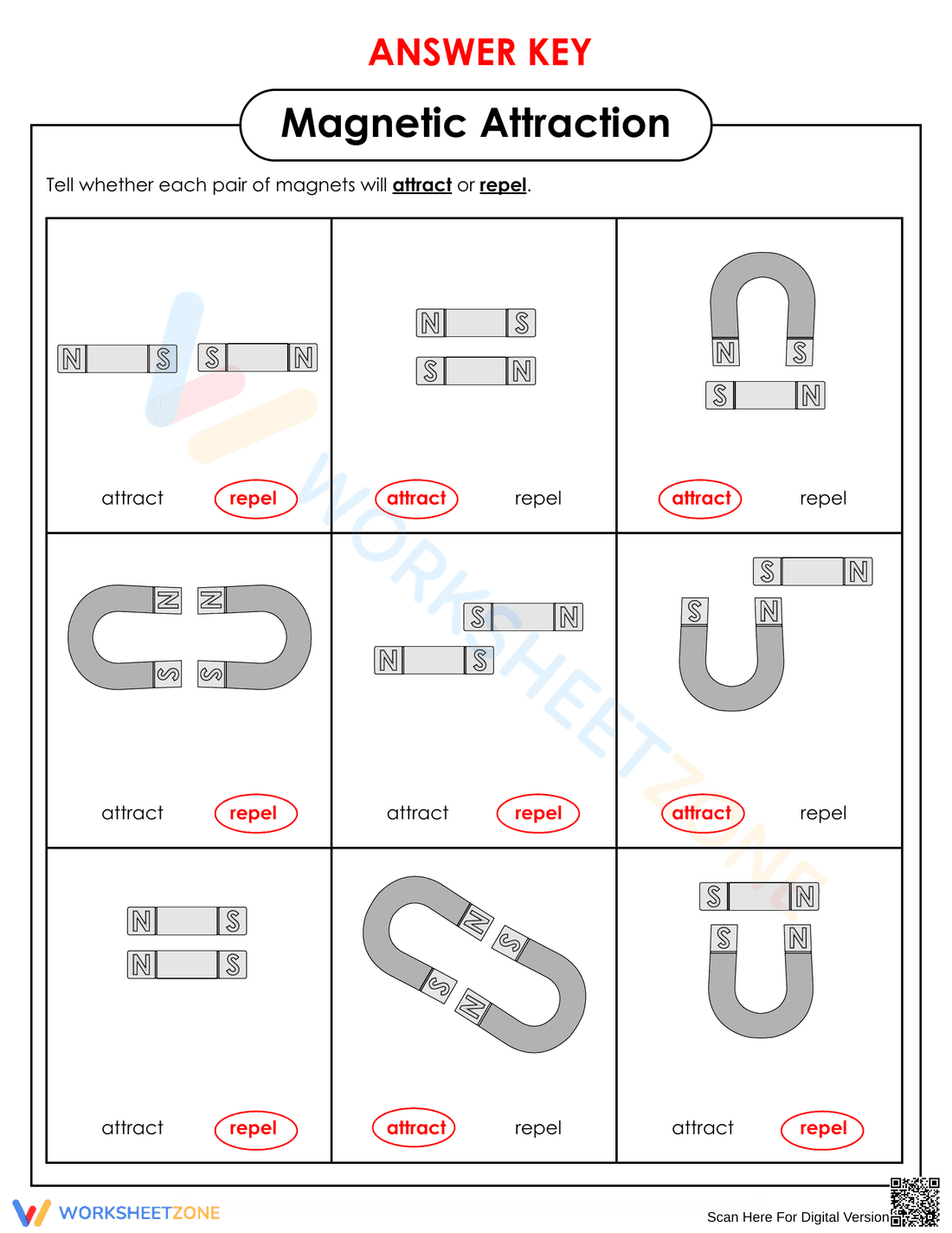
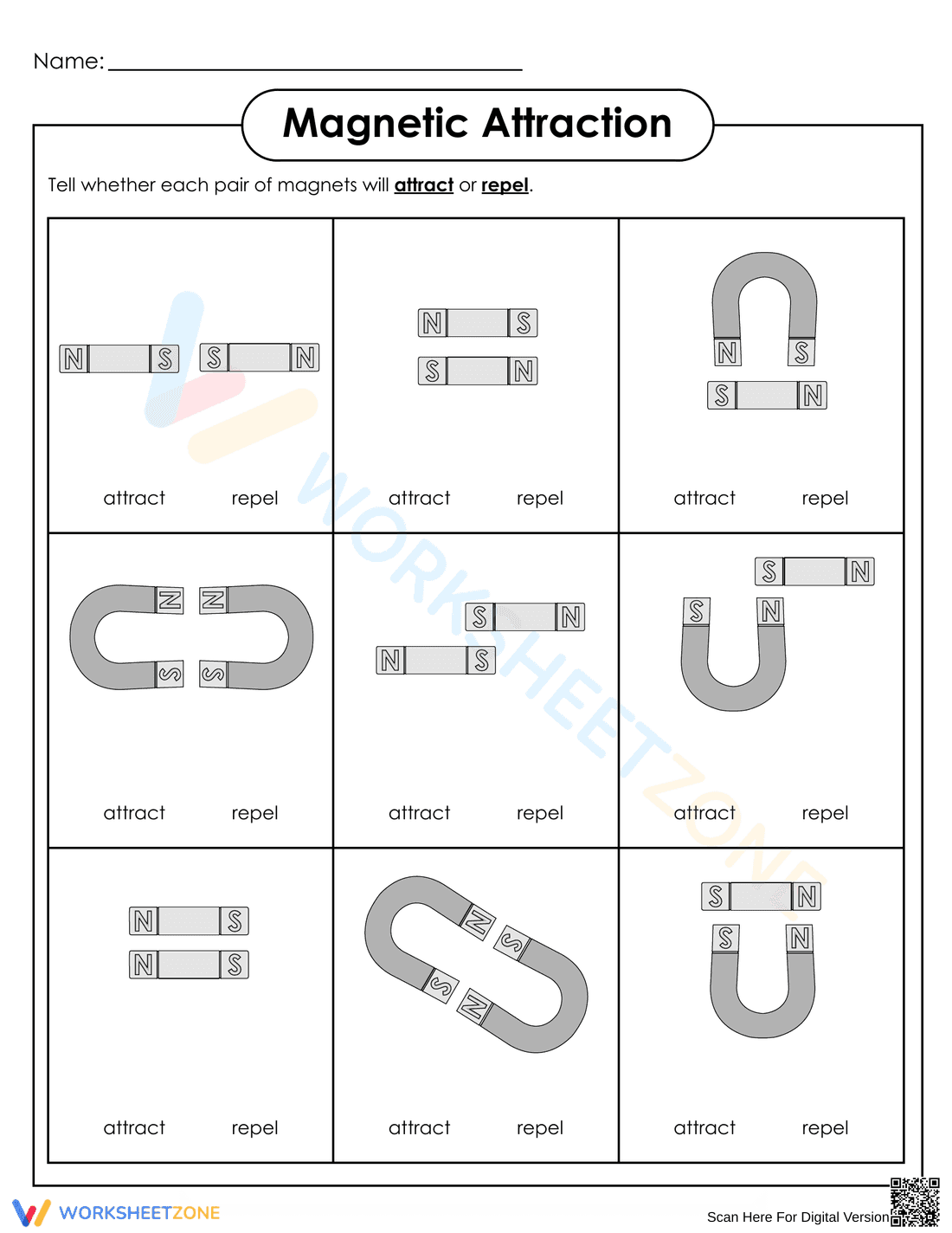
This Grade 5-9 magnetic attraction worksheet helps students master the fundamental principles of magnetism by identifying force interactions between poles. Students analyze visual representations of bar and horseshoe magnets to determine if they will pull together or push apart. It provides immediate reinforcement of the "opposites attract" rule in physical science.
At a Glance
- Grade: 5-9 · Subject: Science
- Standard:
MS-PS2-3— Determine the factors that affect the strength of magnetic forces- Skill Focus: Magnetic attraction and repulsion
- Format: 2 pages · 9 problems · Answer key included · PDF
- Best For: Quick formative assessment or bell-ringer
- Time: 5–10 minutes
The resource features a clean, single-page layout containing nine distinct scenarios. Each problem displays a pair of magnets—including both linear bar magnets and curved horseshoe magnets—with clearly labeled North (N) and South (S) poles. A corresponding answer key is provided, highlighting the correct choice for each interaction to facilitate rapid grading.
The workflow for this resource is designed for maximum efficiency. First, print the single-page PDF (30 seconds). Second, distribute the sheets to students as a warm-up or exit ticket (1 minute). Third, use the included answer key to review results as a whole class or for individual grading (1 minute). Total teacher preparation time is under 2 minutes, making it an ideal sub-plan addition.
This worksheet aligns with MS-PS2-3, which requires students to determine factors that affect the strength of electric and magnetic forces. By identifying the direction of force based on pole orientation, students build the conceptual foundation necessary for more complex electromagnetic studies. Both standard codes can be copied directly into lesson plans, IEP goals, or district curriculum mapping tools.
Use this worksheet during the "Explain" phase of a 5E lesson model to verify that students understand pole interactions before moving to hands-on experimentation. It also serves as an excellent formative-assessment observation tool; watch for students who struggle with horseshoe magnet orientation versus bar magnets. Completion typically takes 5 to 10 minutes.
This resource is designed for middle school science students and upper elementary learners introduced to physical science concepts. It is particularly helpful for visual learners who benefit from clear diagrams. Pair this worksheet with a live demonstration using physical magnets or a digital simulation to bridge the gap between abstract diagrams and physical reality.
According to the NAEP Science Framework, understanding the qualitative aspects of forces, such as magnetic attraction and repulsion, is a prerequisite for mastering energy transfer and field theory in later grades. This worksheet addresses MS-PS2-3 by requiring students to apply the law of magnetic poles to nine specific visual models. Research from Fisher & Frey (2014) emphasizes that clear, focused practice on foundational concepts like these prevents misconceptions from taking root during more complex inquiry-based labs. By isolating the variable of pole orientation, students develop the cognitive fluency needed to predict force directions in electromagnetic systems. This resource provides the structured repetition necessary for long-term retention of physical science principles, ensuring students are prepared for high school physics curriculum requirements and standardized state assessments.


