


























Views
Downloads
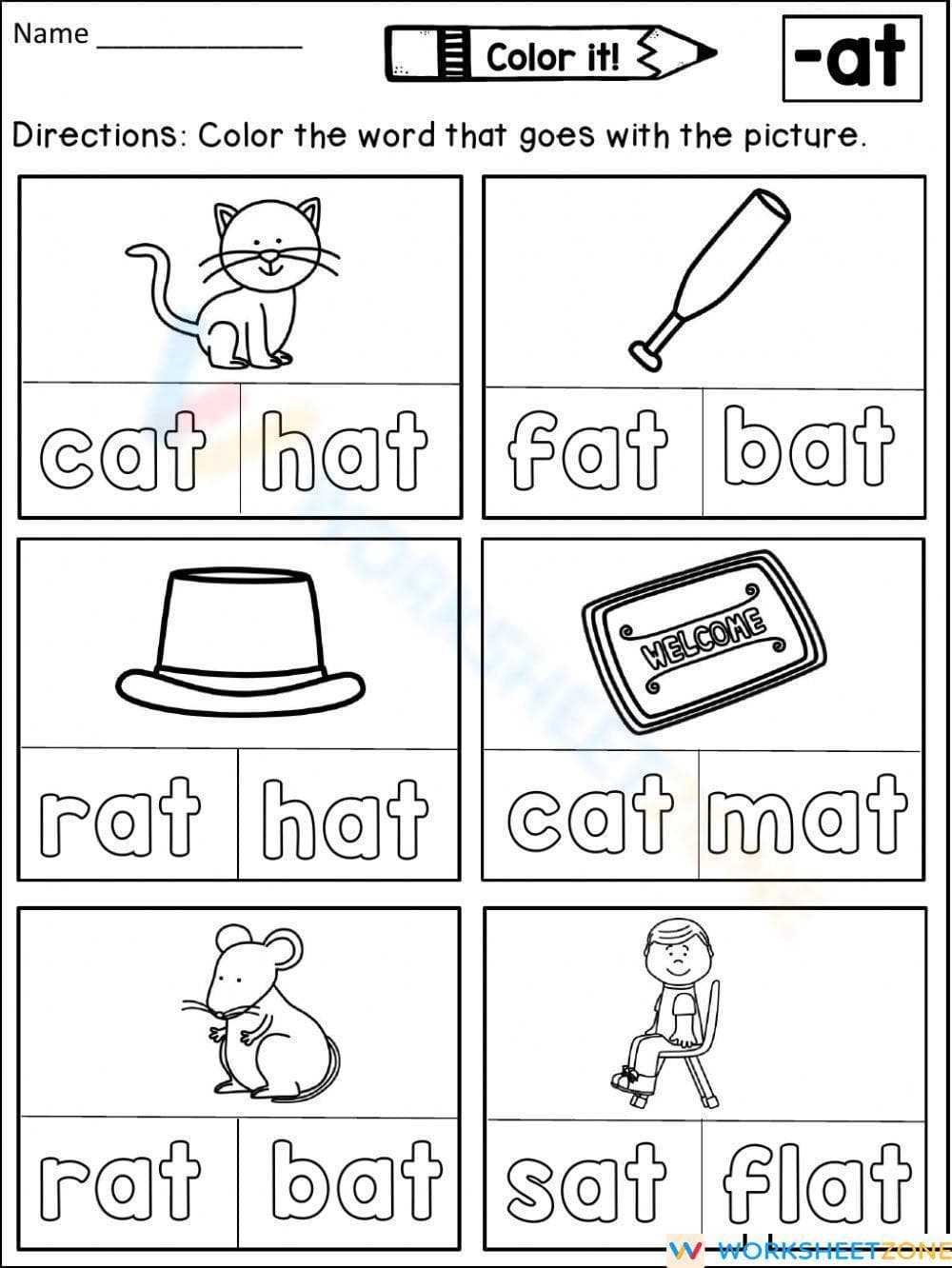

Essential -at Word Family Worksheet | Grade K-2 ELA
Paste this activity's link or code into your existing LMS (Google Classroom, Canvas, Teams, Schoology, Moodle, etc.).
Students can open and work on the activity right away, with no student login required.
You'll still be able to track student progress and results from your teacher account.
This essential phonics worksheet helps early learners master the "-at" word family through engaging visual associations. By matching high-frequency CVC words like cat, bat, and hat to corresponding illustrations, students strengthen their phonemic awareness and decoding skills. This foundational activity ensures students can recognize and produce rhyme, a critical milestone in early literacy development.
At a Glance
- Grade: K–2 · Subject: ELA Phonics
- Standard:
CCSS.ELA-LITERACY.RF.K.3— Know and apply grade-level phonics and word analysis skills in decoding words- Skill Focus: -at Word Family Recognition
- Format: 1 page · 6 problems · Answer key included · PDF
- Best For: Independent practice and phonics centers
- Time: 10–15 minutes
This single-page resource features six distinct word-picture matching tasks. Each block presents a clear illustration, such as a mat, a rat, or a person sitting, alongside two "-at" family words in a hollow "Color it!" font. The worksheet includes a name field and explicit directions, making it a complete, self-contained instructional tool with an included answer key for quick checking.
The zero-prep workflow is designed for maximum efficiency in the classroom: 1. Print: Select the PDF and hit print for the whole class in 30 seconds. 2. Distribute: Hand out the sheets along with crayons or colored pencils in 1 minute. 3. Review: Use the provided answer key for immediate peer-review or teacher-led feedback in 30 seconds. Total teacher preparation time is under two minutes, making this an ideal resource for sub plans, morning work, or literacy centers where independent student work is required.
Primary alignment is to CCSS.ELA-LITERACY.RF.K.3. This standard requires students to know and apply grade-level phonics and word analysis skills in decoding words. By focusing specifically on the "-at" phonogram, the worksheet also supports CCSS.ELA-LITERACY.RF.K.2.A, which focuses on recognizing and producing rhyming words. Both standard codes can be copied directly into lesson plans, IEP goals, or district curriculum mapping tools.
Use this worksheet as a formative assessment during a phonics unit on CVC words or as a morning warm-up activity. It works exceptionally well in a "Read and Color" literacy station where teachers can observe whether students are sounding out the initial consonants or simply guessing based on visual cues. The expected completion time range is 10–15 minutes for most students.
Designed for Preschool, Kindergarten, and Grade 1 students, this resource is perfect for emerging readers and English Language Learners (ELLs) who need concrete visual support. It pairs naturally with rhyming anchor charts, word walls, or a read-aloud session that emphasizes repetitive phonograms and word families to build student confidence.
According to RAND AIRS 2024, consistent exposure to phonogram-based instruction, such as the "-at" word family, significantly accelerates decoding speed in early readers by reducing the cognitive load required to process individual phonemes. This worksheet aligns with CCSS.ELA-LITERACY.RF.K.3 by providing the structured, repetitive practice necessary for students to internalize one-to-one letter-sound correspondences. Research from Fisher & Frey (2014) emphasizes that the gradual release of responsibility model, supported by clear visual scaffolds like the illustrations used here, helps transition students from guided decoding to independent word recognition. By isolating the "-at" rime, students build the phonological sensitivity required for more complex reading tasks later in the primary grades. This resource serves as a high-utility tool for classroom teachers looking to implement evidence-based phonics instruction that meets the rigorous demands of modern state and national literacy standards while maintaining high levels of student engagement during independent work time.


