


























Views
Downloads

Ariel Princess Coloring Page | Essential Kindergarten Art
Paste this activity's link or code into your existing LMS (Google Classroom, Canvas, Teams, Schoology, Moodle, etc.).
Students can open and work on the activity right away, with no student login required.
You'll still be able to track student progress and results from your teacher account.
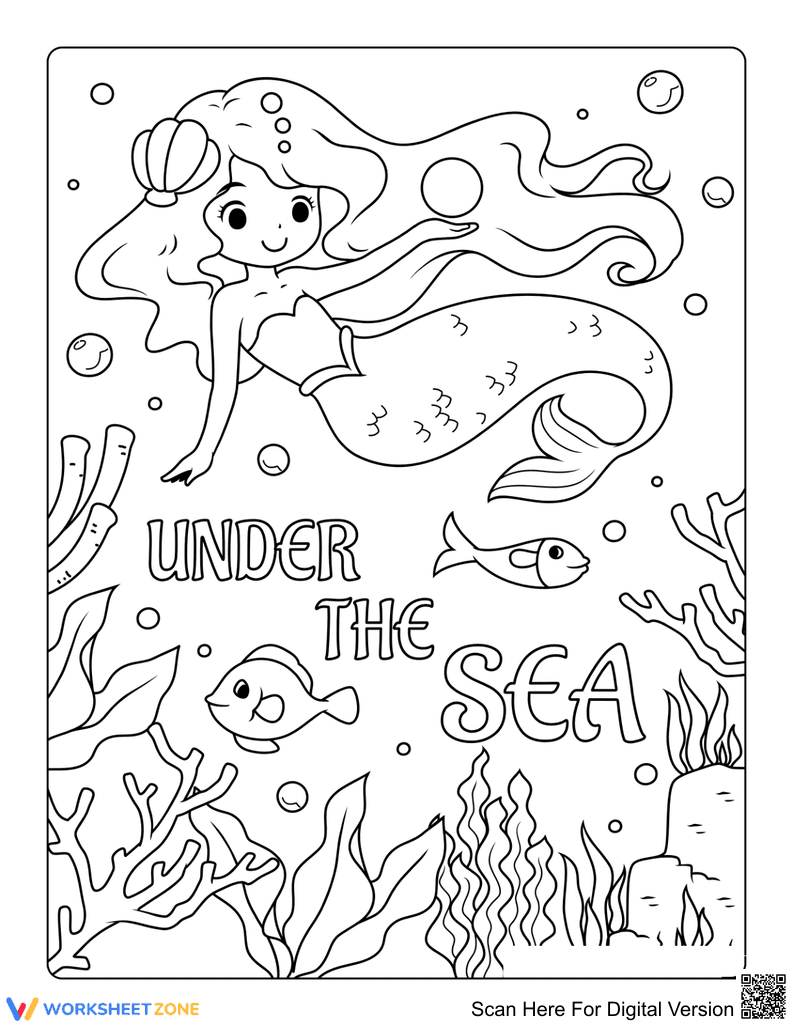
This Ariel Princess coloring page provides young learners with a creative outlet to develop essential fine motor skills and hand-eye coordination. By engaging with this underwater scene, students practice grip control and color boundaries, which are foundational for early writing development. It is a perfect addition to any mermaid-themed lesson or quiet-time activity.
At a Glance
- Grade: Kindergarten · Subject: English
- Standard:
CCSS.ELA-LITERACY.SL.K.5— Add drawings to descriptions to provide additional detail and creative expression- Skill Focus: Fine motor development
- Format: 1 page · 1 task · No answer key required · PDF
- Best For: Early finishers and morning work
- Time: 15–20 minutes
This resource consists of a single-page, high-quality PDF featuring a detailed illustration of a mermaid princess. The scene includes various underwater elements such as tropical fish, bubbles, and intricate coral reefs. The clean line art ensures that students can easily distinguish between different sections of the image, making it suitable for crayons, colored pencils, or markers.
The workflow for this activity is designed for maximum efficiency. First, print the single-page PDF in seconds. Second, distribute the sheets to students along with their preferred coloring tools. Third, review the completed artwork to observe student progress in spatial awareness and color selection. Total teacher preparation time is under 2 minutes, making it an ideal emergency sub plan or transition activity.
This activity aligns with `CCSS.ELA-LITERACY.SL.K.5`, which encourages students to use visual displays to enhance their communication and storytelling. While primarily an artistic task, it supports the physical development necessary for meeting writing standards like CCSS.ELA-LITERACY.L.K.1.A. Both standard codes can be copied directly into lesson plans, IEP goals, or district curriculum mapping tools.
Use this worksheet during a "Letter M" phonics unit to provide a thematic connection. It also serves as an excellent formative assessment tool; observe how students hold their writing utensils to identify those who may need additional occupational therapy support. Expect students to spend approximately 15 to 20 minutes completing the detailed underwater environment.
This worksheet is designed for Kindergarten students, but is also appropriate for Pre-K and Grade 1 learners. It is particularly beneficial for students working on sensory integration or those who require calming, repetitive tasks. Pair this with a read-aloud of a classic mermaid tale or an anchor chart about ocean life to create a comprehensive learning experience.
According to research by Fisher & Frey (2014), integrating visual arts into the early childhood curriculum supports the gradual release of responsibility by allowing students to express comprehension through non-verbal means. This Ariel Princess coloring page targets the CCSS.ELA-LITERACY.SL.K.5 standard, focusing on the plain-English skill of using drawings to provide detail. Studies from the NAEP suggest that fine motor proficiency in Kindergarten is a strong predictor of later academic success in both reading and mathematics. By providing 1 high-quality illustration for student engagement, educators can foster the hand strength required for future writing tasks. This resource is a practical tool for teachers seeking to balance creative expression with the physical demands of the primary classroom environment, ensuring that students remain engaged while building the stamina needed for longer instructional blocks.


