


























Views
Downloads


Essential Grade 4 Science: Metals and Properties Worksheet
Paste this activity's link or code into your existing LMS (Google Classroom, Canvas, Teams, Schoology, Moodle, etc.).
Students can open and work on the activity right away, with no student login required.
You'll still be able to track student progress and results from your teacher account.
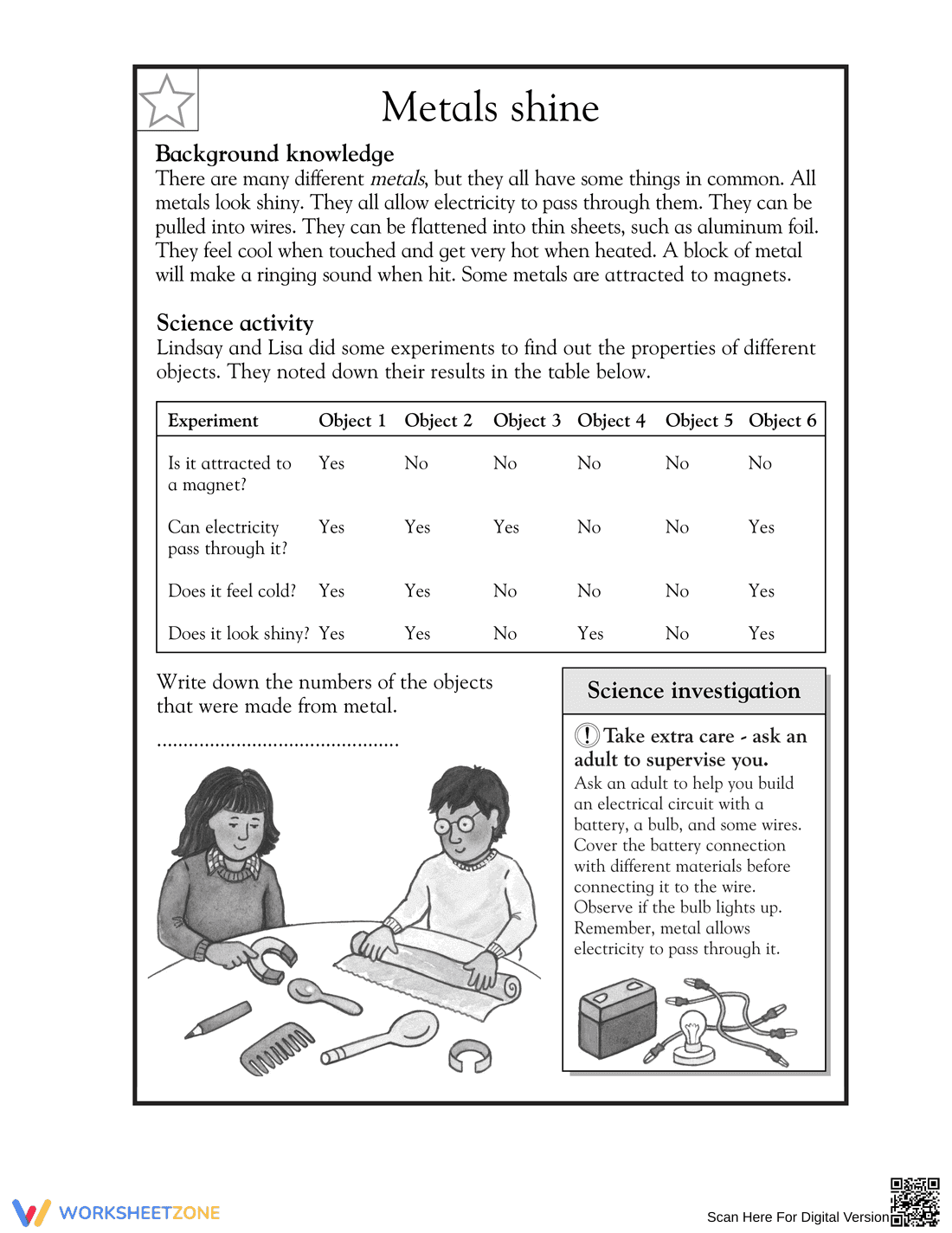
This essential Grade 4 science worksheet enables students to identify metals by analyzing specific physical properties through experimental data. By interpreting a table of results covering magnetism, electrical conductivity, and thermal sensations, learners develop critical thinking skills. This resource bridges the gap between abstract scientific concepts and observable physical evidence.
At a Glance
- Grade: 4 · Subject: Science
- Standard:
5-PS1-3— Identify materials based on observations of their physical properties- Skill Focus: Metal Property Identification
- Format: 1 page · 6 problems · Answer key included · PDF
- Best For: Independent practice or physical science centers
- Time: 15–20 minutes
What's Inside
This single-page PDF features a comprehensive background knowledge section detailing the common characteristics of metals, such as luster and conductivity. The core activity presents a structured data table containing results for six distinct objects across four experimental tests. A dedicated science investigation sidebar provides a safe, guided extension for building a simple circuit, reinforcing the concept of electrical conductivity.
Zero-Prep Workflow
- Print (30 seconds): Generate the required copies for your class or individual science stations.
- Distribute (1 minute): Hand out the worksheets as a stand-alone activity or as part of a broader physical science unit on matter.
- Review (1 minute): Use the included answer key to quickly verify student data analysis and identification of the metal objects.
Standards Alignment
The worksheet is primarily aligned with 5-PS1-3, which requires students to make observations and measurements to identify materials based on their properties. By analyzing the provided experimental data table, students demonstrate their ability to use evidence-based reasoning to classify matter. This standard code can be copied directly into lesson plans, IEP goals, or district curriculum mapping tools.
How to Use It
Deploy this worksheet during the direct instruction phase of a unit on the properties of matter to provide concrete examples of how scientists test materials. For formative assessment, observe if students can correctly correlate multiple "Yes" results in the table with the identifying characteristics of metals listed in the background text. Most students will complete the analysis in under 20 minutes.
Who It's For
This resource is designed for Grade 3 and Grade 4 students beginning their study of physical science and material properties. It provides excellent support for English Language Learners through clear headers and structured data. For natural pairing, use this worksheet alongside a physical collection of objects for a live sorting center or a passage on metallurgy.
According to the RAND AIRS 2024 analysis of elementary science education, providing students with structured data tables is essential for developing the evidence-based reasoning required by the 5-PS1-3 standard. This worksheet focuses on the plain-English skill of identifying materials through physical properties such as magnetism and conductivity. By requiring students to synthesize multiple test results for a single object, the activity promotes higher-order cognitive processing beyond simple observation. Research indicates that connecting theoretical background knowledge to experimental data points improves long-term retention of physical science concepts. Teachers can utilize this printable tool to assess student mastery of material classification without the overhead of complex lab setups. This systematic approach ensures that learners understand the multi-faceted nature of metallic properties while building the foundational skills needed for more advanced chemistry and physics topics in middle school.


