


























Views
Downloads
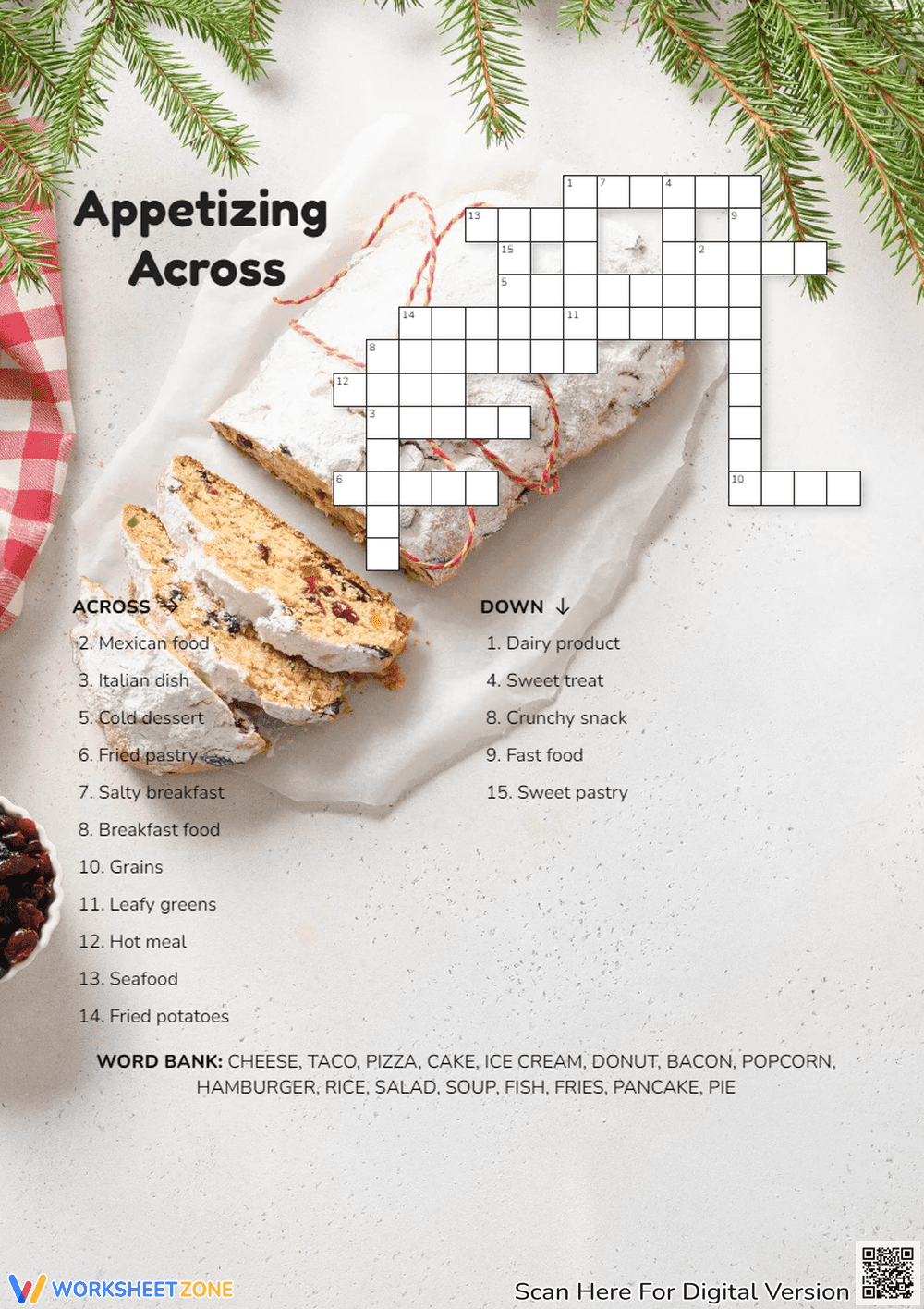

Printable Food Crossword Puzzle | Grade 3
Paste this activity's link or code into your existing LMS (Google Classroom, Canvas, Teams, Schoology, Moodle, etc.).
Students can open and work on the activity right away, with no student login required.
You'll still be able to track student progress and results from your teacher account.
This engaging food crossword puzzle helps students build essential vocabulary and spelling skills through context clues. By matching descriptive hints to a provided word bank, young learners reinforce their understanding of common food categories while practicing accurate spelling in a fun format.
At a Glance
- Grade: 3 · Subject: ELA
- Standard:
CCSS.ELA-LITERACY.L.3.6— Acquire and use grade-appropriate vocabulary words- Skill Focus: Vocabulary and Spelling
- Format: 1 page · 16 problems · Answer key included · PDF
- Best For: Morning work or early finishers
- Time: 10–15 minutes
This single-page printable features a visually appealing crossword grid set against a festive food background. It includes 16 distinct clues divided into "Across" and "Down" categories, prompting students to identify items like "Mexican food" or "Leafy greens." A comprehensive 16-word bank is provided at the bottom of the page to support spelling accuracy and reduce frustration. A complete answer key is included in the download for quick grading.
Zero-Prep Workflow
This resource is designed for immediate classroom implementation.
- Print (1 minute): Simply download the PDF and print a class set.
- Distribute (1 minute): Hand out the worksheets as students enter the room or transition between subjects. The instructions are self-explanatory.
- Review (3 minutes): Use the included answer key to quickly check student work or project it on the board for self-correction.
With a total teacher prep time of under two minutes, this activity is an ideal addition to any emergency sub plan folder.
Standards Alignment
This worksheet aligns directly with CCSS.ELA-LITERACY.L.3.6, requiring students to acquire and use accurately grade-appropriate conversational and general academic words. By categorizing and identifying specific foods from broad descriptions, students demonstrate practical vocabulary application. Both standard codes can be copied directly into lesson plans, IEP goals, or district curriculum mapping tools.
How to Use It
This versatile worksheet functions perfectly as an independent morning work assignment to settle students at the start of the day. It also serves as an excellent "sponge" activity for early finishers during a longer language arts block. While students work, teachers can conduct quick formative assessments by observing how efficiently learners use the process of elimination with the word bank. Expect most students to complete the puzzle within a 10 to 15-minute time frame.
Who It's For
This resource is primarily designed for second, third, and fourth-grade students developing their independent reading and vocabulary skills. The inclusion of a word bank provides built-in differentiation, making the task accessible for English Language Learners or students requiring additional spelling support. Pair this crossword with a broader unit on nutrition, cultural foods, or a descriptive writing lesson to maximize its instructional value.
Effective vocabulary instruction relies on multiple exposures to words in varied, engaging contexts. This worksheet supports CCSS.ELA-LITERACY.L.3.6 by challenging students to acquire and use grade-appropriate vocabulary words through a structured puzzle format. According to Fisher & Frey (2014), providing students with interactive and low-stakes opportunities to manipulate vocabulary significantly increases long-term retention and word recognition speed. The crossword format inherently demands attention to spelling and letter count, reinforcing orthographic mapping processes essential for fluent reading. By integrating a word bank, the activity lowers the affective filter, allowing students to focus on meaning and context clues rather than experiencing spelling fatigue. This targeted practice ensures that learners can confidently identify and categorize common terms, building a stronger foundation for both reading comprehension and expressive writing tasks across the elementary curriculum.


