


























Views
Downloads
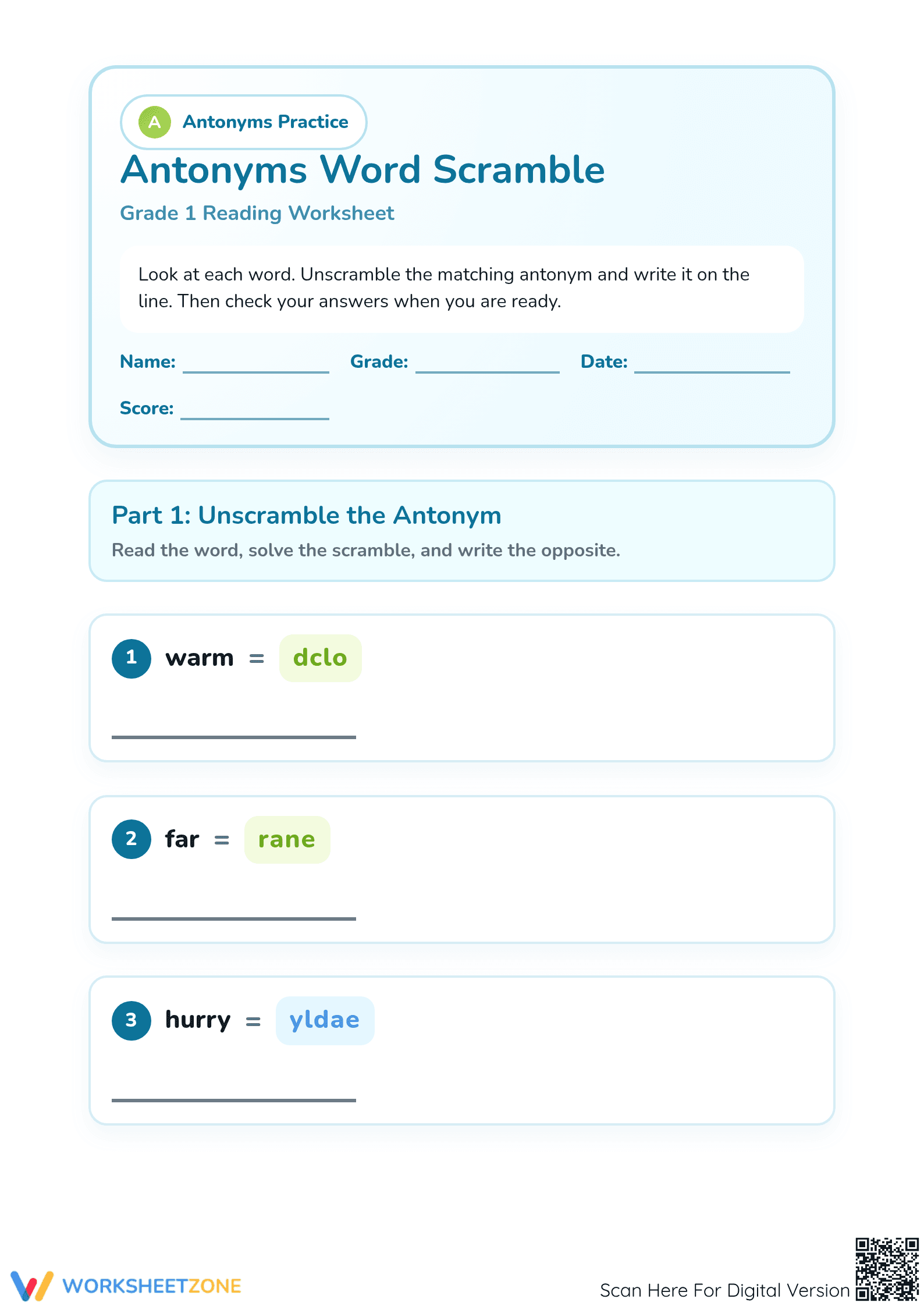
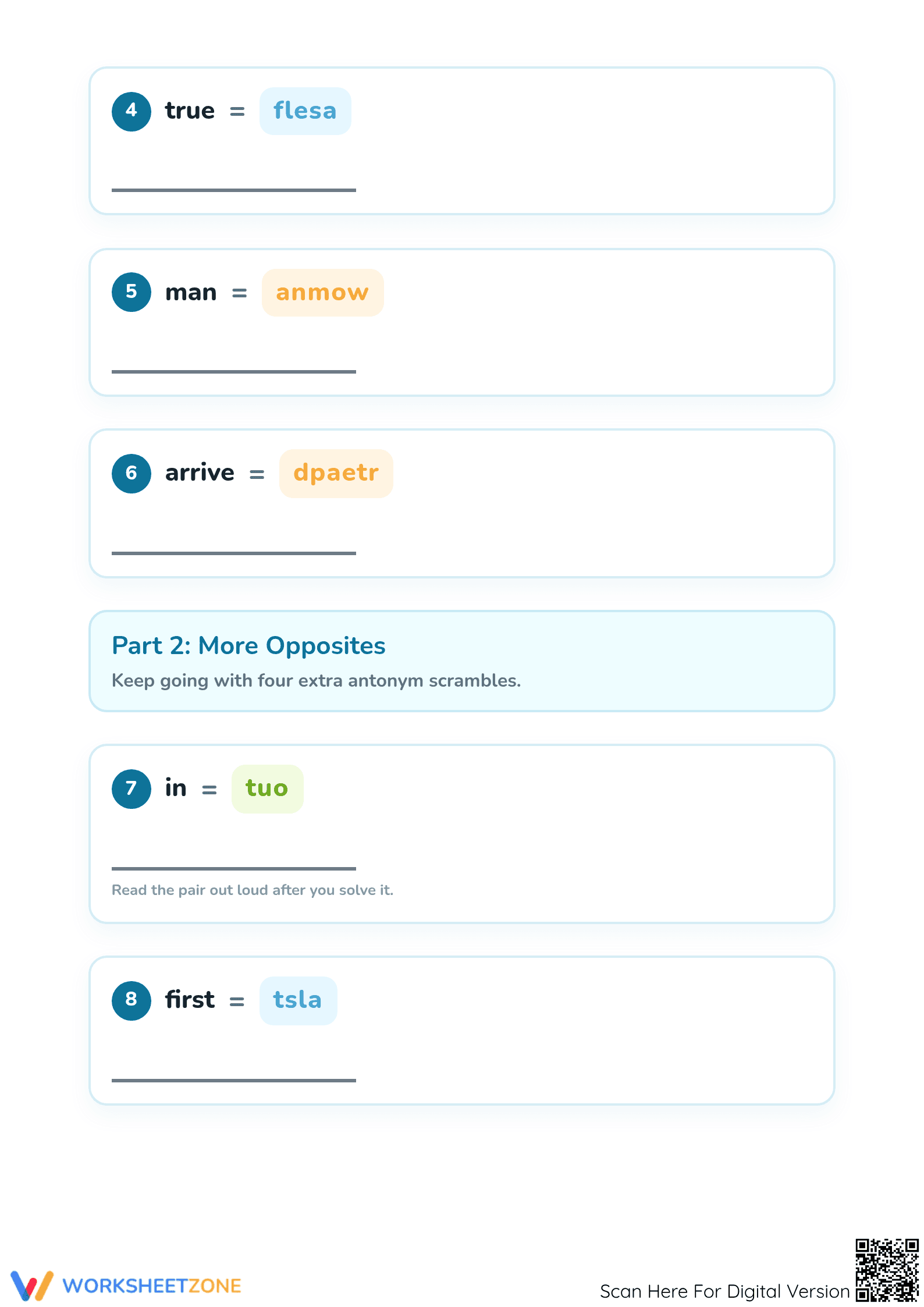
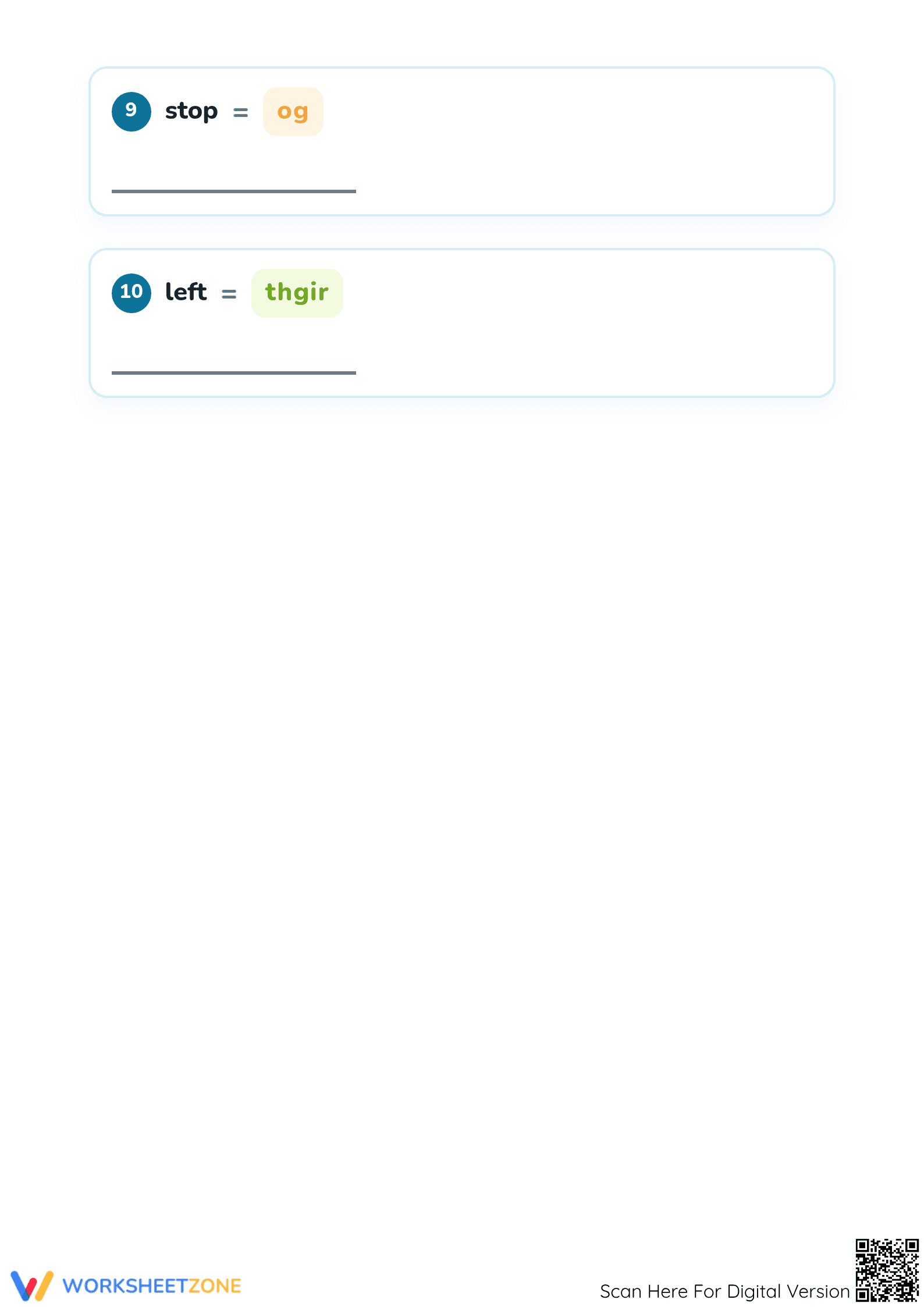

Printable Antonyms Word Scramble Worksheet | Grade 1 ELA
Paste this activity's link or code into your existing LMS (Google Classroom, Canvas, Teams, Schoology, Moodle, etc.).
Students can open and work on the activity right away, with no student login required.
You'll still be able to track student progress and results from your teacher account.
The Antonyms Word Scramble 4 worksheet provides Grade 1 students with a focused pathway to mastering lexical opposites. This resource ensures learners internalize relationships between common adjectives and verbs. Students unscramble letter sets to reveal antonyms, reinforcing both spelling and vocabulary depth through 10 targeted tasks.
At a Glance
- Grade: 1 · Subject: English Language Arts (ELA)
- Standard:
CCSS.ELA-LITERACY.L.1.5— Demonstrate understanding of word relationships and nuances in word meanings through antonym identification- Skill Focus: Antonyms and Word Scrambles
- Format: 3 pages · 10 problems · Answer key included · PDF
- Best For: Independent vocabulary practice and lexical reinforcement
- Time: 15–20 minutes
What's Inside
Across three printable pages, students encounter 10 unique word scramble challenges. Each task presents a base word paired with a jumbled letter set. The inclusion of handwriting lines encourages proper letter formation, while the tiered sections help learners manage cognitive load. A full answer key is included for zero-prep review.
Skill Progression
- Guided Practice: The first tasks use high-frequency opposites like warm/cold to build student confidence and familiarize them with the unscrambling mechanic.
- Supported Practice: Middle tasks transition to complex concepts like true/false, requiring students to synthesize phonetic knowledge with lexical recall.
- Independent Practice: The final section challenges students to identify directional terms like left/right without adult prompting, fostering vocabulary independence.
This resource utilizes the gradual-release model to ensure students move from modeled identification to independent mastery of opposite pairs.
Standards Alignment
This resource is explicitly aligned to `CCSS.ELA-LITERACY.L.1.5`, which requires students to demonstrate understanding of word relationships. By focusing on antonyms, the worksheet directly addresses the foundational need for students to categorize and differentiate word meanings. This standard code can be copied directly into lesson plans, IEP goals, or district curriculum mapping tools.
How to Use It
Implement this worksheet during the independent practice phase of a vocabulary lesson. Before starting, perform a quick oral check for opposite pairs. During the activity, circulate and observe student approach to the scrambles. This serves as a quick formative assessment for lexical readiness and spelling proficiency before moving to complex reading passages.
Who It's For
The worksheet is ideal for first-grade students, English Language Learners (ELLs) requiring visual vocabulary support, and special education settings focusing on semantic fluency. It pairs naturally with an anchor chart displaying common opposite pairs or a reading passage. Differentiation can be achieved by allowing students to use magnetic letters to solve scrambles first.
According to the RAND AIRS 2024 report, structured lexical practice that combines word manipulation with semantic meaning improves vocabulary retention in early readers. The Antonyms Word Scramble 4 worksheet applies these principles by requiring Grade 1 students to actively reconstruct target antonyms through phonetic analysis. This dual-processing task—unscrambling and identifying opposites—ensures that the CCSS.ELA-LITERACY.L.1.5 skill of understanding how words relate is mastered at a cognitive depth beyond simple memorization. Fisher & Frey (2014) highlight that such word-work activities are essential for the gradual release of responsibility in literacy development. This resource provides the precise task count and standard alignment needed for data-driven instructional planning in modern elementary classrooms.


