


























Views
Downloads
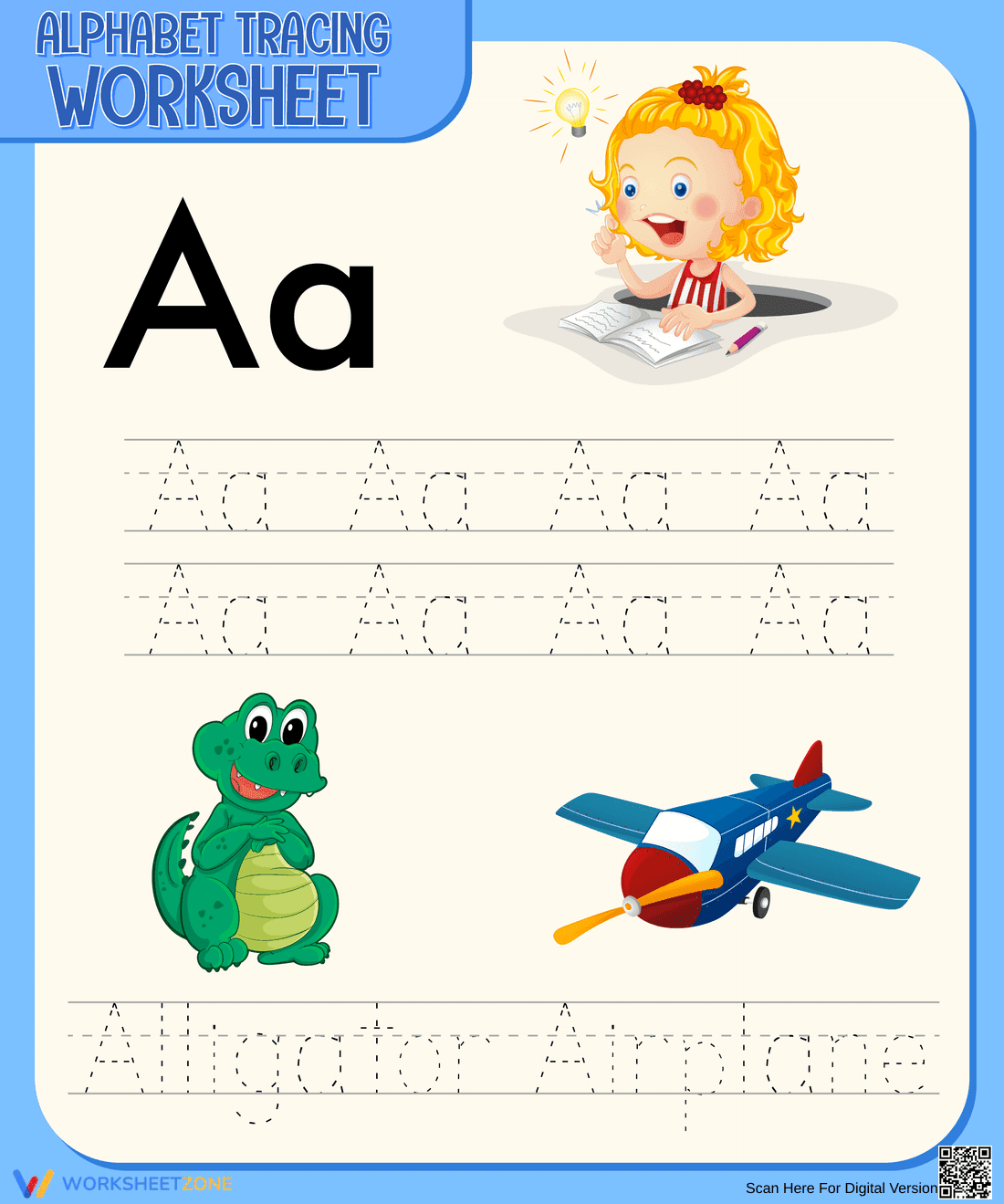

Letter A Alphabet Tracing Worksheet | Essential Grade K
Paste this activity's link or code into your existing LMS (Google Classroom, Canvas, Teams, Schoology, Moodle, etc.).
Students can open and work on the activity right away, with no student login required.
You'll still be able to track student progress and results from your teacher account.
This Letter A tracing worksheet helps early learners master uppercase and lowercase letter formation through repetitive, guided practice. Students develop the fine motor control necessary for legible handwriting while connecting the letter 'A' to familiar vocabulary like alligator and airplane. This resource ensures a solid foundation for literacy and phonics development in young children.
At a Glance
- Grade: Kindergarten · Subject: ELA
- Standard:
CCSS.ELA-LITERACY.L.K.1.A— Print many upper- and lowercase letters of the alphabet- Skill Focus: Letter A formation
- Format: 1 page · 10 tasks · Answer key included · PDF
- Best For: Morning work or literacy centers
- Time: 10–15 minutes
This single-page PDF features 8 sets of uppercase and lowercase 'Aa' tracing pairs with directional arrows to guide proper stroke order. Below the letter practice, students trace the words "Alligator" and "Airplane," paired with high-quality illustrations to reinforce letter-sound association. The layout is clean and distraction-free, making it ideal for students just beginning their writing journey.
Zero-Prep Workflow
- Print: Generate copies of the single-page PDF for your entire class or small group in seconds.
- Distribute: Hand out the sheets with pencils or crayons during your phonics block or morning entry.
- Review: Check completed work for proper grip and stroke direction to provide immediate feedback.
This worksheet is an ideal sub-plan addition or a quick transition activity between lessons, requiring less than 2 minutes of teacher preparation time.
Standards Alignment
The primary focus is `CCSS.ELA-LITERACY.L.K.1.A`, which requires students to print many upper- and lowercase letters. By providing dotted-line scaffolds and directional cues, this worksheet supports the transition from letter recognition to active production. Both standard codes can be copied directly into lesson plans, IEP goals, or district curriculum mapping tools.
How to Use It
Use this worksheet during direct instruction as a guided activity where the teacher models the strokes on a whiteboard while students follow along. It also serves as an effective formative assessment tool; observe students as they trace to identify those struggling with pencil pressure or spatial awareness. Expect most students to complete the page in 10 to 15 minutes.
Who It's For
This resource is designed for preschool, kindergarten, and first-grade students who need targeted practice with the first letter of the alphabet. It is particularly helpful for English Language Learners (ELLs) who benefit from the visual cues of the alligator and airplane. Pair this with a letter 'A' anchor chart or a phonics song for a comprehensive learning experience.
According to the RAND AIRS 2024 report, repetitive tracing exercises are fundamental in developing the muscle memory required for early literacy success. This worksheet targets CCSS.ELA-LITERACY.L.K.1.A by providing structured opportunities for students to practice printing the letter A in both its upper- and lowercase forms. Research indicates that connecting letter formation with visual vocabulary, such as "alligator" and "airplane," significantly improves phonemic awareness and long-term retention in early childhood settings. By utilizing 10 specific tracing tasks, this resource offers the high-frequency practice necessary for students to achieve mastery in letter production. The inclusion of directional arrows aligns with best practices for handwriting instruction, ensuring that students develop efficient writing habits from the start. This evidence-based approach provides a reliable tool for educators to support foundational writing skills in a classroom or home-school environment.


