


























Views
Downloads

Printable Letter E Alphabet Tracing Worksheet | Grade K
Paste this activity's link or code into your existing LMS (Google Classroom, Canvas, Teams, Schoology, Moodle, etc.).
Students can open and work on the activity right away, with no student login required.
You'll still be able to track student progress and results from your teacher account.
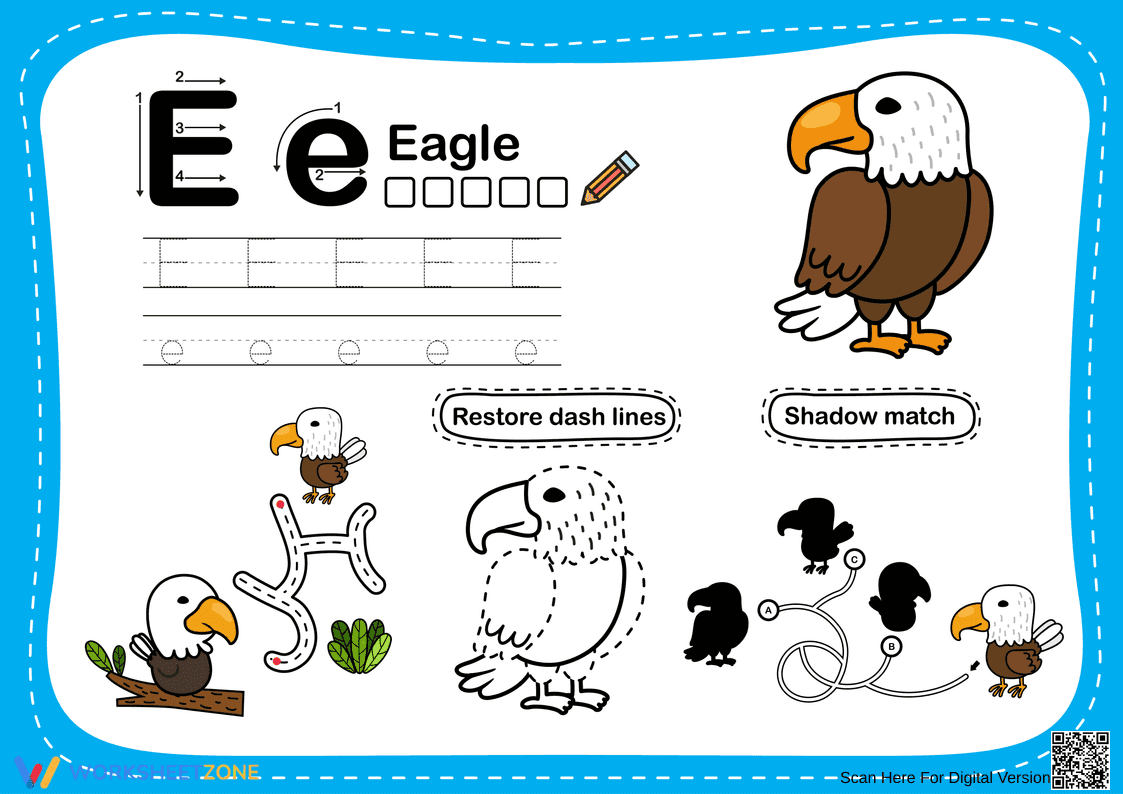
This Letter E worksheet provides early learners with a structured path to alphabet mastery. Students practice uppercase and lowercase formation while building visual discrimination skills through engaging eagle-themed activities. By combining handwriting with fine motor tasks, this resource ensures children develop the muscle memory and recognition necessary for foundational literacy success.
At a Glance
- Grade: Kindergarten · Subject: ELA
- Standard:
CCSS.ELA-LITERACY.RF.K.1.D— Recognize and name all upper- and lowercase letters of the alphabet- Skill Focus: Letter E formation
- Format: 1 page · 4 tasks · Answer key included · PDF
- Best For: Morning work or literacy centers
- Time: 10–15 minutes
Inside this single-page PDF, you will find a comprehensive set of Letter E activities. It features guided tracing for both "E" and "e" with directional arrows, a "restore dash lines" eagle drawing task, and a shadow matching game. The worksheet uses a cohesive eagle theme to reinforce phonics and vocabulary, providing a clear, distraction-free layout for young students.
The zero-prep workflow is designed for busy educators. First, print the single-page PDF (30 seconds). Next, distribute the sheets to students with pencils and crayons (1 minute). Finally, review the letter formation and shadow matches as a whole group or during individual check-ins (1 minute). This resource is an ideal sub-plan or quick-start morning activity.
This resource aligns with `CCSS.ELA-LITERACY.RF.K.1.D`, which requires students to recognize and name all upper- and lowercase letters of the alphabet. It also supports fine motor development essential for writing. Both standard codes can be copied directly into lesson plans, IEP goals, or district curriculum mapping tools.
Use this worksheet during the "You Do" phase of a letter-of-the-week lesson. It serves as an excellent formative assessment; observe student grip and stroke order during the tracing portion to identify those needing additional intervention. The expected completion time is 10 to 15 minutes, making it perfect for transition periods.
This worksheet is designed for preschool, kindergarten, and first-grade students who are beginning their handwriting journey. It is particularly effective for English Language Learners (ELLs) who benefit from the visual cues provided by the eagle illustrations. Pair this with a letter E anchor chart or a phonics song for a multi-sensory experience.
Foundational literacy research emphasizes that letter recognition is one of the strongest predictors of future reading success. According to the RAND AIRS 2024 report, early exposure to multisensory letter formation—combining tracing with visual discrimination tasks—significantly improves long-term retention in kindergarten cohorts. This worksheet addresses CCSS.ELA-LITERACY.RF.K.1.D by providing explicit practice in identifying and forming the letter E. By integrating "restore dash lines" and "shadow match" activities, the resource moves beyond rote memorization to engage higher-order visual processing. Fisher & Frey (2014) note that such scaffolded practice allows students to build the necessary orthographic mapping skills required for fluent decoding. Educators can utilize this 1-page tool to provide 15 minutes of high-impact, focused practice that bridges the gap between simple recognition and confident handwriting. This evidence-based approach ensures that students meet critical early literacy benchmarks while developing the fine motor control essential for academic writing.


