


























Views
Downloads




Aligned Rhetorical Pivot Worksheet | Grade 11 English III
Paste this activity's link or code into your existing LMS (Google Classroom, Canvas, Teams, Schoology, Moodle, etc.).
Students can open and work on the activity right away, with no student login required.
You'll still be able to track student progress and results from your teacher account.
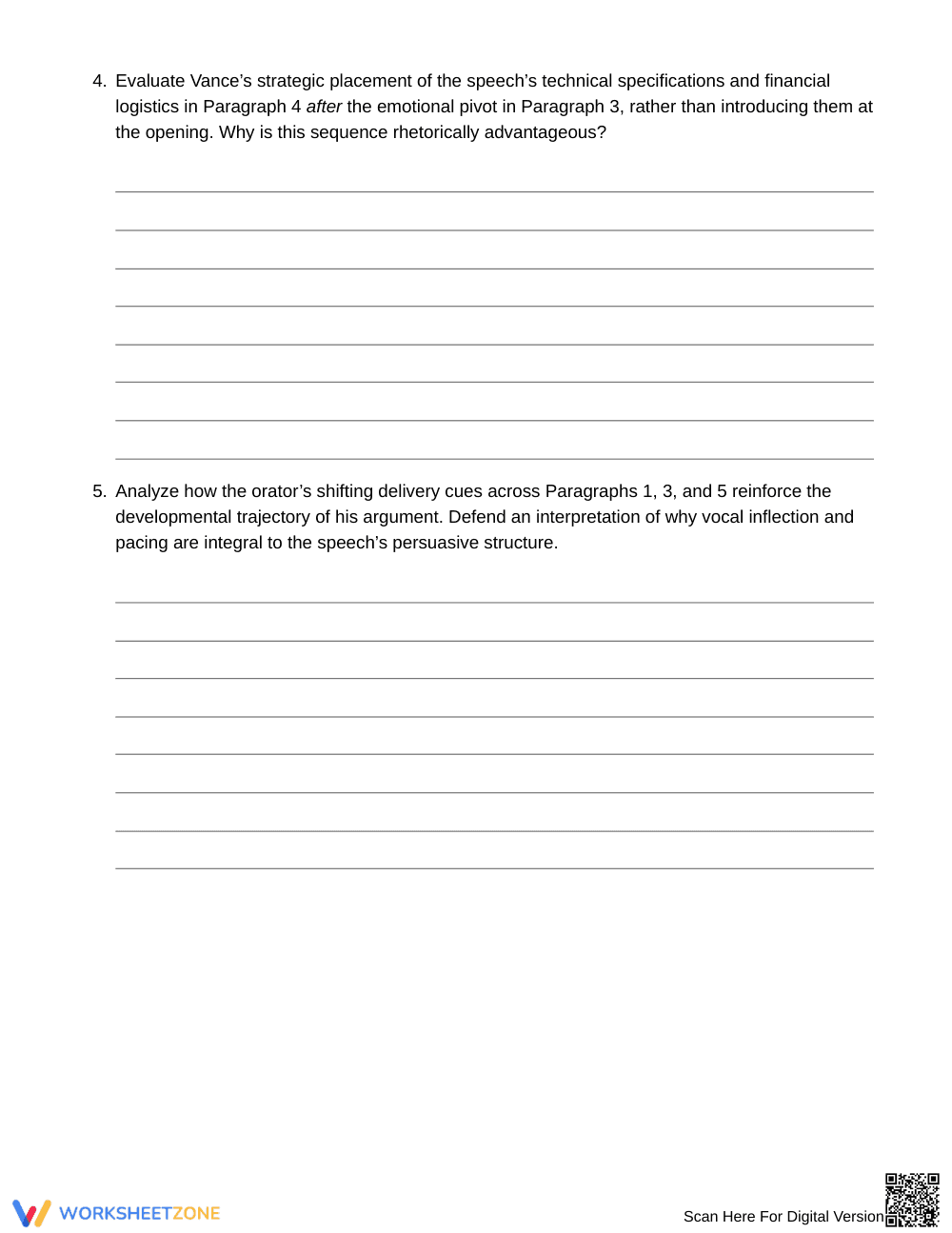
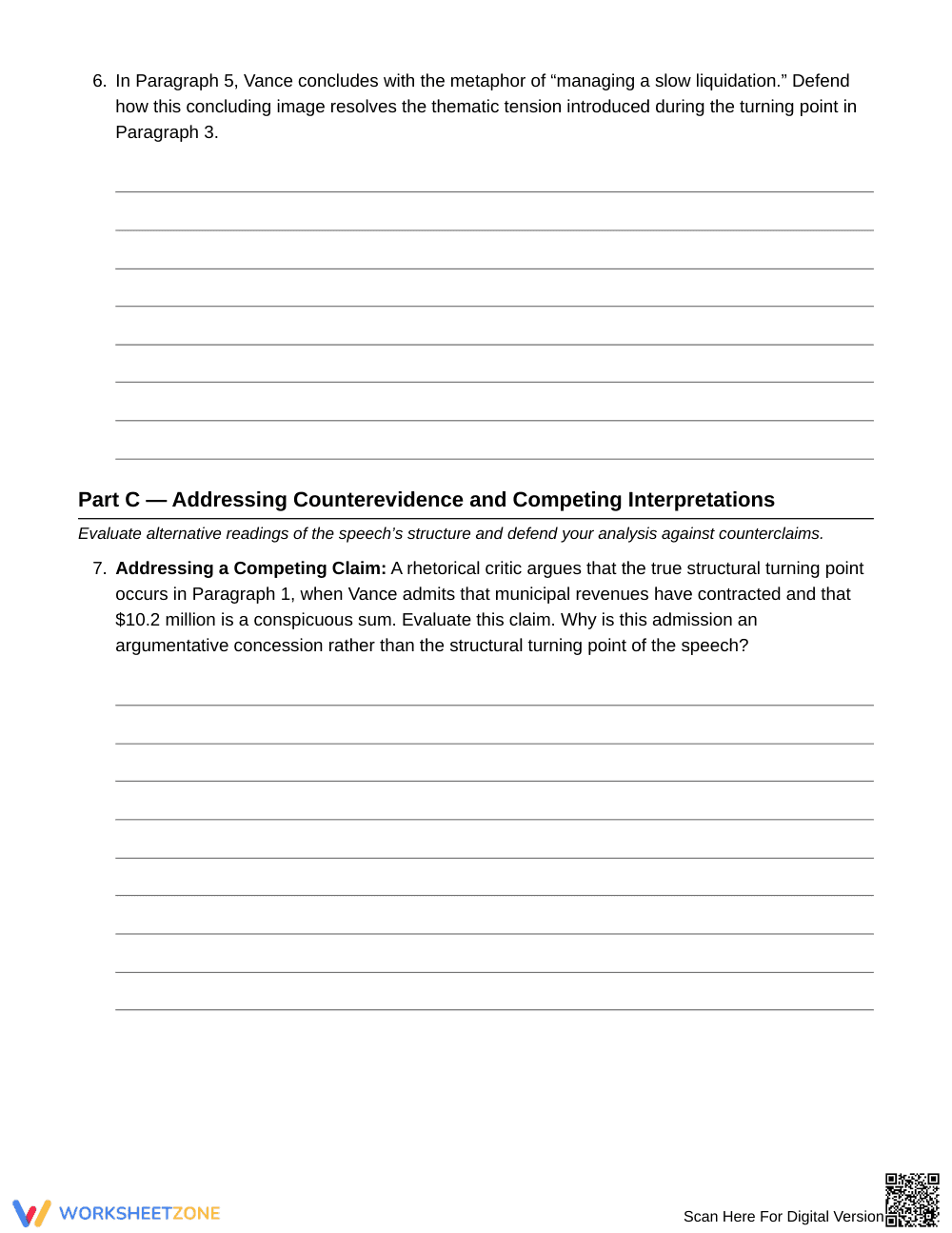
This Grade 11 rhetorical analysis worksheet develops student mastery in identifying, analyzing, and defending structural pivots within complex argumentative speeches. Students evaluate an authentic civic transcript, tracing how rhetorical shifts, vocal delivery cues, and evidence sequencing transform initial concessions into persuasive momentum across 8 targeted analytical tasks.
At a Glance
- Grade: 11 · Subject: English III
- Standard:
RI.11-12.5— Analyze in detail how an author's ideas or claims are developed and refined- Skill Focus: Defend a Rhetorical Turning Point
- Format: 6 pages · 8 problems · Answer key included · PDF
- Best For: High school speech and rhetoric units
- Time: 45–60 minutes
This 6-page instructional package features a complete municipal speech transcript accompanied by delivery notations, 8 rigorous analytical prompts, and a comprehensive 3-page model answer key. Tasks require students to cite exact textual evidence, evaluate structural shifts, interpret antithesis and metaphor, and defend their analytical conclusions against competing interpretations.
Skill Progression
- Guided Practice: Tasks 1–2 establish foundational textual evidence by directing students to isolate the precise turning point sentence, delivery cues, and contrasting cost metrics in the speech.
- Supported Practice: Tasks 3–6 guide students through reasoned rhetorical defenses, analyzing how figurative language, data placement, and delivery inflection advance the speaker's claim.
- Independent Practice: Tasks 7–8 challenge students to evaluate competing critical readings and defend structural necessity against opposing counterarguments.
This structured sequence reflects the gradual release of responsibility framework, systematically building from objective evidence extraction to sophisticated rhetorical critique.
Standards Alignment
This worksheet is aligned to primary standard `RI.11-12.5`: Analyze and evaluate the effectiveness of the structure an author uses in his or her exposition or argument, including whether the structure makes points clear, convincing, and engaging. It additionally reinforces RI.11-12.1 through rigorous textual citation. Both standard codes can be copied directly into lesson plans, IEP goals, or district curriculum mapping tools.
How to Use It
Assign this resource during or immediately following direct instruction on rhetorical structure and persuasive oratory. For whole-class instruction, read the municipal speech aloud while observing delivery notes, then have students complete Part A in collaborative pairs before transitioning to Parts B and C independently. For formative assessment, examine student responses to Task 7 to gauge whether learners can successfully distinguish structural turning points from introductory concessions. Expected completion time is 45 to 60 minutes.
Who It's For
Designed for Grade 11 English III and Advanced Placement English Language students, this resource includes embedded delivery cues and structured analytical tiers to support diverse learners. Pair this worksheet with an anchor chart on rhetorical devices or a recorded civic address to deepen student engagement with argumentative structure.
Mastering the identification and defense of structural turning points in complex civic speeches is vital for upper-level secondary students preparing for collegiate discourse and standardized textual analysis. When learners evaluate how a speaker transitions from defensive concessions to offensive assertions, they develop higher-order evaluative reasoning aligned with standard RI.11-12.5. Grounded in the gradual-release framework established by Fisher & Frey (2014), this resource moves students from evidence location to the critical defense of counterarguments, reinforcing how rhetorical choices function in argumentative architecture. Teachers can cite this structured inquiry model as empirical evidence of student mastery in analyzing an author's structural choices, evaluating persuasive leverage, and defending analytical claims against opposing viewpoints. The 6-page format provides 8 targeted analytical tasks alongside a comprehensive 3-page answer key to support objective, standards-aligned grading across diverse high school English Language Arts classrooms.


