





























Aligned Passage Comparison Worksheet | Grade 11 English III
Paste this activity's link or code into your existing LMS (Google Classroom, Canvas, Teams, Schoology, Moodle, etc.).
Students can open and work on the activity right away, with no student login required.
You'll still be able to track student progress and results from your teacher account.
This rhetorical analysis worksheet equips eleventh-grade students to compare two distinct versions of a civic speech delivered before a city council. By evaluating how strategic revisions in diction, syntax, and delivery cues shift persuasive power, high school learners strengthen their ability to analyze authorial point of view and rhetorical craft across paired informational texts.
At a Glance
- Grade: 11 · Subject: English III
- Standard:
RI.11-12.6— Evaluate author point of view and analyze how style and content build persuasiveness- Skill Focus: Compare Two Versions of a Key Passage
- Format: 6 pages · 10 problems · Answer key included · PDF
- Best For: Rhetorical analysis and paired-text close reading
- Time: 45–60 minutes
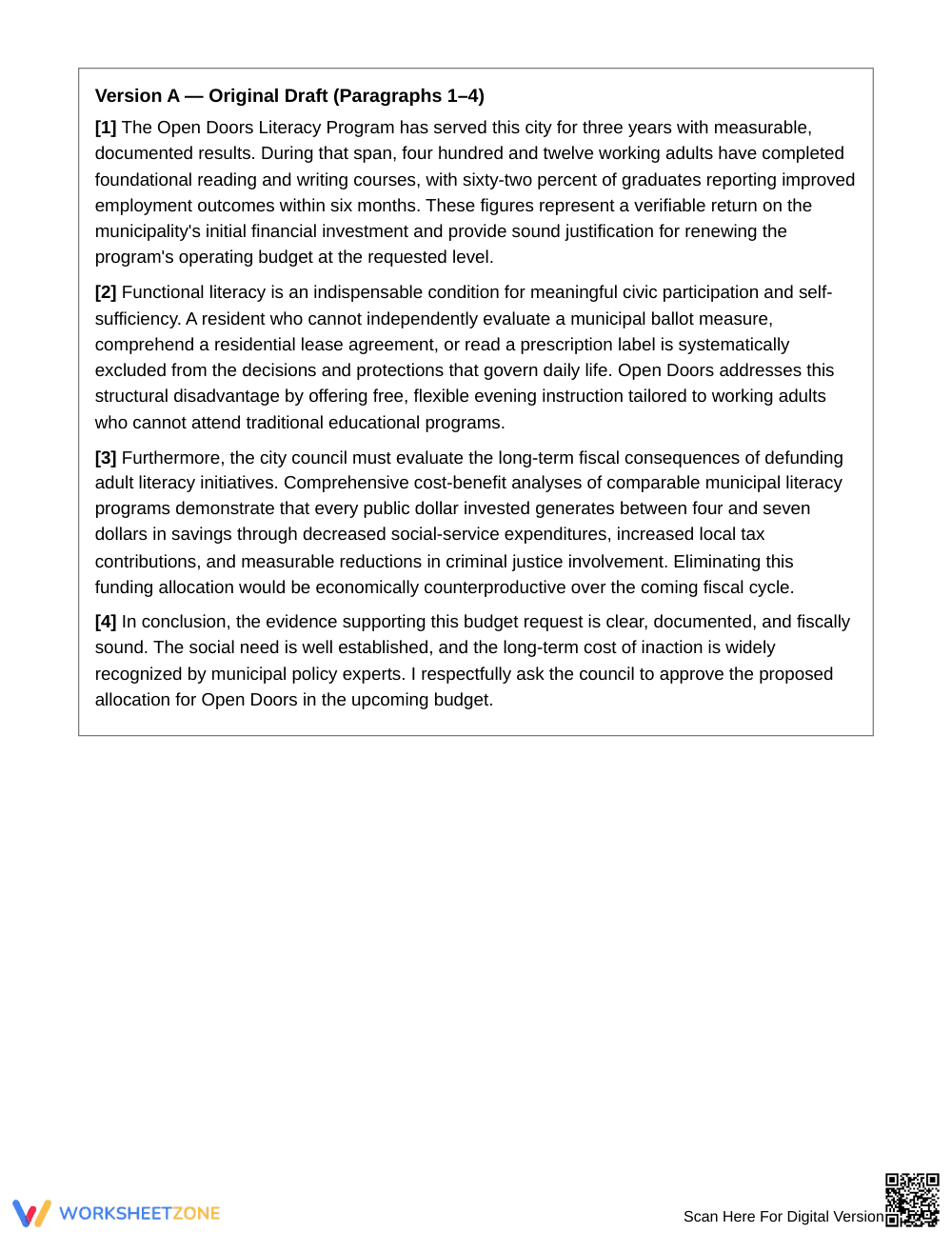
The 6-page PDF pairs a formal municipal draft with a delivered speech transcript containing performance cues. Across three student pages, learners reference a transcript guide and answer 10 analytical problems: two criteria-setting tasks, six paired-text analysis questions, and two consequential evaluation items. A complete 3-page answer key provides model explanations.
Skill Progression
- Guided Practice: Tasks 1–2 establish comparative criteria and evaluate audience positioning.
- Supported Practice: Tasks 3–8 analyze specific shifts in diction, syntax, delivery cues, and ethos.
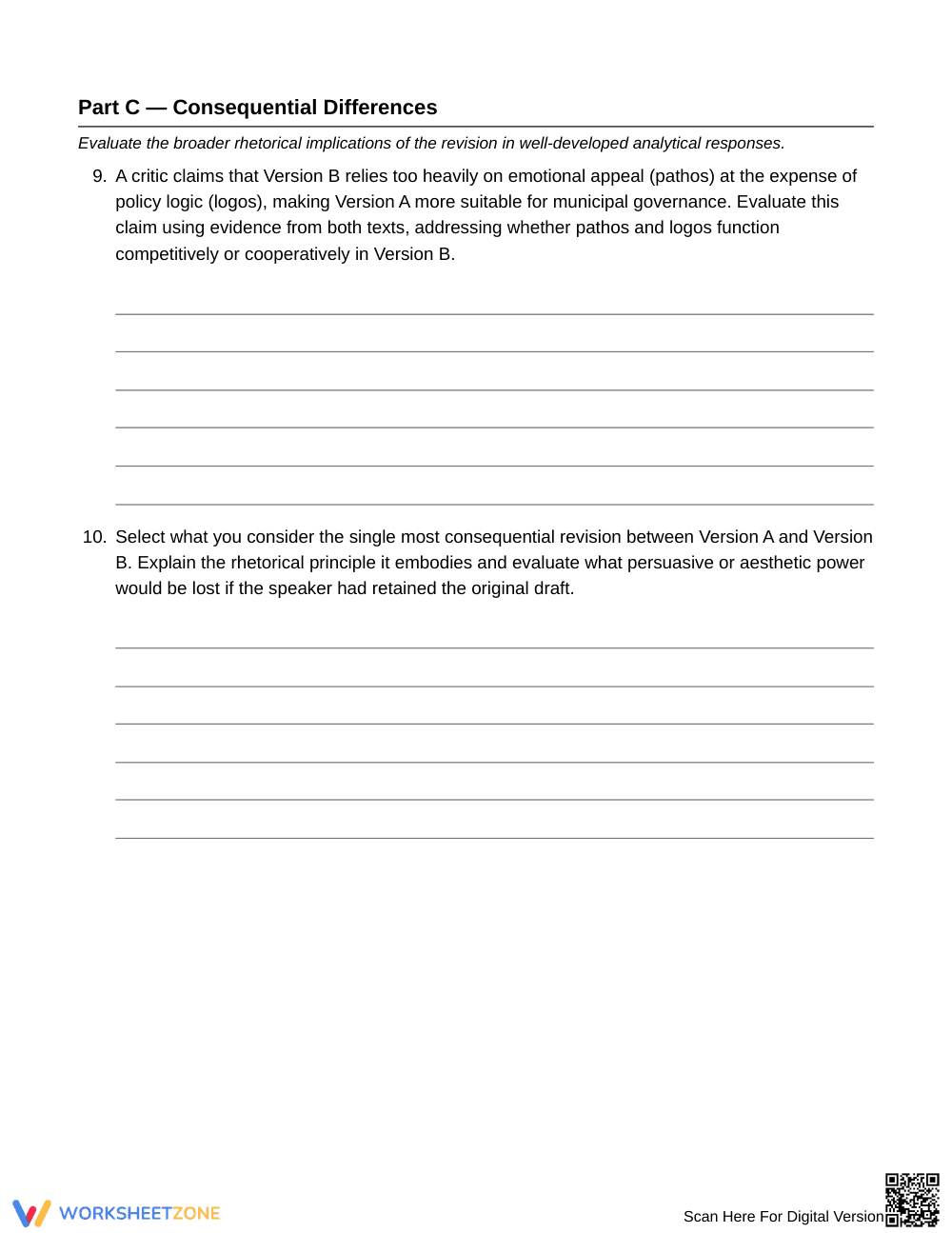
- Independent Practice: Tasks 9–10 evaluate overarching appeals and defend the most consequential revision.
This sequence follows a gradual release of responsibility model, guiding students from foundational criteria toward independent rhetorical evaluation.
Standards Alignment
This worksheet aligns to primary standard RI.11-12.6: Determine an author's point of view or purpose in a text in which the rhetoric is particularly effective, analyzing how style and content contribute to power or persuasiveness. Supporting standard RI.11-12.1 reinforces citing thorough evidence to support rhetorical comparisons. Both standard codes can be copied directly into lesson plans, IEP goals, or district curriculum mapping tools.
How to Use It
Use this activity during direct instruction on rhetorical analysis or as paired-text practice. Have students read Version A independently, then read Version B aloud using the delivery cues to hear rhetorical shifts. Alternatively, assign it for collaborative partner analysis. For formative assessment, check whether students recognize how syntax reshapes speaker ethos. Completion typically takes 45 to 60 minutes.
Who It's For
This worksheet is tailored for Grade 11 English III and AP English Language students analyzing argumentative nonfiction. To differentiate, provide sentence frames for short-answer items or highlight parallel arguments across both drafts. It pairs naturally with direct instruction on classical appeals or a historical speech revision study.
According to Fisher & Frey (2014), comparative analysis of paired texts accelerates adolescent literacy by requiring learners to synthesize divergent rhetorical choices rather than passively decoding isolated passages. This 6-page English III instructional resource directly implements standard RI.11-12.6 by guiding eleventh-grade students through the systematic comparison of two versions of a key civic passage. Learners examine how an oratorical revision transforms policy data into civic advocacy, evaluating how shifts in sentence cadence, second-person anaphora, and delivery markers alter audience engagement and persuasive force. By moving systematically from criteria-setting to consequential evaluation across 10 rigorous tasks, students gain the analytical precision needed to evaluate complex informational texts. Supported by complete model responses in a 3-page answer key, this resource provides high school educators with an evidence-based mechanism for developing mature rhetorical discernment and textual comparison skills.


