




























Aligned Logical Connections Worksheet | Grade 10 English II
Paste this activity's link or code into your existing LMS (Google Classroom, Canvas, Teams, Schoology, Moodle, etc.).
Students can open and work on the activity right away, with no student login required.
You'll still be able to track student progress and results from your teacher account.
This Grade 10 informational text worksheet trains students to identify, diagnose, and repair misread logical connections in complex texts. By evaluating structural nuances, qualifying claims, and data relationships in an authentic transit report, readers learn to analyze authorial intent accurately rather than adopting oversimplified interpretations.
At a Glance
- Grade: 10 · Subject: English II
- Standard:
RI.9-10.5— Analyze how an author develops and refines claims through specific paragraphs- Skill Focus: Repair a Misread Logical Connection
- Format: 6 pages · 10 problems · Answer key included · PDF
- Best For: Close reading argument evaluation
- Time: 45–60 minutes
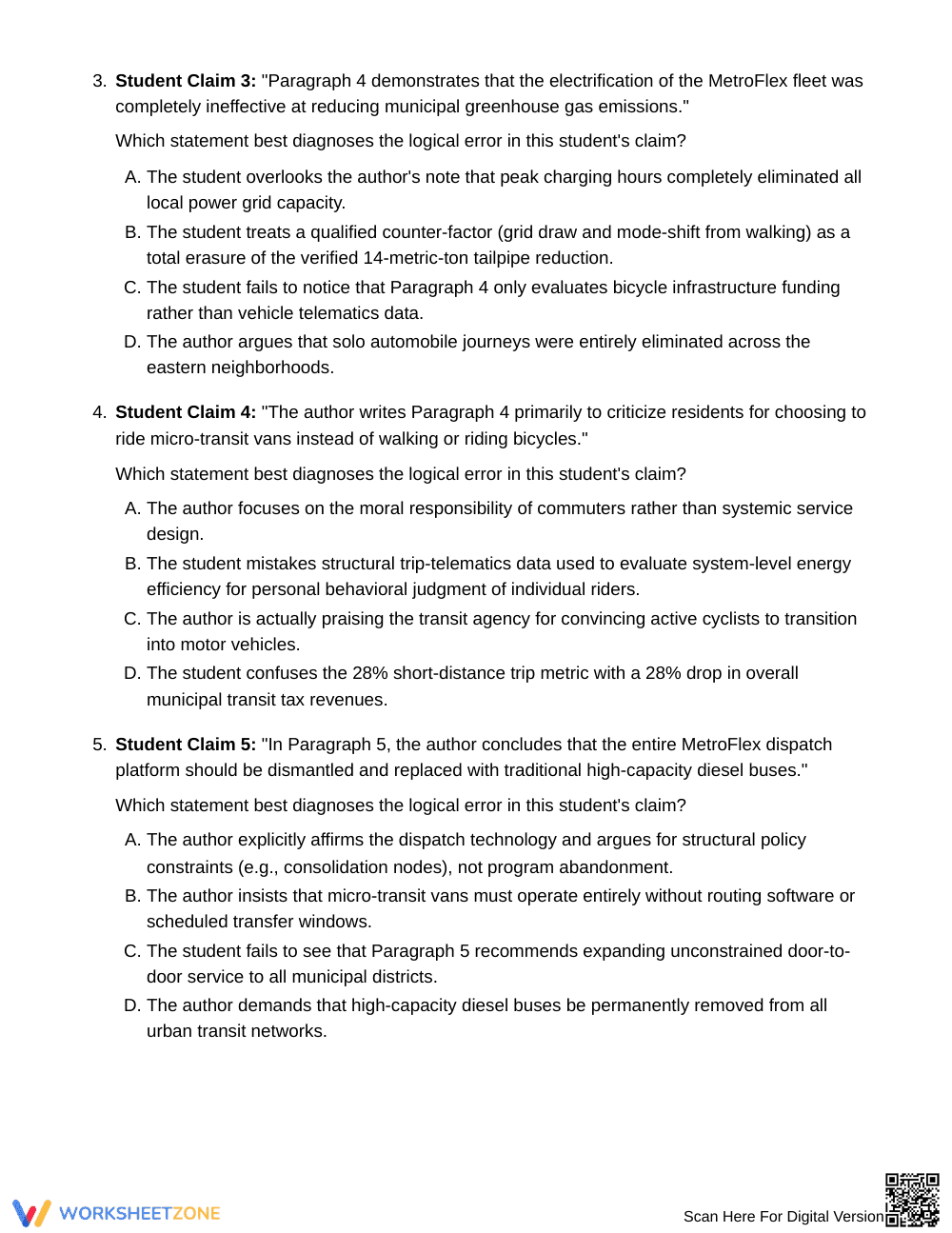
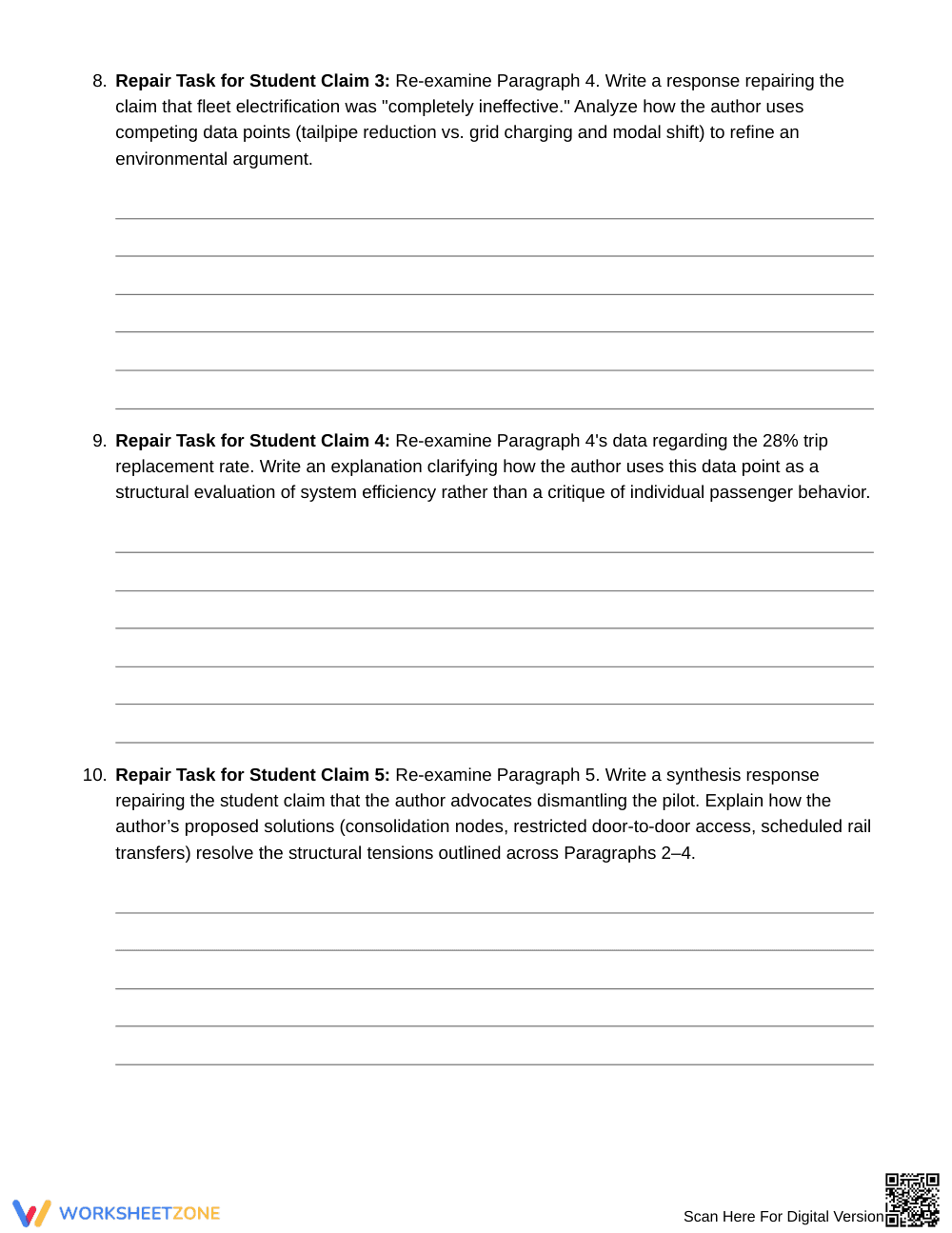
This 6-page worksheet features a multi-paragraph report on municipal transit planning. It includes an instructional rule box on structural transitions, a worked model diagnosing a reading error, 5 diagnostic multiple-choice items, and 5 evidence-based written repair prompts. A complete 3-page explanatory answer key provides sample responses and rationales for every item.
Skill Progression
- Guided practice (Model): An annotated flawed claim with a diagnosis and repaired statement demonstrates how to identify qualified evidence.
- Supported practice (Items 1–5): Five multiple-choice questions challenge students to identify analytical misreadings like confusing correlation with causation.
- Independent practice (Items 6–10): Five written prompts require students to cite text evidence and explain how structural choices refine the argument.
This gradual-release structure moves students from assisted error detection to independent textual analysis.
Standards Alignment
The primary standard is RI.9-10.5: Analyze in detail how an author's ideas or claims are developed and refined by particular sentences or paragraphs. Additionally, tasks support RI.9-10.1 by requiring textual evidence for every structural claim. Both standard codes can be copied directly into lesson plans, IEP goals, or district curriculum mapping tools.
How to Use It
Use this worksheet during direct instruction on informational text structure or as a formative assessment after initial reading. Teachers can check Part A responses to catch misread qualifications before students write in Part B. Expected completion time is 45 to 60 minutes.
Who It's For
Built for Grade 10 English II students, this activity supports on-grade learners and striving readers evaluating complex non-fiction arguments. Multiple-choice scaffolds assist varied skill levels. Pair this practice with an anchor chart on authorial concessions and transitions.
Research from Fisher & Frey (2014) highlights that secondary students frequently struggle when interpreting complex informational texts not because of vocabulary deficits, but because they overlook subtle organizational markers and qualified relationships between claims. Educational standard RI.9-10.5 requires Grade 10 learners to move beyond surface-level comprehension and analyze how authors build, refine, and qualify arguments across sentences and paragraphs. By actively diagnosing analytical misconceptions and repairing misread logical connections, students build essential metacognitive discernment for close reading. Fisher & Frey demonstrate that explicit error-analysis routines accelerate reading comprehension by requiring students to justify why an interpretation fails logically before formulating an evidence-based correction. This targeted worksheet provides direct structural practice, guiding high school readers to trace authorial reasoning, distinguish qualified concessions from outright refutations, and construct rigorous, text-grounded analytical responses across 10 standard-aligned tasks.


