




























Aligned Defend Text Sequence Worksheet | Grade 9 English I
Paste this activity's link or code into your existing LMS (Google Classroom, Canvas, Teams, Schoology, Moodle, etc.).
Students can open and work on the activity right away, with no student login required.
You'll still be able to track student progress and results from your teacher account.
This informational text worksheet equips Grade 9 students to evaluate and defend how authors structure complex technical reports. Working with a five-paragraph ecological restoration proposal, learners formulate qualified claims explaining logistical dependencies, evaluate section placement, and refute competing structural configurations to master textual architecture and authorial design.
At a Glance
- Grade: 9 · Subject: English I
- Standard:
RI.9-10.5— Analyze in detail how an author organizes and sequences claims effectively- Skill Focus: Defend a Sequence of Sections
- Format: 6 pages · 8 problems · Comprehensive 4-page answer key included · Printable PDF
- Best For: Advanced informational text structure analysis
- Time: 45–60 minutes
What's Inside
This 6-page printable resource centers on a technical report, "Project Assessment: Revitalization of the Mill Creek Riparian Corridor," detailing urban ecological restoration across five paragraphs. A Reasoning Reminder frames structural dependencies before students answer 8 constructed-response prompts. The resource includes a thorough 4-page answer key featuring exemplar responses, dependency analyses, and full refutations.
Skill Progression
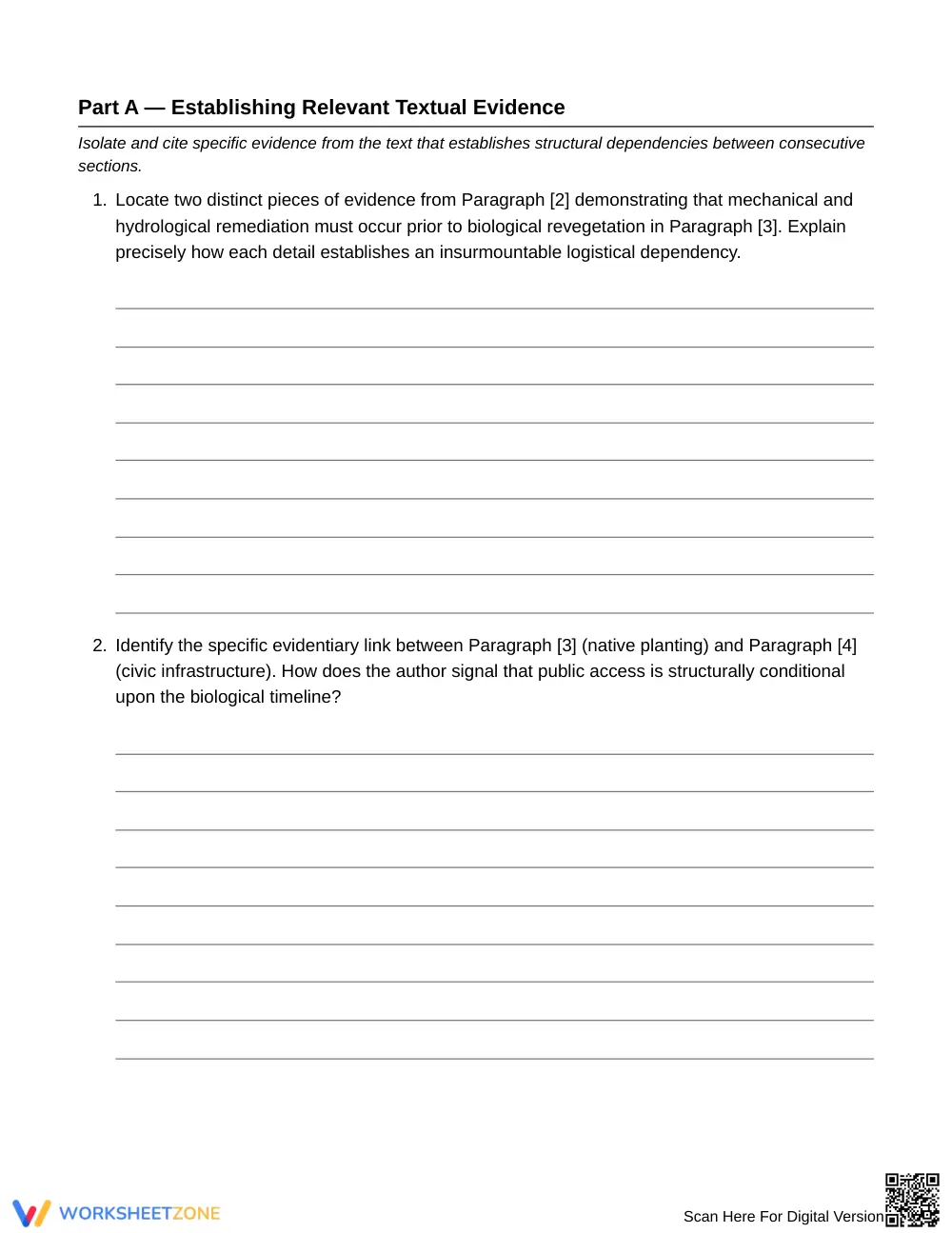
- Guided Practice (Part A — 2 Tasks): Students identify prerequisite links, isolating evidence that explains why site grading must precede biological plantings.
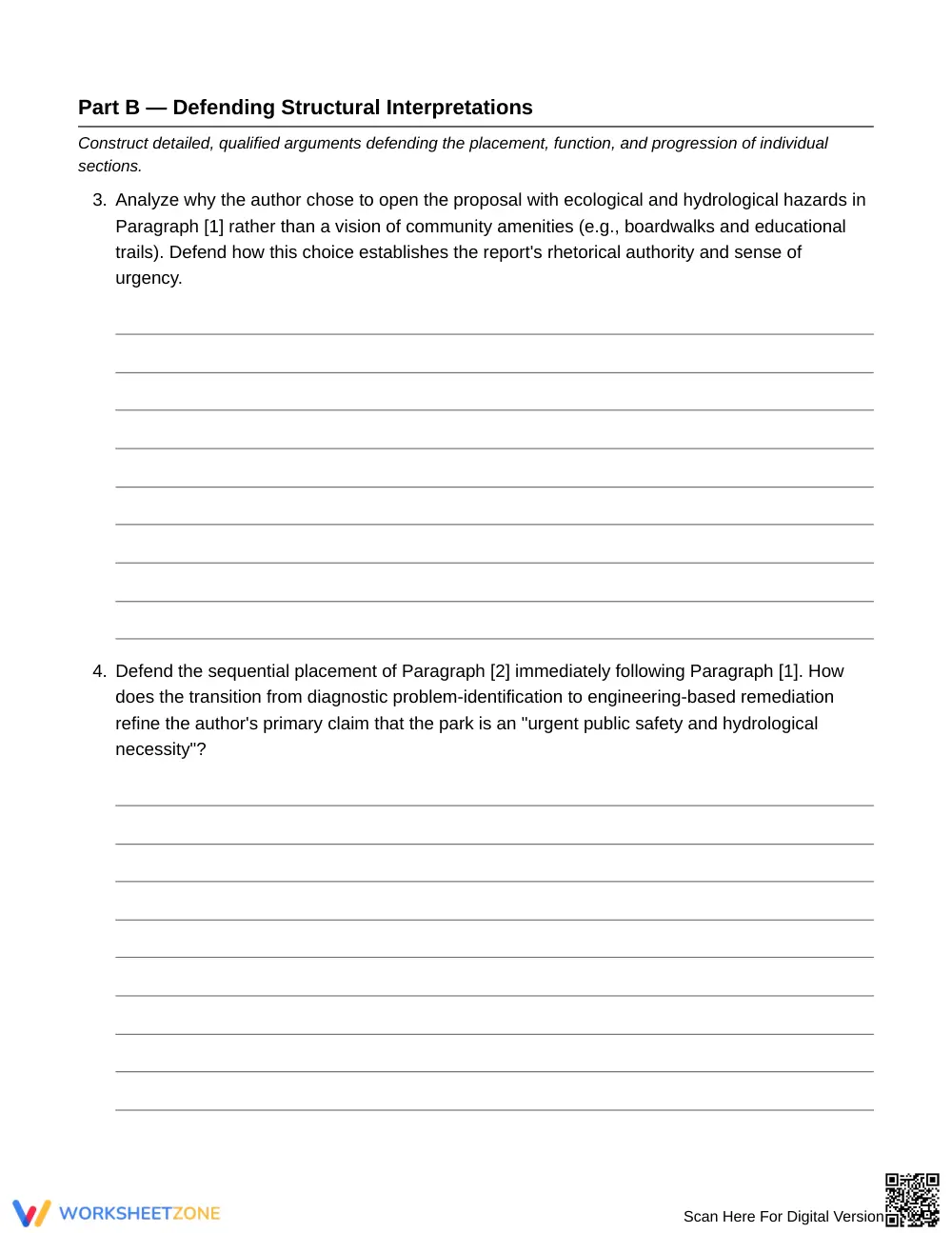
- Supported Practice (Part B — 4 Tasks): Learners construct qualified claims defending paragraph function, justifying why ecological hazards open the proposal and fiscal governance closes it.
- Independent Practice (Part C — 2 Tasks): Students independently refute structural counter-proposals from hypothetical auditors and activists to defend the overall macro-structure.
This progression mirrors the gradual release of responsibility model, shifting learners from evidentiary identification to autonomous structural critique.
Standards Alignment
This resource aligns to `RI.9-10.5`: "Analyze in detail how an author's ideas or claims are developed and refined by particular sentences, paragraphs, or larger portions of a text." It also supports `RI.9-10.1` by requiring students to cite strong textual evidence to support architectural claims. Both standard codes can be copied directly into lesson plans, IEP goals, or district curriculum mapping tools.
How to Use It
Use this worksheet after direct instruction on text structure during close reading analysis. As a formative assessment tip, check that students articulate clear prerequisite dependencies in Part A before they tackle the counter-arguments in Part C. The 8-task progression takes approximately 45 to 60 minutes, working well for independent analytical practice or collaborative peer evaluation.
Who It's For
Built for Grade 9 English I students, this worksheet suits general education and advanced readers tackling technical nonfiction. The embedded reminder scaffolds thesis development for striving writers, while the counter-argument tasks challenge advanced analytical thinkers. Pair this resource with lessons on rhetorical organization or mentor informational texts.
According to Fisher & Frey (2014), explicit instruction in text architecture and structural defense significantly improves secondary students' ability to synthesize complex expository discourse. Under standard RI.9-10.5, Grade 9 learners must move beyond passive reading comprehension to defend the sequential arrangement of text sections, identifying why specific evidentiary claims logically depend on preceding arguments. By requiring students to analyze prerequisite relationships and refute plausible alternative arrangements, this curriculum asset directly operationalizes disciplinary literacy frameworks. Research from Fisher & Frey demonstrates that when students actively interrogate why an informational section occupies a designated place rather than merely summarizing its contents, their command of structural logic and argumentative cohesion increases measurably. Consequently, mastering sequence defense through rigorous ecological proposals bridges text evaluation and advanced analytical writing across secondary English language arts classrooms, preparing students for college-level rhetorical analysis.


