


























Views
Downloads



Adjectives Starting with K | Grade 3-4 Essential Practice
Paste this activity's link or code into your existing LMS (Google Classroom, Canvas, Teams, Schoology, Moodle, etc.).
Students can open and work on the activity right away, with no student login required.
You'll still be able to track student progress and results from your teacher account.
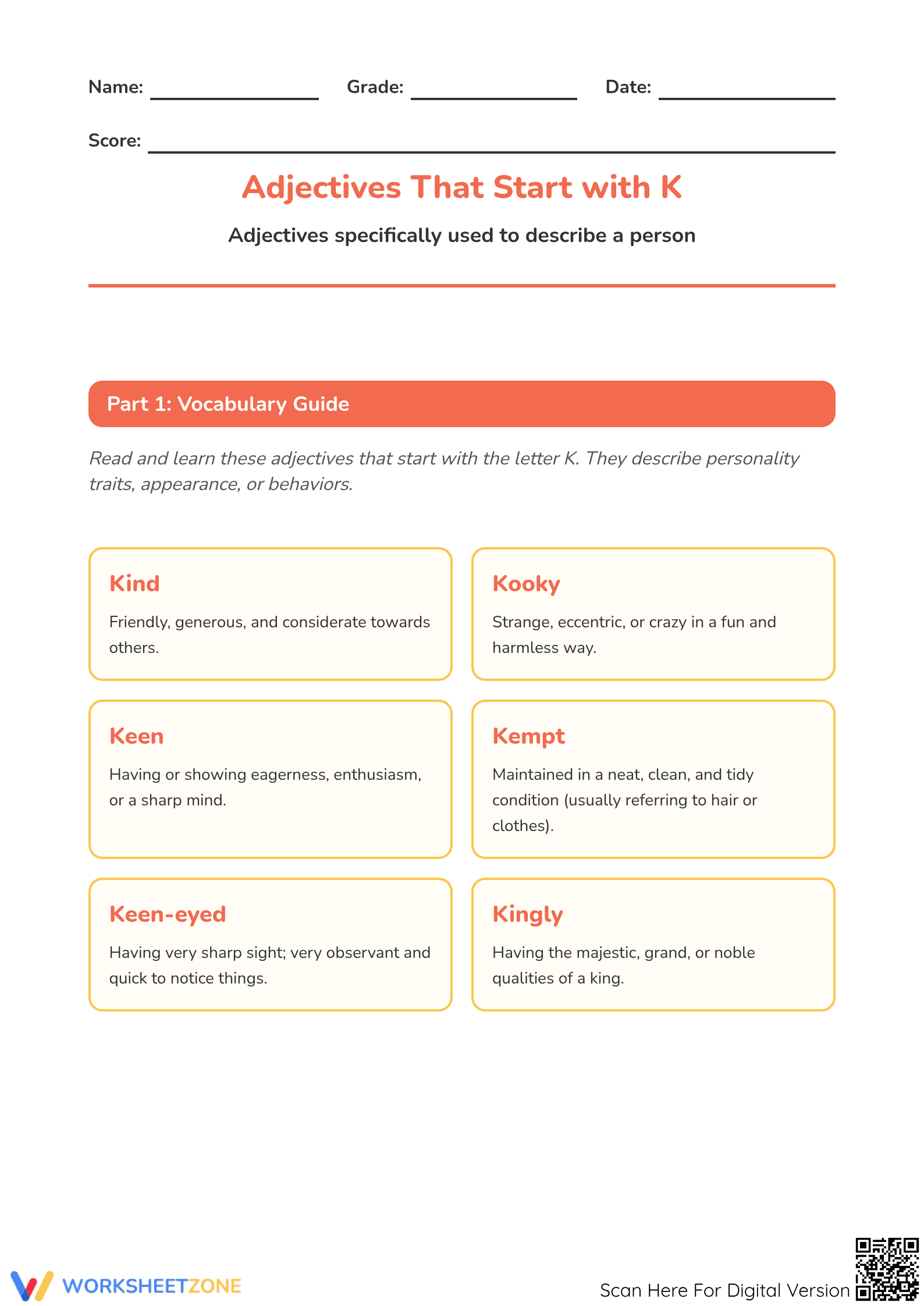
This Grade 3 and Grade 4 vocabulary worksheet focuses on adjectives starting with the letter K specifically used to describe people. Students move from initial word recognition to contextual application and creative sentence construction. By mastering these specific descriptors, learners improve their ability to craft vivid character sketches and precise narrative descriptions in their writing.
At a Glance
- Grade: 3-4 · Subject: ELA
- Standard:
CCSS.ELA-LITERACY.L.4.6— Acquire and use grade-appropriate general academic and domain-specific words- Skill Focus: Character Trait Adjectives (Letter K)
- Format: 3 pages · 13 problems · Answer key included · PDF
- Best For: Vocabulary expansion and character description practice
- Time: 20–30 minutes
What's Inside
This comprehensive 3-page PDF includes a dedicated vocabulary guide featuring six high-impact adjectives: kind, kooky, keen, kempt, keen-eyed, and kingly. Each word is accompanied by a student-friendly definition. The packet contains a matching exercise to reinforce definitions, a six-question cloze activity for contextual practice, and a creative writing section for independent application. A full answer key is provided for quick grading.
Skill Progression
- Guided Practice: Students engage with the Vocabulary Guide and matching section (5 tasks) to build foundational recognition and definition recall.
- Supported Practice: Learners move to contextual application with fill-in-the-blank sentences (6 tasks) using a provided word bank to scaffold success.
- Independent Practice: The creative writing section (2 tasks) requires students to generate original sentences to describe characters using their new vocabulary.
This sequence follows the gradual-release model to ensure students move from word awareness to functional mastery.
Standards Alignment
The primary focus is `CCSS.ELA-LITERACY.L.4.6`, which requires students to acquire and use accurately grade-appropriate general academic and domain-specific words and phrases. It also supports `CCSS.ELA-LITERACY.W.4.3.D` by encouraging the use of concrete words and phrases to convey experiences and events precisely. Both standard codes can be copied directly into lesson plans, IEP goals, or district curriculum mapping tools.
How to Use It
Use this resource during the elaboration phase of a writing workshop to help students move beyond generic descriptors. It works well as a literacy center activity after a direct instruction lesson on characterization. Teachers can use the creative writing section as a formative assessment to observe if students can apply the nuance of words like "kooky" versus "kind" correctly. Completion typically takes 25 minutes.
Who It's For
This resource is designed for third and fourth-grade students developing their descriptive writing skills. It is particularly helpful for English Language Learners (ELLs) who benefit from the explicit definitions and sentence frames. Pair this worksheet with a character-heavy mentor text or a character trait anchor chart to provide a robust linguistic environment for developing writers.
According to the RAND AIRS 2024 report on literacy development, explicit vocabulary instruction that moves from definition to contextual usage is critical for reading comprehension and writing quality in the upper elementary grades. This worksheet implements these findings by providing a 3-page structured sequence that targets specific adjectives starting with the letter K. By engaging with 13 distinct tasks, students transition from passive recognition of words like "kempt" or "keen-eyed" to active production in original sentences. This alignment with evidence-based practices ensures that learners do not just memorize definitions but integrate new descriptors into their working lexicon. Research from Fisher & Frey (2014) supports this gradual release of responsibility, which is mirrored in the worksheet's progression from a guided guide to independent creative writing. Using the CCSS.ELA-LITERACY.L.4.6 standard as a framework, this resource provides the necessary scaffolding for Grade 3 and 4 students to achieve linguistic precision.


