


























Views
Downloads



Essential Adjectives After Nouns Worksheet | Grade 2-3 ELA
Paste this activity's link or code into your existing LMS (Google Classroom, Canvas, Teams, Schoology, Moodle, etc.).
Students can open and work on the activity right away, with no student login required.
You'll still be able to track student progress and results from your teacher account.
This Grade 2-3 grammar worksheet helps students identify adjectives that appear after the noun in a sentence. By practicing this specific syntactical structure, learners strengthen their understanding of how descriptive words modify subjects, even when separated by a verb. This essential resource provides immediate reinforcement for developing ELA skills and sentence analysis.
At a Glance
- Grade: 2–3 · Subject: English Language Arts
- Standard:
CCSS.ELA-LITERACY.L.2.1.E— Use adjectives and choose between them depending on what is to be modified- Skill Focus: Adjectives appearing after nouns
- Format: 3 pages · 18 problems · Answer key included · PDF
- Best For: Independent grammar practice and skill reinforcement
- Time: 15–20 minutes
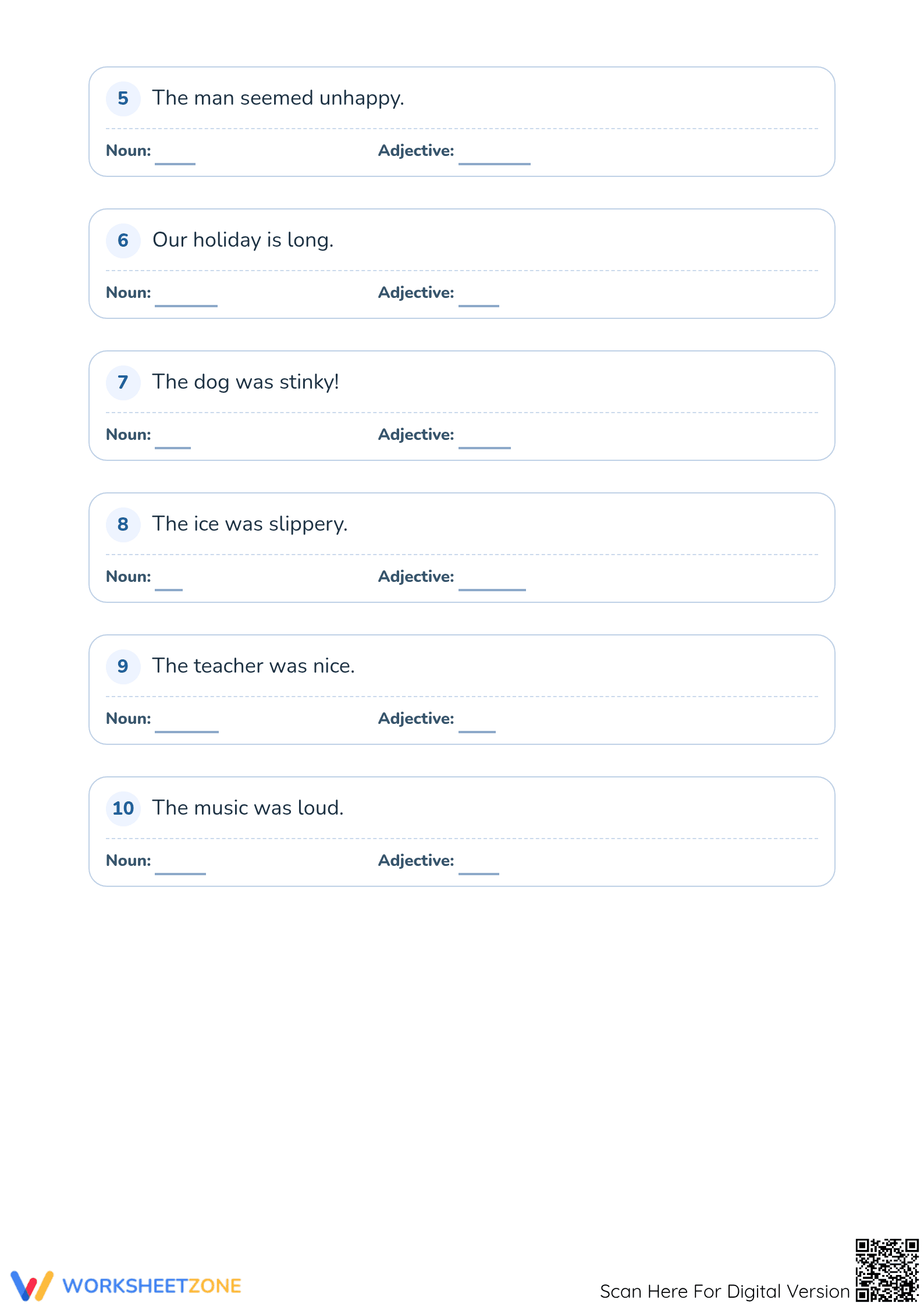
The packet contains a comprehensive three-page layout designed for clarity and engagement. Inside, students find ten structured sentences in Part 1. The layout includes dedicated lines for writing the specific noun and adjective found in each sentence. Part 2 features a word bank sorting activity with eight terms to categorize.
Skill Progression
- Guided practice: The first four items include a helpful hint box and explicit labels for nouns and adjectives to build student confidence.
- Supported practice: Items five through ten remove the visual aids, requiring learners to apply the descriptive rule to full sentences.
- Independent practice: The sorting activity concludes the set by asking students to differentiate between eight nouns and adjectives from a word bank without sentence-level context.
This gradual-release approach ensures a smooth transition from guided recognition to conceptual mastery of adjective placement.
Standards Alignment
This resource aligns with `CCSS.ELA-LITERACY.L.2.1.E`, which requires students to use adjectives and adverbs correctly within sentences. The activities specifically target the identification of modifiers that follow their nouns, a key component of foundational grammar mastery. This standard code can be copied directly into lesson plans, IEP goals, or district curriculum mapping tools.
How to Use It
Assign this worksheet during the independent practice portion of a grammar lesson or as a follow-up activity after direct instruction on adjectives. It also serves as an effective formative assessment tool; observe whether students can distinguish between the subject and its modifier in sentences with "to be" verbs.
Who It's For
This practice set is ideal for second and third-grade students working on foundational grammar skills. It is particularly useful for small-group intervention, literacy centers, or as a zero-prep homework assignment. Pair this worksheet with a descriptive writing prompt or a short passage to see students apply these grammatical concepts in their own creative writing.
According to CCSS.ELA-LITERACY.L.2.1.E, students must develop a sophisticated understanding of how adjectives modify nouns within diverse sentence structures. This printable worksheet targets the specific syntactical challenge of identifying adjectives that follow nouns, often as predicate adjectives. Research from Fisher & Frey (2014) emphasizes the importance of scaffolding grammar instruction through clear identification and categorization tasks. By requiring students to underline the noun and circle the adjective across ten structured sentences, this resource reinforces the relationship between modifiers and their subjects. The secondary sorting activity further solidifies parts-of-speech recognition, moving students from rote identification to conceptual mastery. Providing multiple practice opportunities helps learners internalize descriptive patterns, which is a key predictor of writing fluency and reading comprehension in early elementary years. This comprehensive practice set ensures that second and third graders build the linguistic foundation necessary for complex sentence construction and accurate textual analysis in subsequent academic grades.


