


























Views
Plays

ACE General Knowledge Quiz | Essential College Worksheet
Paste this activity's link or code into your existing LMS (Google Classroom, Canvas, Teams, Schoology, Moodle, etc.).
Students can open and work on the activity right away, with no student login required.
You'll still be able to track student progress and results from your teacher account.
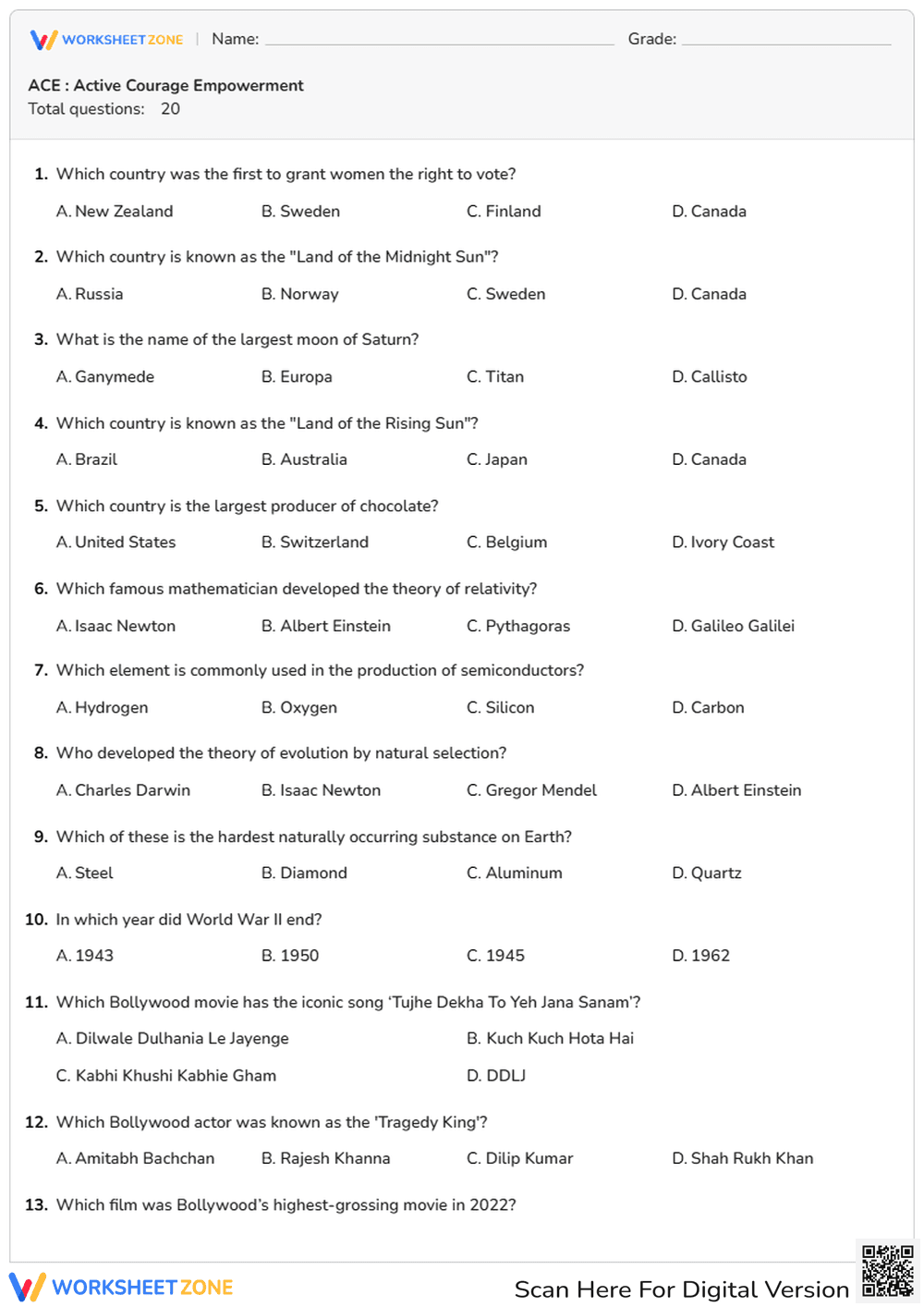
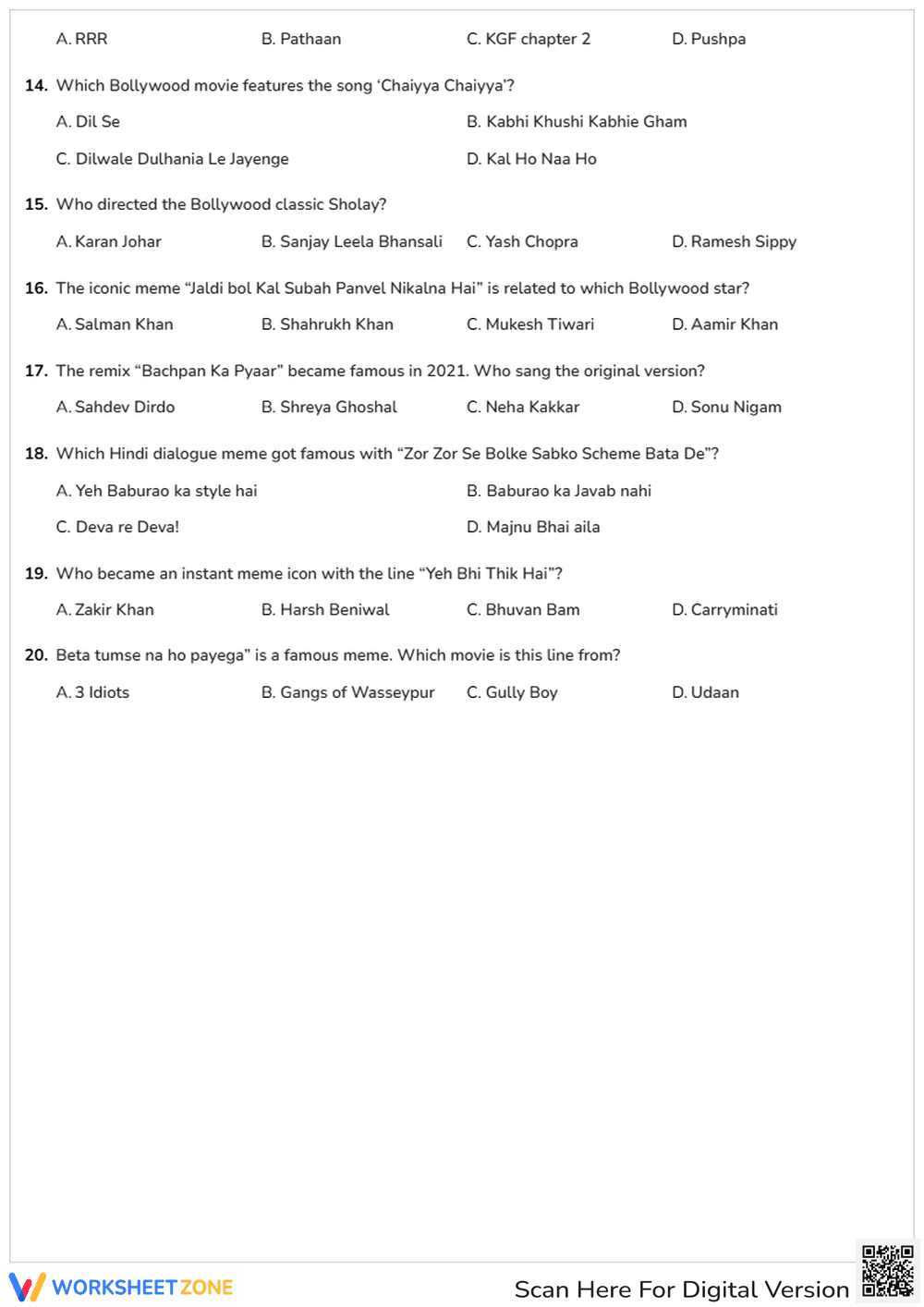
This interdisciplinary general knowledge quiz challenges college students to recall facts across history, science, and global pop culture. By engaging with 20 diverse multiple-choice questions, learners demonstrate broad cultural literacy and the ability to retrieve information from varied domains. It serves as an ideal icebreaker or formative assessment for introductory survey courses.
At a Glance
- Grade: College · Subject: Social Studies & Science
- Standard:
CCSS.ELA-LITERACY.RI.11-12.1— Cite strong and thorough textual evidence to support analysis of what the text says- Skill Focus: Interdisciplinary Fact Retrieval
- Format: 2 pages · 20 problems · Answer key included · PDF
- Best For: Trivia rounds or general knowledge assessment
- Time: 15–20 minutes
The worksheet consists of two pages featuring 20 multiple-choice questions. The first half focuses on traditional academic domains including geography, astronomy, physics, and biology. The second half pivots to contemporary cultural literacy, specifically focusing on Bollywood cinema and internet meme culture. This structure ensures a balanced assessment of both formal education and modern social awareness.
Zero-Prep Workflow:
- Print: Select the two-page PDF and print enough copies for your cohort (30 seconds).
- Distribute: Hand out the quiz as a bell-ringer or competitive round one activity (1 minute).
- Review: Use the included answer key to facilitate a rapid peer-grading session or group discussion (5 minutes).
Total teacher preparation time is under two minutes, making this an excellent option for sub plans or unexpected schedule gaps.
The primary standard is CCSS.ELA-LITERACY.RI.11-12.1, which requires students to demonstrate mastery of informational content and evidence-based recall. While interdisciplinary, it also supports CCSS.ELA-LITERACY.RH.11-12.7 by requiring the integration of knowledge from diverse formats and subjects. Both standard codes can be copied directly into lesson plans, IEP goals, or district curriculum mapping tools.
Assign this quiz during the first week of a semester to gauge the diverse background knowledge of a new student group. It works exceptionally well as a low-stakes formative assessment before starting a unit on global perspectives. Instructors should observe which categories students struggle with most to tailor future cultural literacy discussions. Completion typically takes 15 to 20 minutes.
This resource is designed for college-level students, particularly those in general education, sociology, or media studies courses. It is also suitable for high school seniors preparing for university-level trivia competitions. Pair this worksheet with a digital response system or a lecture on the importance of interdisciplinary connections in the modern age.
Research by Fisher & Frey (2014) emphasizes that broad background knowledge is a significant predictor of reading comprehension and academic success at the post-secondary level. This 20-question assessment aligns with CCSS.ELA-LITERACY.RI.11-12.1 by requiring students to synthesize and retrieve information across multiple domains, including history, science, and global media. By testing both traditional academic facts and contemporary cultural markers like Bollywood and memes, the worksheet acknowledges the multifaceted nature of modern literacy. Such interdisciplinary exercises encourage students to see connections between disparate fields of study, a core competency in college-level social studies. Utilizing this tool provides instructors with a quick, data-driven snapshot of student engagement and prior knowledge, facilitating more targeted instructional strategies. The inclusion of diverse global topics ensures that the assessment remains relevant in an increasingly interconnected academic environment.


