


























Views
Downloads
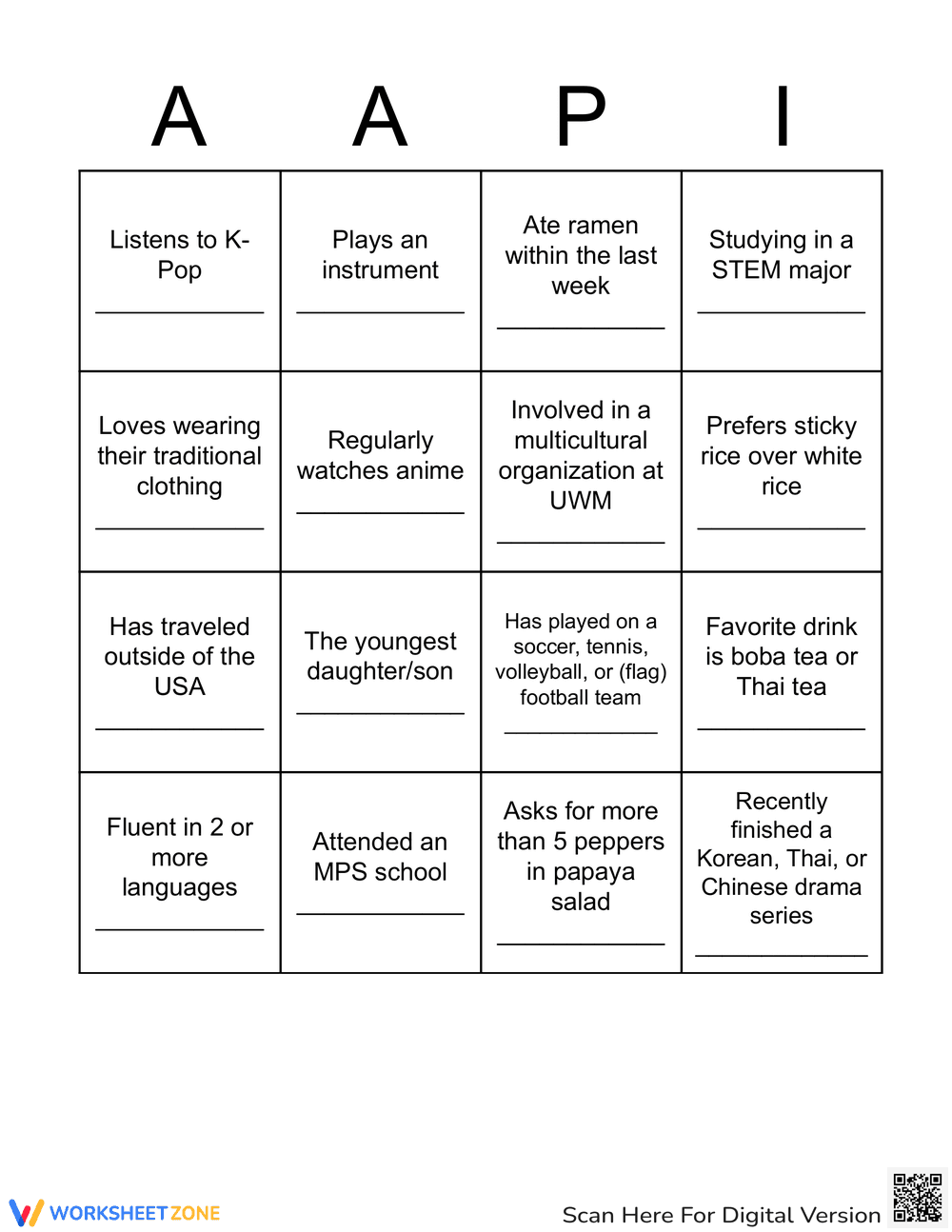


AAPI Heritage Month Bingo | Grade 2 Essential Printable
Paste this activity's link or code into your existing LMS (Google Classroom, Canvas, Teams, Schoology, Moodle, etc.).
Students can open and work on the activity right away, with no student login required.
You'll still be able to track student progress and results from your teacher account.
This Grade 2 AAPI Heritage Month bingo worksheet facilitates meaningful classroom conversations about Asian American and Pacific Islander cultures. Students engage in a collaborative game that highlights diverse traditions, foods, and achievements. It is designed to foster an inclusive environment while building essential speaking and listening skills during seasonal celebrations.
At a Glance
- Grade: 2 · Subject: ELA / Social Studies
- Standard:
CCSS.ELA-LITERACY.SL.2.1— Participate in collaborative conversations with diverse partners about grade 2 topics- Skill Focus: Cultural Awareness & Speaking
- Format: 2 pages · 16 prompts · Call list included · PDF
- Best For: Community building and heritage month celebrations
- Time: 15–20 minutes
The download includes a 16-square interactive bingo card featuring culturally relevant prompts such as traditional clothing, food preferences like boba tea or ramen, and linguistic diversity. A second page provides a structured Call List for the teacher or a student leader, allowing for easy game management. The layout is clean, high-contrast, and ready for immediate printing.
Zero-Prep Workflow
- Print: Generate the required number of bingo cards and the single call list in under 30 seconds.
- Distribute: Hand out the cards and explain the "find someone who" or traditional calling rules in about 1 minute.
- Review: Discuss the cultural items as they are called to spark brief class discussions over 15 minutes.
Total teacher preparation time is under 2 minutes, making it an ideal sub plan or Friday afternoon activity.
This resource aligns with CCSS.ELA-LITERACY.SL.2.1, which requires students to follow agreed-upon rules for discussions and build on others' talk in conversations. By using these bingo cards, students practice active listening and respectful interaction. Both standard codes can be copied directly into lesson plans, IEP goals, or district curriculum mapping tools.
Use this as a "Human Bingo" icebreaker where students move around the room to find classmates who match the descriptions in the squares. Alternatively, use it as a whole-group listening activity during a direct instruction lesson on AAPI history. Formative assessment occurs as you observe students' ability to articulate their own experiences or ask clarifying questions about the cultural prompts. Completion typically takes 15 to 20 minutes.
This worksheet is perfect for general education classrooms in grades 1-3, English Language Learners (ELL) looking to build vocabulary, and social studies groups. It pairs naturally with a read-aloud about AAPI heroes or an anchor chart detailing different Asian and Pacific Islander regions.
According to Fisher & Frey (2014), collaborative classroom activities like educational games are vital for developing oral language proficiency and social-emotional intelligence. This AAPI Heritage Month bingo worksheet utilizes the CCSS.ELA-LITERACY.SL.2.1 standard to create a low-stakes environment for students to practice speaking and listening. By focusing on 16 specific cultural markers, the resource encourages students to recognize and value diversity within their own peer groups. Research from the NAEP suggests that inclusive curriculum materials significantly improve student engagement and sense of belonging. This printable tool provides a structured way to integrate cultural competency into the daily ELA block without requiring extensive teacher research or preparation. It serves as a bridge between social studies content and language arts standards, ensuring that heritage month celebrations remain academically grounded while staying fun and interactive for young learners.


