




























Views
Downloads



Printable A Treat For Alice Worksheet | Grade 1 ELA

Paste this activity's link or code into your existing LMS (Google Classroom, Canvas, Teams, Schoology, Moodle, etc.).
Students can open and work on the activity right away, with no student login required.
You'll still be able to track student progress and results from your teacher account.
This Grade 1 reading comprehension worksheet provides a delightful narrative and structured questions to build foundational literacy skills. Students read a short story about Alice and Mommy, then demonstrate understanding through multiple-choice and true-or-false activities. This resource ensures early readers can identify key details and sequence events accurately in a literary text.
At a Glance
- Grade: 1 · Subject: English Language Arts
- Standard:
CCSS.ELA-LITERACY.RL.1.1— Ask and answer questions about key details in a text- Skill Focus: Literal Comprehension & Detail Identification
- Format: 3 pages · 7 problems · Answer key included · PDF
- Best For: Independent practice or literacy centers
- Time: 15–20 minutes
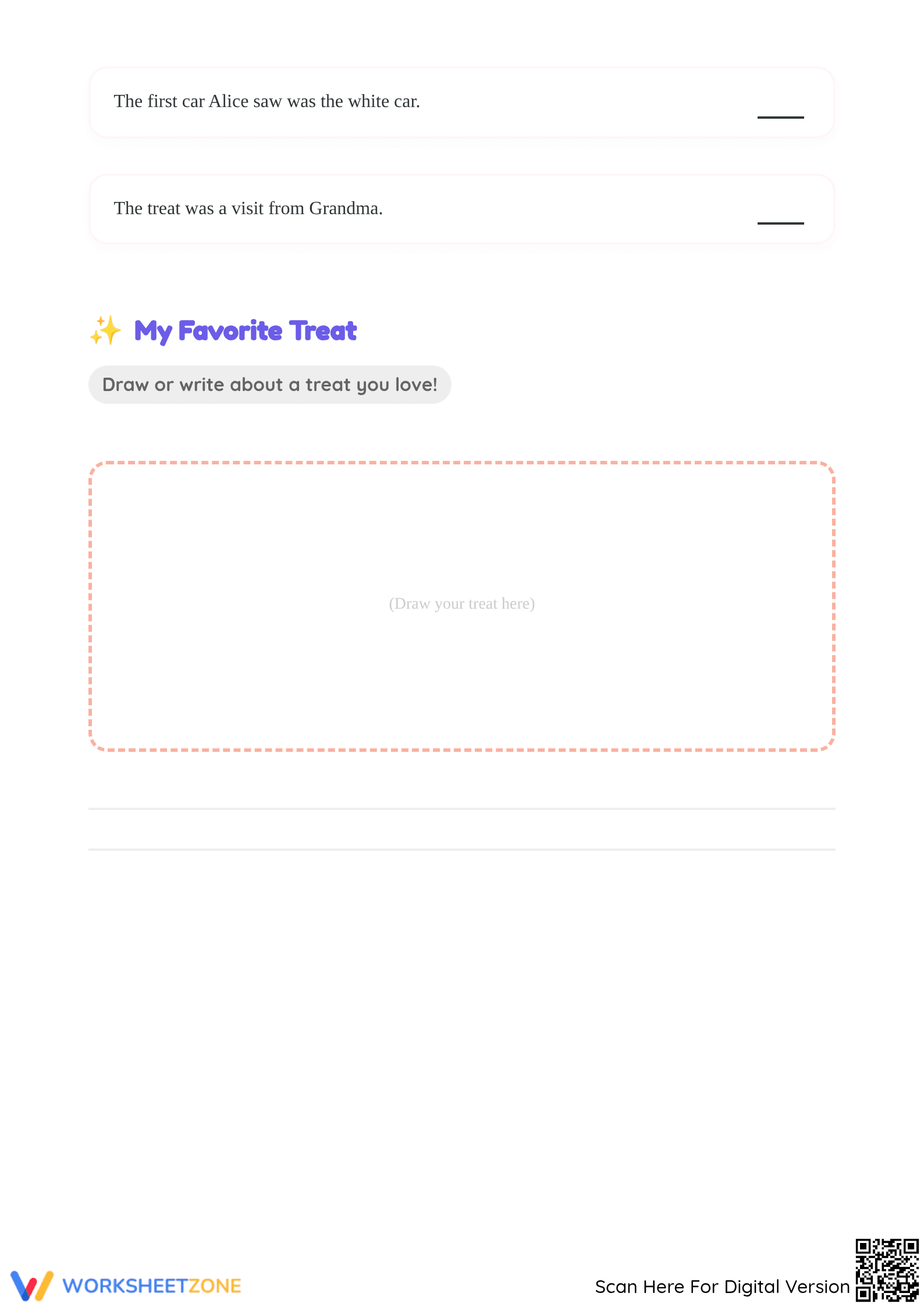
The packet includes a single-page illustrated story, "A Treat for Alice," followed by two pages of assessment and extension. The second page features three "Comprehension Check" multiple-choice questions focusing on setting and plot details, plus a "True or False?" section with three statements. The final page concludes with a creative "My Favorite Treat" prompt, allowing students to draw or write about their own experiences.
Zero-Prep Workflow
Teachers can implement this resource in three simple steps. First, print the three-page PDF (approx. 10 seconds). Next, distribute the packets to students for independent reading and response (approx. 1 minute). Finally, use the provided answer key to review responses or have students self-correct during a whole-group wrap-up (approx. 1 minute). Total teacher preparation time is under two minutes, making it an ideal choice for sub plans or emergency literacy blocks.
Standards Alignment
The primary focus of this worksheet is `CCSS.ELA-LITERACY.RL.1.1`, which requires students to ask and answer questions about key details in a text. By requiring students to identify characters like Alice and Mommy and plot points like the car's color, the tasks directly measure this standard's core competencies. This standard code can be copied directly into lesson plans, IEP goals, or district curriculum mapping tools.
How to Use It
Use this worksheet during the "You Do" phase of a gradual release model. After modeling how to look back in a text for evidence, assign this packet to verify student mastery. A useful formative-assessment observation tip is to watch if students physically flip back to the first page to confirm the color of Mommy's car; this indicates they are using text-based evidence rather than guessing.
Who It's For
This resource is designed for first-grade students or second-grade students needing additional support with literal comprehension. It serves as an excellent pairing resource for a direct instruction lesson on narrative structure or a themed unit on family and surprises. The inclusion of a drawing prompt provides a necessary entry point for students still developing their writing stamina.
Academic research from NAEP emphasizes that structured practice in literal comprehension is the bedrock of later inferential thinking. This "A Treat for Alice" worksheet targets CCSS.ELA-LITERACY.RL.1.1 by forcing young readers to isolate specific nouns and adjectives within a narrative context. Fisher & Frey (2014) highlights that the gradual release of responsibility, supported by scaffolds like the multiple-choice questions found here, improves retention of story elements. By engaging with 7 distinct tasks, students move from passive reading to active interrogation of the text, identifying characters and settings accurately. This resource provides the necessary repetition to move these skills from guided practice to independent mastery, ensuring that Grade 1 students meet district benchmarks for reading fluency and comprehension.


