


























Views
Downloads

ABC Behavior Log Worksheet | Essential Tracking Tool
Paste this activity's link or code into your existing LMS (Google Classroom, Canvas, Teams, Schoology, Moodle, etc.).
Students can open and work on the activity right away, with no student login required.
You'll still be able to track student progress and results from your teacher account.
Identify the root causes of challenging actions with this structured behavior tracking tool. This worksheet provides a clear framework for documenting the Antecedent, Behavior, and Consequence (ABC) of specific incidents, allowing educators and parents to move beyond surface-level observations. By recording precise data, users can pinpoint environmental triggers and develop targeted interventions that foster positive student outcomes.
At a Glance
- Grade: K–12 · Subject: Behavior Activities
- Standard:
CCSS.ELA-LITERACY.W.2.8— Recall information from experiences to document and answer questions about specific events.- Skill Focus: Behavior Pattern Analysis
- Format: 1 page · 8 observation rows · No-prep PDF
- Best For: Functional Behavior Assessment (FBA) data collection
- Time: 5–10 minutes per entry
What's Inside
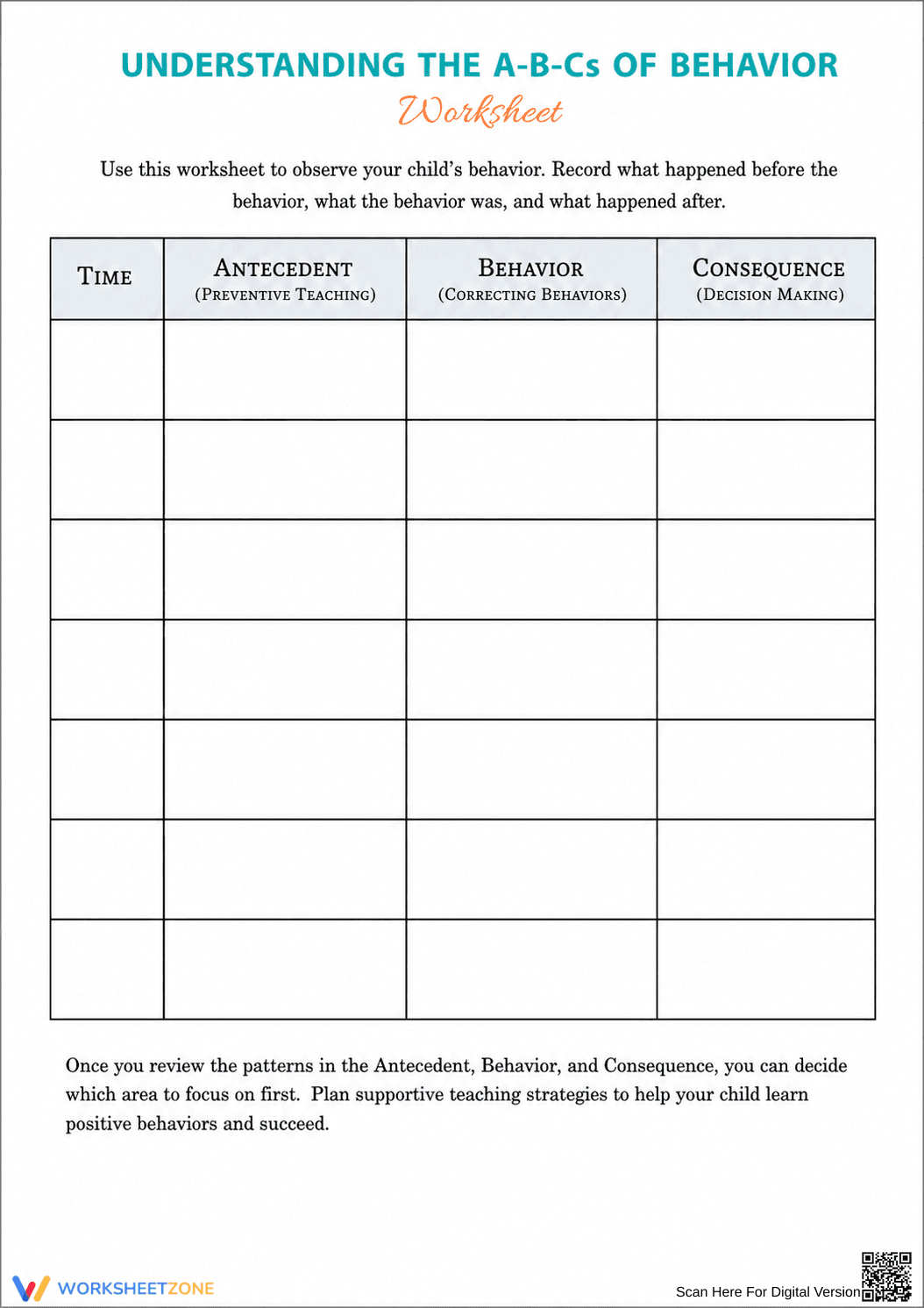
This single-page PDF features a clean, professional layout designed for high-speed data entry in busy environments. The core of the worksheet is an 8-row observation table with four critical columns: Time, Antecedent (Preventive Teaching), Behavior (Correcting Behaviors), and Consequence (Decision Making). The header includes concise instructions to ensure consistency across different observers, making it an ideal tool for collaborative teams.
Zero-Prep Workflow
- Print (1 Minute): Generate enough copies for a week of observations or keep a master copy in a clipboard for immediate access during transitions.
- Distribute (30 Seconds): Hand the log to para-professionals, substitute teachers, or parents to ensure 360-degree monitoring of the student's day.
- Review (5 Minutes): At the end of the day, scan the 8 rows to identify recurring antecedents, such as specific times of day or academic subjects that trigger frustration.
Standards Alignment
This resource aligns with `CCSS.ELA-LITERACY.W.2.8`, which requires individuals to recall information from experiences or gather information from provided sources to answer a question. In a behavioral context, this involves documenting objective facts about an environment to answer why a specific behavior is occurring. Both standard codes can be copied directly into lesson plans, IEP goals, or district curriculum mapping tools.
How to Use It
Use this log as a formative assessment tool during the "during instruction" phase to capture real-time data without interrupting the flow of the lesson. For effective results, observe the student for a 30-minute window and record every instance of the target behavior. A key formative tip is to look for "non-events"—times when the antecedent occurred but the behavior did not—to identify existing student strengths and successful coping mechanisms.
Who It's For
This worksheet is designed for special education teachers, school psychologists, and general education teachers managing inclusive classrooms. It serves as an excellent primary resource when paired with a student's Individualized Education Program (IEP) or a Functional Behavior Assessment (FBA) report. It is also highly effective for parents seeking to align home behavior strategies with school expectations.
According to research by Fisher & Frey (2014), the systematic collection of objective data is the cornerstone of effective scaffolding and behavioral intervention. This ABC behavior log facilitates that process by providing a standardized format for recording the sequence of events that maintain challenging behaviors. By utilizing the 8-row tracking system, educators can move from anecdotal evidence to data-driven decision-making, which is shown to improve the efficacy of Tier 2 and Tier 3 interventions. The clear distinction between the antecedent and the consequence helps in identifying whether a behavior is maintained by escape, attention, or sensory input. This alignment with evidence-based practices ensures that the resulting behavior intervention plans are grounded in observable facts rather than subjective impressions. Using this tool consistently allows for the longitudinal tracking of progress, making it an indispensable asset for any professional focused on social-emotional learning and classroom management.


