


























Views
Downloads

Essential Potential vs. Kinetic Energy Worksheet | Grade 7
Paste this activity's link or code into your existing LMS (Google Classroom, Canvas, Teams, Schoology, Moodle, etc.).
Students can open and work on the activity right away, with no student login required.
You'll still be able to track student progress and results from your teacher account.
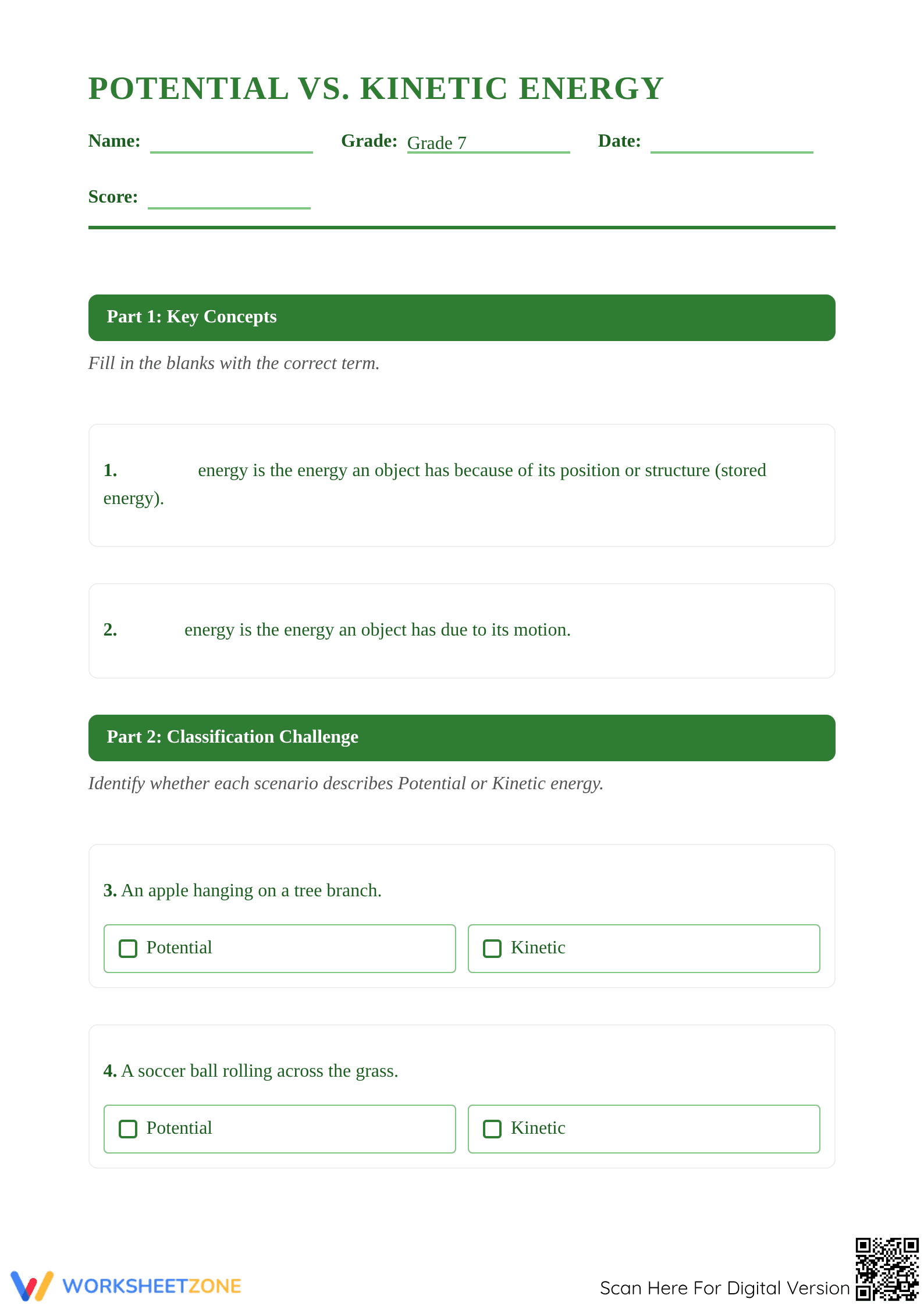
This Grade 7 science worksheet helps students master the fundamental differences between potential and kinetic energy. Through a series of structured classification and sorting tasks, learners develop a concrete understanding of stored energy versus energy in motion. By the end of the activity, students will be able to predict energy states in real-world scenarios.
At a Glance
- Grade: 7 · Subject: Science
- Standard:
MS-PS3-2— Model how potential energy is stored and released in a system- Skill Focus: Potential vs. Kinetic Energy transformation
- Format: 3 pages · 16 problems · Answer key included · PDF
- Best For: Physical science unit introduction or review
- Time: 25–35 minutes
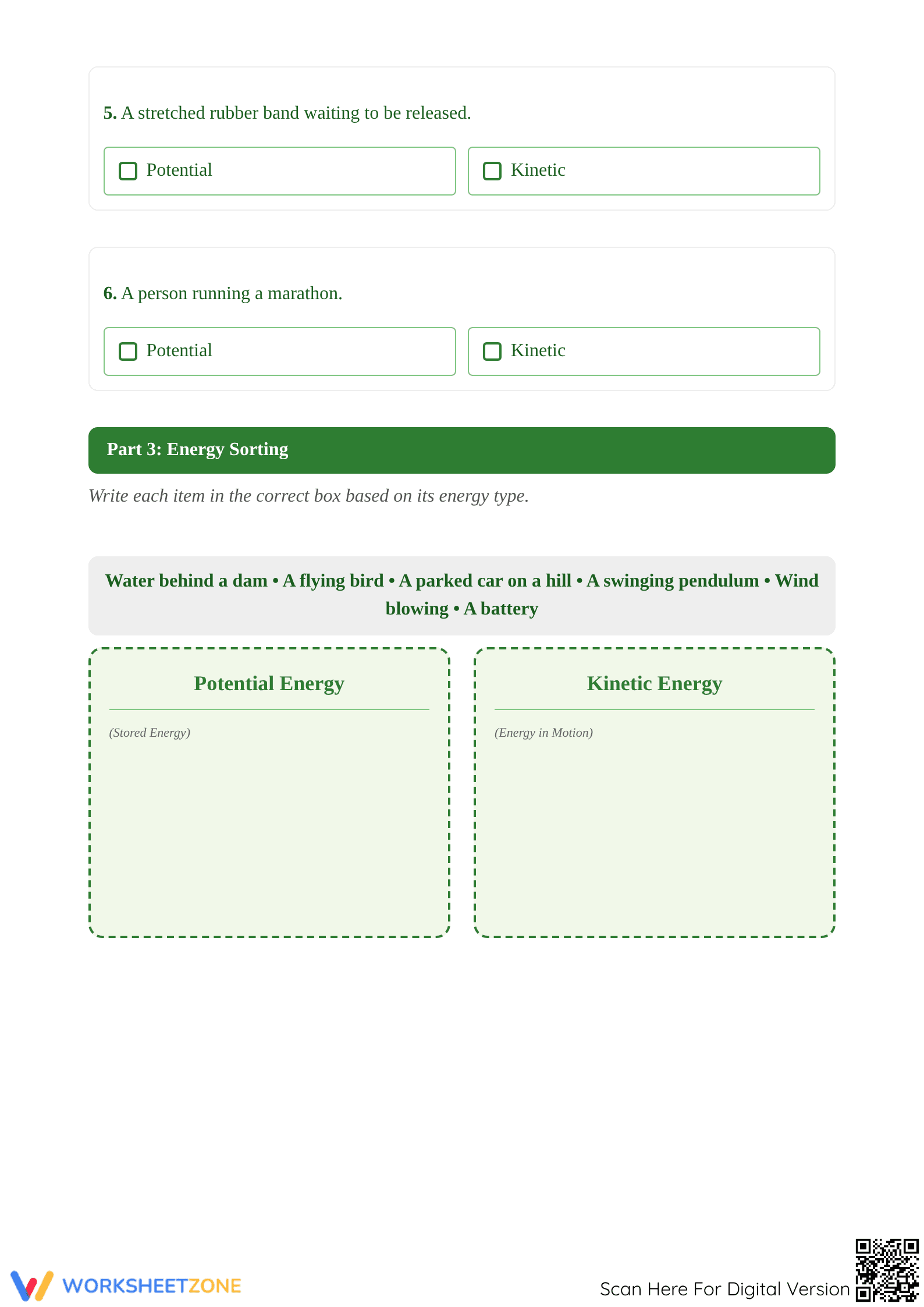
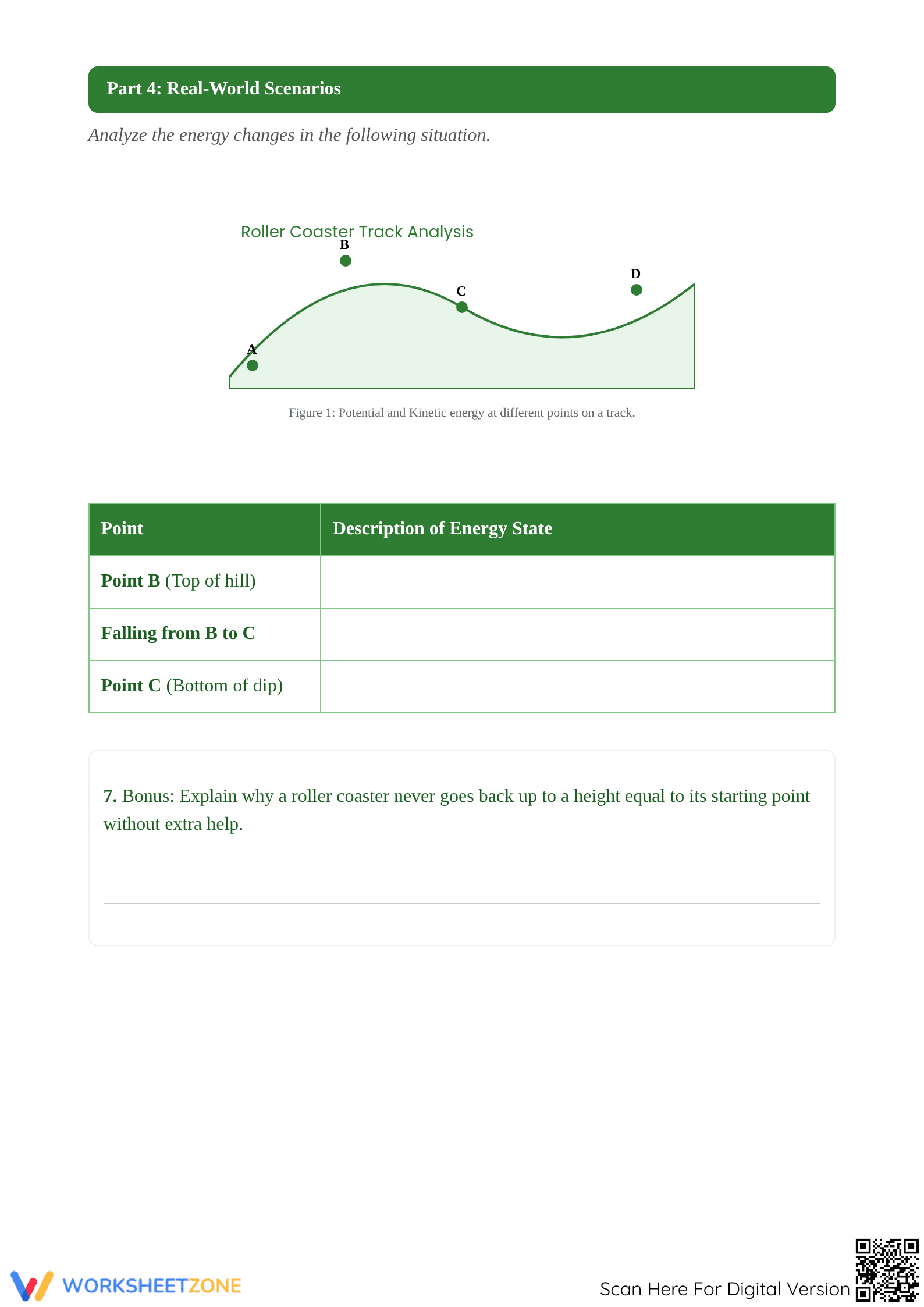
What's Inside: This 3-page comprehensive workbook features four distinct parts designed to build mastery. It includes definition-based fill-in-the-blanks, a classification challenge with 4 specific scenarios, an energy sorting matrix for 6 different objects, and a detailed roller coaster track analysis. A bonus higher-order thinking question addresses the Law of Conservation of Energy. Full answer keys are provided for quick grading.
Skill Progression
- Guided Practice: The activity begins with terminology-focused fill-in-the-blanks to establish a baseline of scientific vocabulary regarding stored energy and motion.
- Supported Practice: Students transition to identifying energy types in isolated scenarios, such as a rolling soccer ball or a stretched rubber band, utilizing visual check-boxes.
- Independent Practice: Learners apply their knowledge to a complex system using a roller coaster track model to track energy transformations at multiple points.
This sequence follows a gradual-release model to ensure students internalize the concepts before tackling complex real-world diagrams.
Standards Alignment
Primary standard MS-PS3-2: "Develop a model to describe that when the arrangement of objects interacting at a distance changes, different amounts of potential energy are stored in the system." The worksheet also provides foundational support for MS-PS3-5 regarding energy transfer within a system. Both standard codes can be copied directly into lesson plans, IEP goals, or district curriculum mapping tools.
How to Use It
Use this resource as a mid-unit formative assessment to check for common misconceptions before moving into quantitative energy calculations. During direct instruction, project the roller coaster diagram on page three for a collaborative "Think-Pair-Share" activity. It also serves as a high-quality substitute lesson plan for seventh-grade science. Expected completion time for the full 16-task set is 30 minutes.
Who It's For
Designed specifically for middle school science classrooms, this worksheet is ideal for Grade 7 learners. The visual sorting boxes and diagram-based analysis provide excellent scaffolding for students requiring concrete representations of abstract physical science concepts. It pairs naturally with an anchor chart on energy types or a hands-on lab involving pendulums and ramps.
This science resource targets the MS-PS3-2 standard, focusing on the plain-English skill of modeling how potential energy is stored and transformed into kinetic energy. According to the RAND AIRS 2024 report, scaffolded practice that moves from definition to complex system analysis significantly improves long-term retention of physical science concepts in middle school learners. By utilizing 16 varied tasks—including sorting and real-world diagram analysis—this worksheet ensures students engage with the material at multiple Depth of Knowledge levels. The inclusion of an answer key and a bonus extension question aligns with evidence-based instructional design principles found in ScienceDirect TpT Analysis, which emphasizes the value of immediate feedback and differentiation in secondary education. This resource provides a robust foundation for more advanced physics topics in high school while remaining accessible for 7th-grade students.


