




























Views
Downloads

MS-ESS3-3 Aligned Worksheet: Environment & Pollution

Paste this activity's link or code into your existing LMS (Google Classroom, Canvas, Teams, Schoology, Moodle, etc.).
Students can open and work on the activity right away, with no student login required.
You'll still be able to track student progress and results from your teacher account.
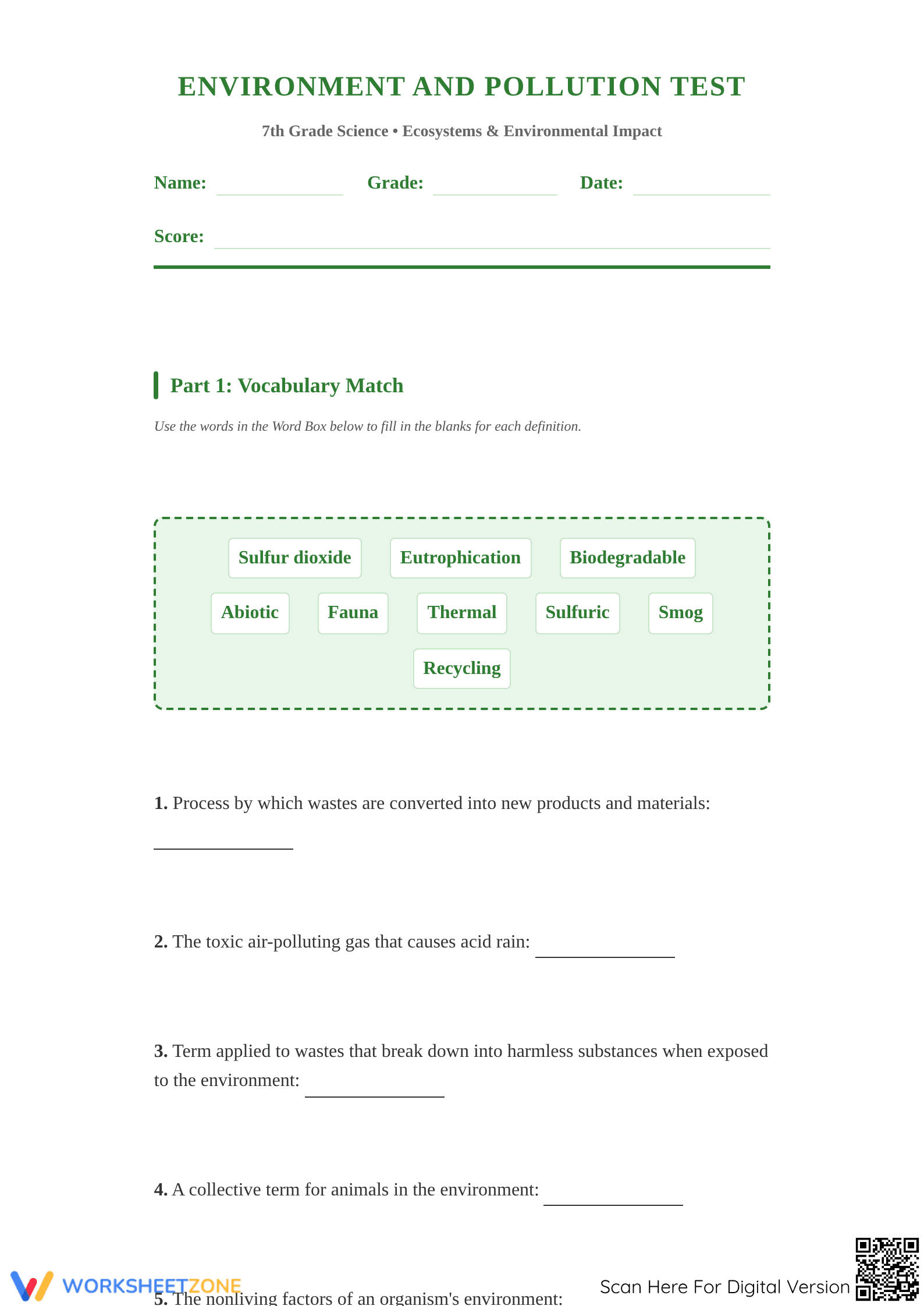
This Grade 7 science worksheet assesses student understanding of human impact on ecosystems through a comprehensive environment and pollution test. Students identify key pollutants, analyze the effects of eutrophication, and evaluate conservation strategies. By connecting specific vocabulary to real-world scenarios, learners demonstrate mastery of complex environmental interactions and the consequences of human-induced changes.
At a Glance
- Grade: 7 · Subject: Science
- Standard:
MS-ESS3-3— Apply scientific principles to monitor and minimize human impact on the environment- Skill Focus: Pollution types and ecosystem conservation
- Format: 3 pages · 15 problems · Answer key included · PDF
- Best For: Unit summative assessment or intensive review
- Time: 40–50 minutes
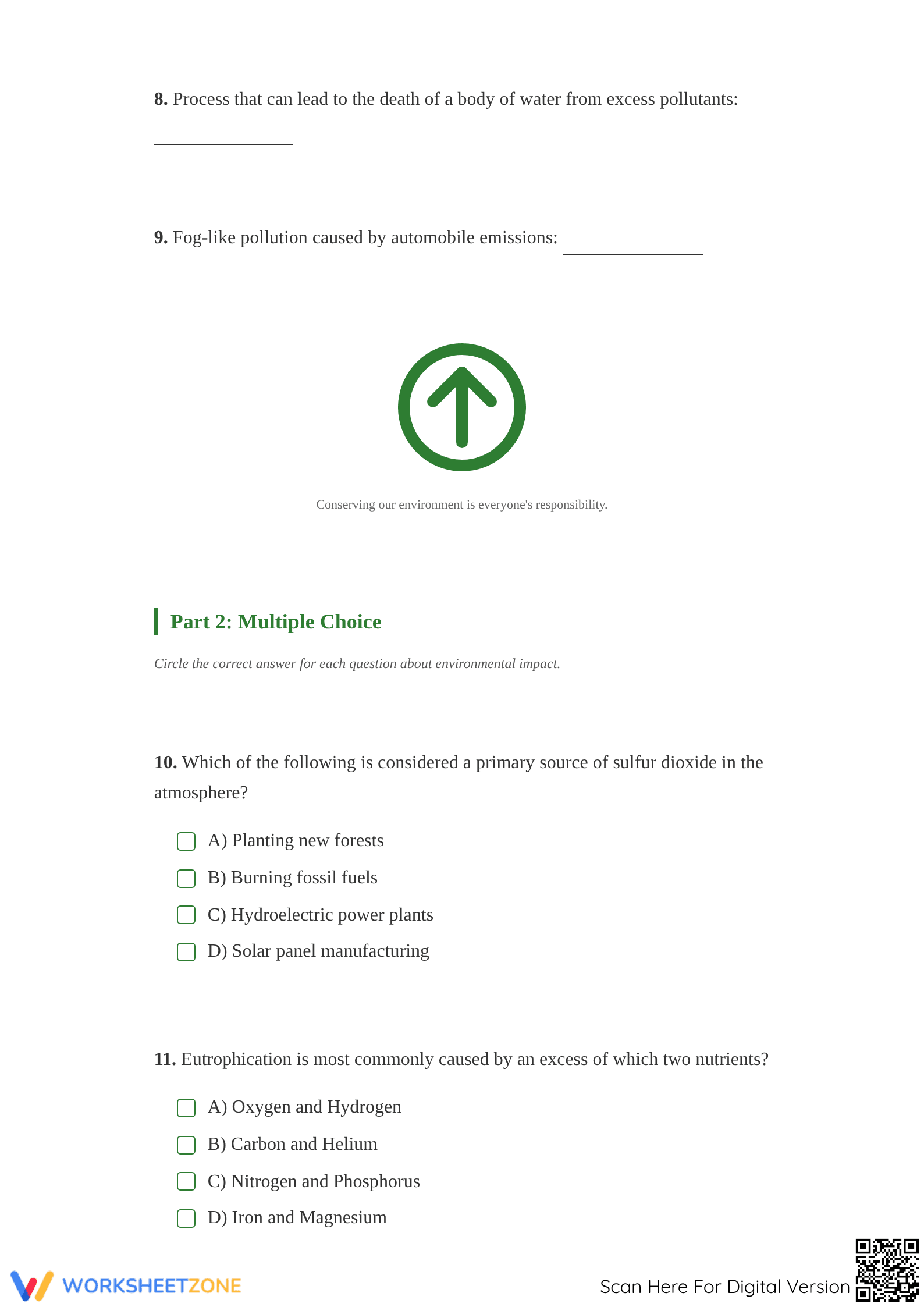
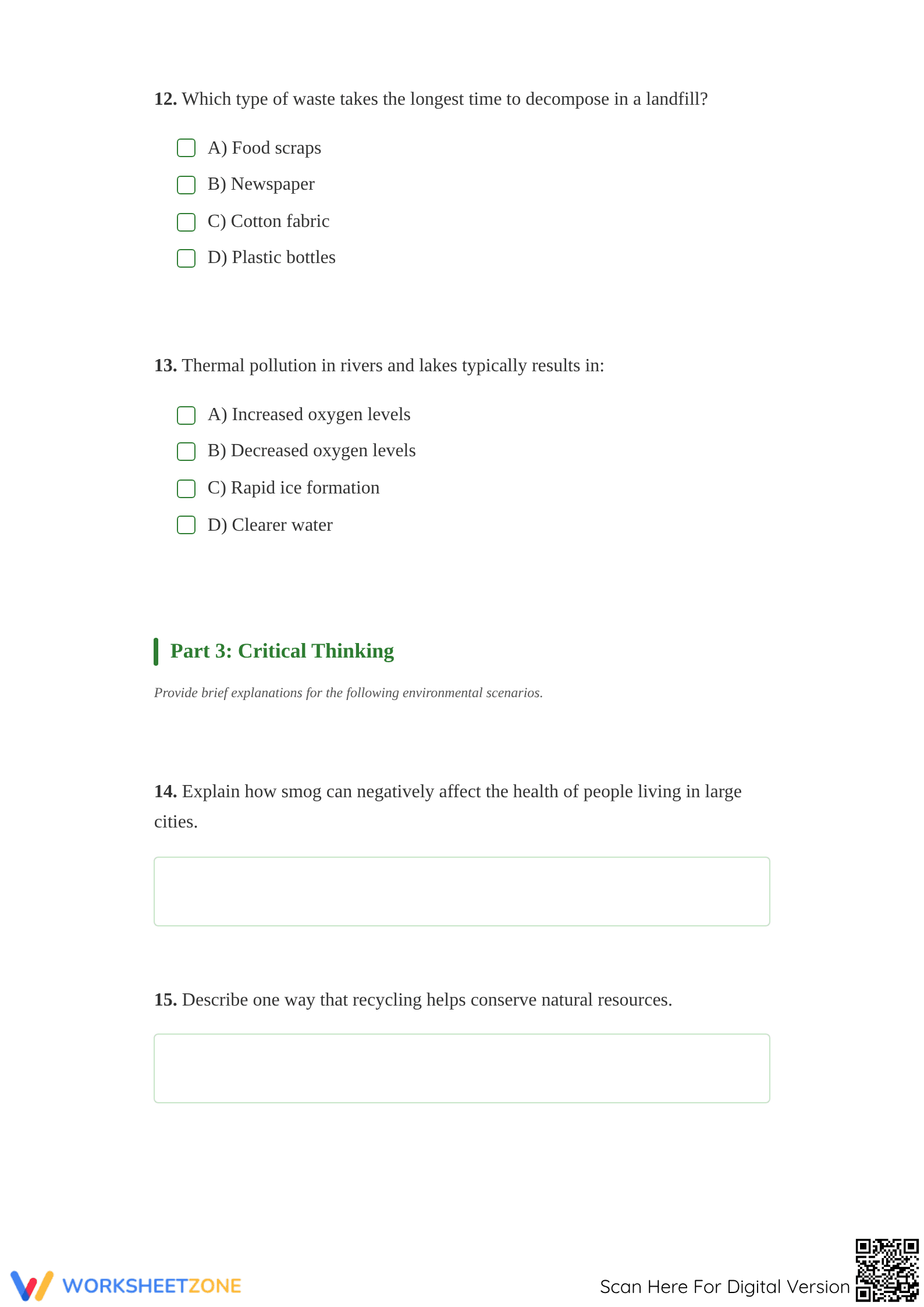
The three-page document features a multi-modal assessment structure designed to probe different depths of knowledge. It includes a nine-item vocabulary matching section using a dedicated word box, four data-driven multiple-choice questions focusing on atmospheric and aquatic pollution, and two critical thinking prompts requiring written explanations. A complete answer key is provided for efficient grading and immediate feedback.
Mastery Evidence
Assessment tasks are tiered to provide clear evidence of student proficiency levels. The vocabulary matching section confirms basic literacy in environmental terminology (Approaching), while the multiple-choice items require application of concepts to specific pollution sources like fossil fuels (Meeting). Finally, the critical thinking responses allow students to synthesize information about urban smog and resource conservation to demonstrate higher-order analysis (Exceeding).
Standards Alignment
This resource is centered on `MS-ESS3-3`, requiring students to understand how human activities affect the Earth's systems. By identifying pollutants like sulfur dioxide and processes like eutrophication, students build the foundational knowledge necessary to design mitigation strategies. This standard code can be copied directly into lesson plans, IEP goals, or district curriculum mapping tools.
How to Use It
Deploy this worksheet as a summative unit test after completing direct instruction on human impacts and biodiversity. For formative use, assign the vocabulary and multiple-choice sections mid-unit to observe if students can distinguish between different pollution vectors. Expect a completion time of 45 minutes, allowing for deep reflection during the final critical thinking portion.
Who It's For
This assessment is tailored for middle school science students exploring environmental science or ecology. It provides structured support for general education learners while offering the conceptual depth needed for advanced tracks. It pairs naturally with a multimedia presentation on the carbon cycle or an anchor chart detailing the effects of acid rain.
The integration of standardized assessment formats with open-ended critical thinking prompts aligns with the evidence-based practices identified in recent educational research. According to the ScienceDirect TpT Analysis (2024), middle school science resources that combine specialized vocabulary acquisition with scenario-based analysis significantly improve long-term retention of NGSS-aligned concepts. This worksheet specifically addresses the MS-ESS3-3 standard by forcing students to articulate the relationship between specific human actions, such as automobile emissions, and their subsequent environmental effects like smog formation. By requiring written explanations for conservation methods, the resource supports the development of scientific literacy and the ability to communicate complex system interactions. This structured approach ensures that students are not merely memorizing terms but are instead building a robust mental model of how human-induced pollution alters ecosystem services and atmospheric stability across varying geographic scales.


