




























Views
Downloads

Pygmy Hippo Reading Worksheet | Grade 7 Essential

Paste this activity's link or code into your existing LMS (Google Classroom, Canvas, Teams, Schoology, Moodle, etc.).
Students can open and work on the activity right away, with no student login required.
You'll still be able to track student progress and results from your teacher account.
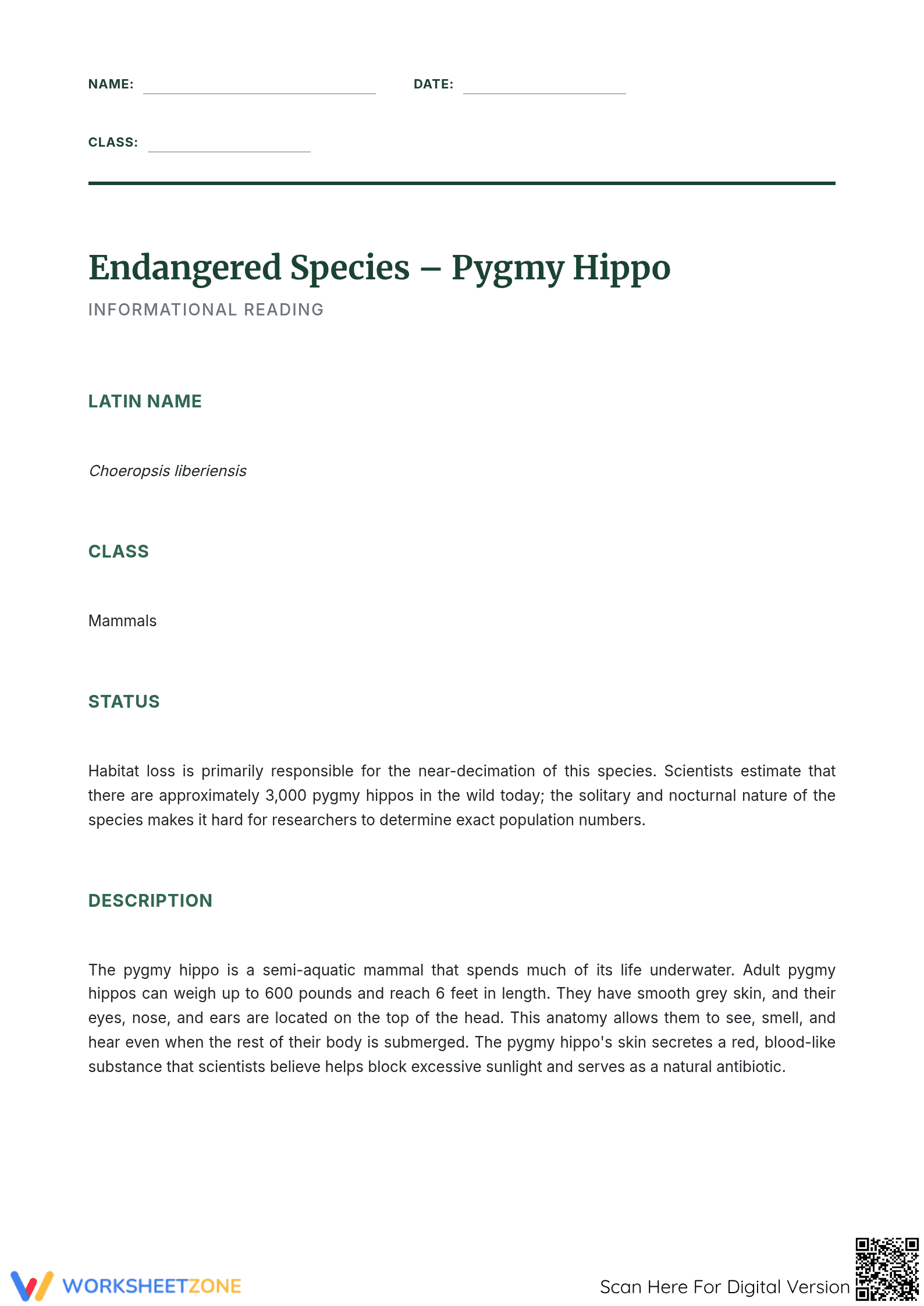
This Grade 7 informational reading worksheet focuses on the Pygmy Hippo, an endangered species. Students engage with a detailed text covering habitat, diet, and physical characteristics to build critical literacy skills. By analyzing specific details, learners improve their ability to extract information and synthesize facts from non-fiction sources effectively.
At a Glance
- Grade: 7 · Subject: English
- Standard:
CCSS.ELA-LITERACY.RI.7.1— Cite several pieces of textual evidence to support analysis of informational texts- Skill Focus: Informational Reading Comprehension
- Format: 3 pages · 4 problems · Answer key included · PDF
- Best For: Independent reading practice or science integration
- Time: 20–30 minutes
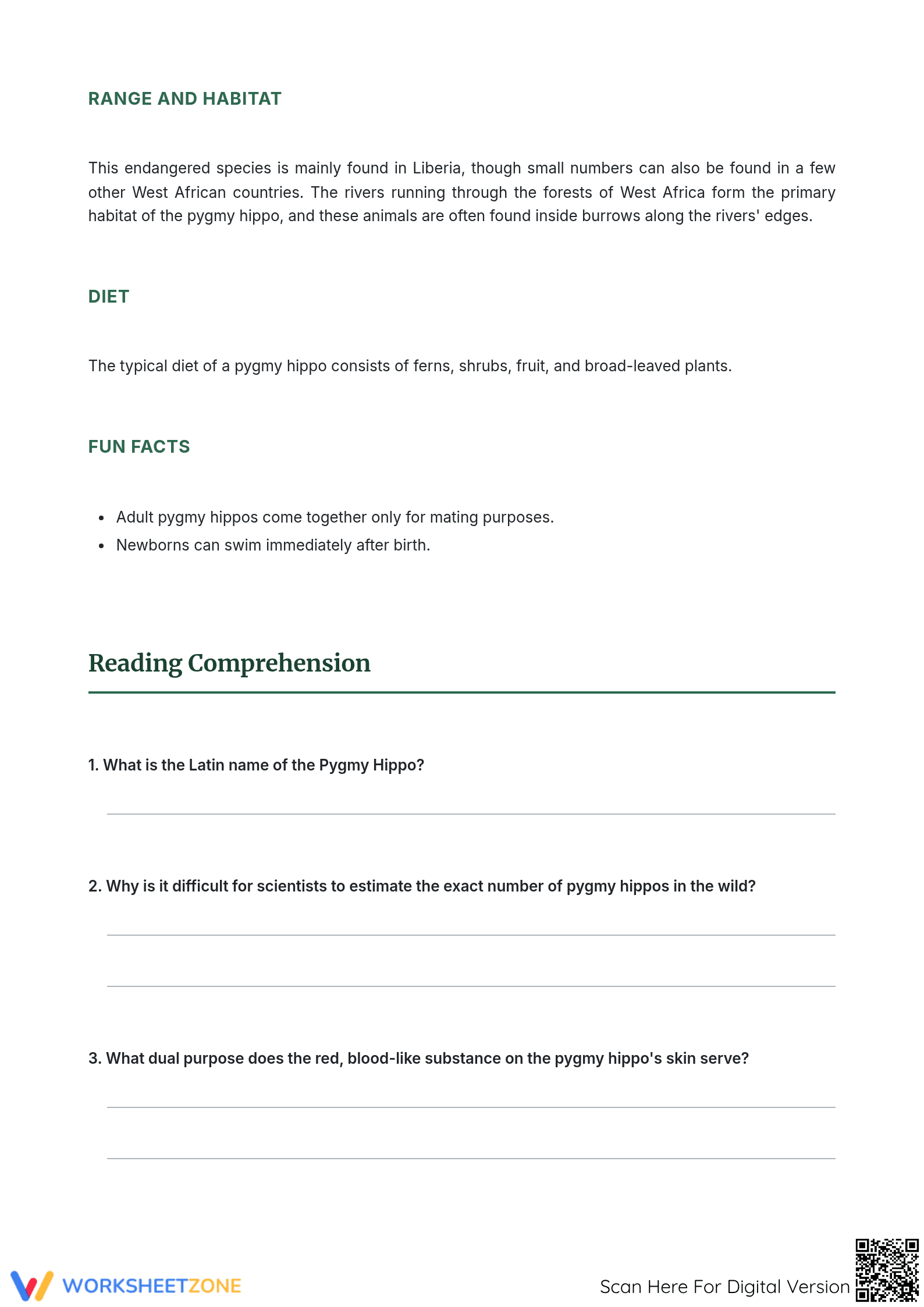
The resource contains a comprehensive three-page layout. The first two pages provide a structured informational text divided into clear subheadings like "Status" and "Range and Habitat." The third page features four open-ended comprehension questions requiring written responses. A complete three-page answer key is included for immediate feedback and grading.
Skill Progression
- Guided practice: Students first scan the bolded subheadings and Latin terminology to orient themselves within the scientific text.
- Supported practice: Learners read the "Description" and "Diet" sections, identifying 3-5 key facts about the hippo's unique physiology and environmental needs.
- Independent practice: Students answer 4 complex questions that require them to synthesize information across different sections of the text without prompts.
This sequence follows a gradual-release model, moving from basic identification to evidence-based analysis.
Standards Alignment
The primary focus is `CCSS.ELA-LITERACY.RI.7.1`, which requires students to cite several pieces of textual evidence to support analysis of what the text says explicitly as well as inferences drawn from the text. Additionally, it supports RI.7.2 by encouraging students to determine central ideas. Both standard codes can be copied directly into lesson plans, IEP goals, or district curriculum mapping tools.
How to Use It
Assign this during the "You Do" phase of a lesson on informational text structures. It works well as a formative assessment to check if students can locate specific details within a multi-page document. Expect students to spend 25 minutes reading and responding. Observe if they flip back to the text to verify their answers.
Who It's For
This is designed for seventh-grade students but is suitable for sixth-grade enrichment or eighth-grade review. It pairs naturally with a science unit on biodiversity or an ELA unit on conservation-themed non-fiction passages.
This Grade 7 informational reading resource is built to address CCSS.ELA-LITERACY.RI.7.1, focusing on the student's ability to cite textual evidence regarding the Pygmy Hippo. According to Fisher & Frey (2014), the use of complex informational texts with specific subheadings helps middle schoolers develop the close reading habits necessary for high school readiness. By requiring students to answer four open-ended questions based on a 500-word passage, the worksheet reinforces the cognitive shift from simple recall to evidence-based synthesis. Research from the NAEP indicates that students who regularly engage with diverse non-fiction topics, such as endangered species, show higher proficiency in cross-curricular literacy. This worksheet provides the necessary structure for students to practice these skills independently while offering teachers a reliable answer key for quick assessment. The standard code CCSS.ELA-LITERACY.RI.7.1 is central to the design, ensuring that every task maps directly to grade-level expectations for informational text analysis.


