


























Views
Downloads

Printable Okapi Reading Worksheet | Grade 7 ELA
Paste this activity's link or code into your existing LMS (Google Classroom, Canvas, Teams, Schoology, Moodle, etc.).
Students can open and work on the activity right away, with no student login required.
You'll still be able to track student progress and results from your teacher account.
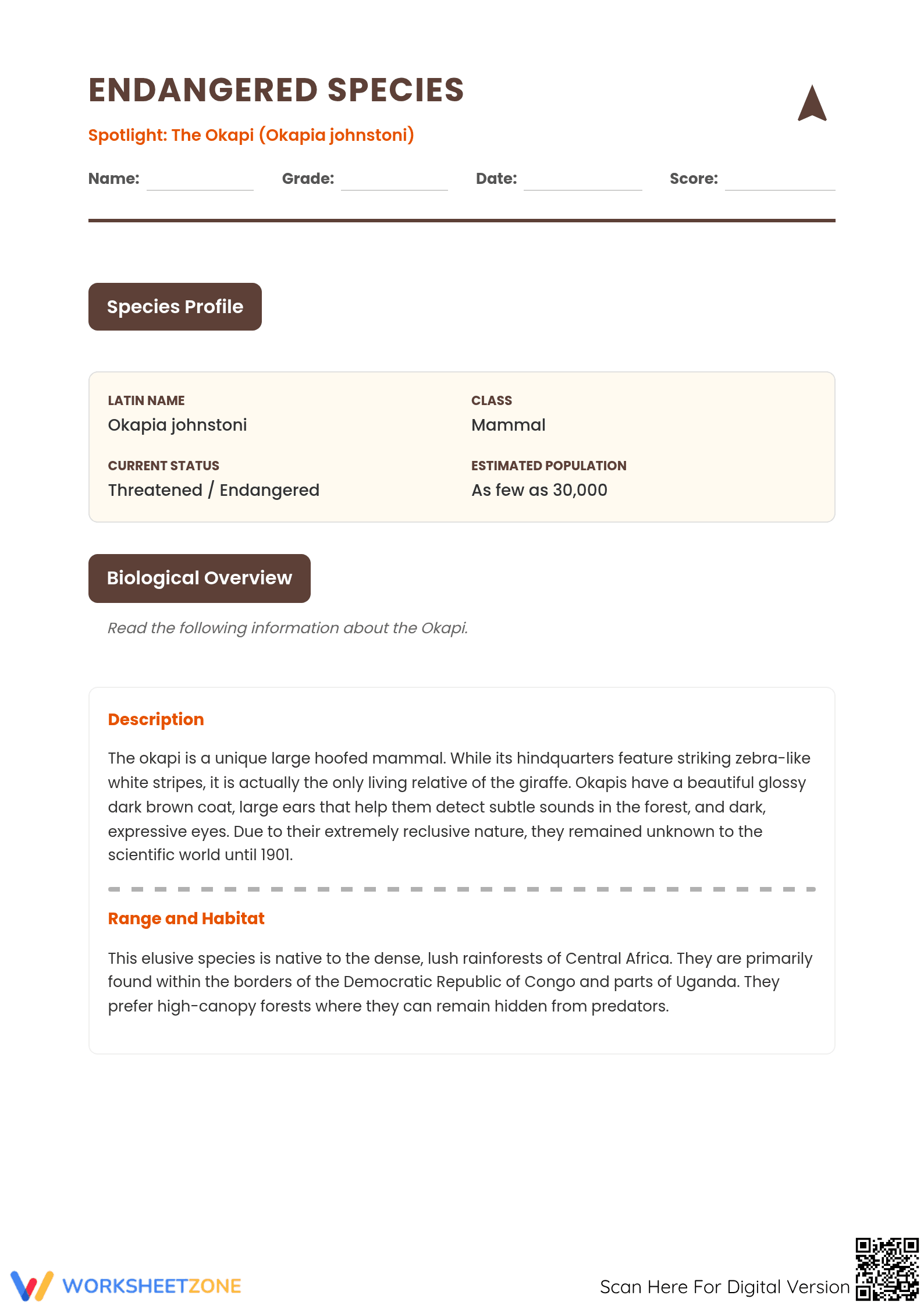
This Grade 7 informational text worksheet guides students through a deep investigation into the biology and conservation status of the okapi. By analyzing the provided species profile and habitat data, learners develop the ability to extract specific evidence from text to support scientific claims. It is an essential resource for building literacy within the science curriculum.
At a Glance
- Grade: 7 · Subject: ELA
- Standard:
RI.7.1— Cite several pieces of textual evidence to support analysis of informational text- Skill Focus: Informational Text Analysis
- Format: 3 pages · 6 problems · Answer key included · PDF
- Best For: Reading comprehension and scientific literacy practice
- Time: 25–35 minutes
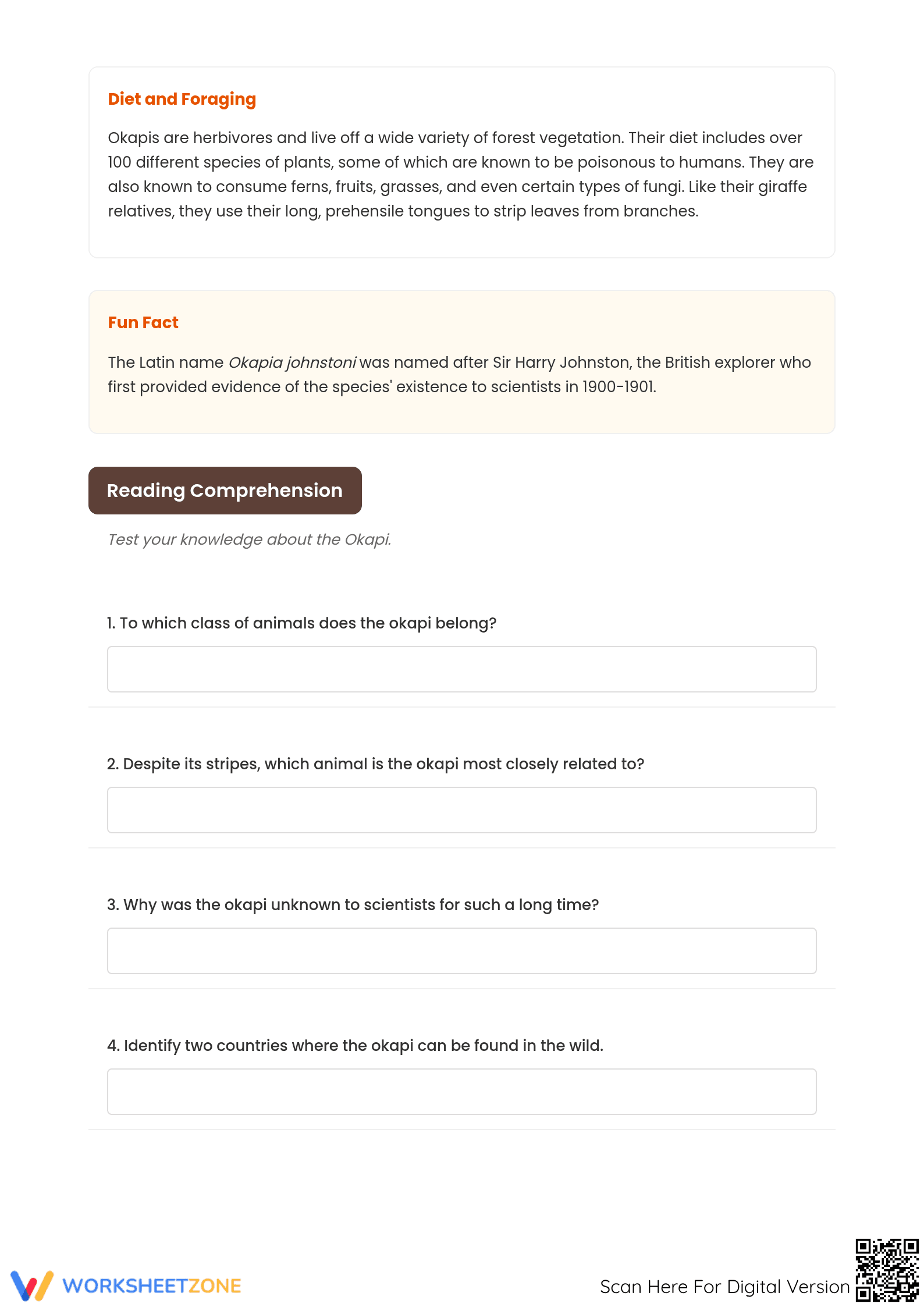
The packet contains three comprehensive pages focused on the okapi. The first two pages provide a rich informational text covering the animal's Latin name, reclusive nature, and Central African habitat. The final section consists of six targeted reading comprehension questions that require students to summarize key facts and perform critical analysis of physical adaptations. A complete answer key ensures easy grading.
Skill Progression
- Guided Practice: Students begin by identifying literal facts from the text, such as animal classification and geographic range, across four structured tasks.
- Supported Practice: Learners transition to explaining complex details, including diet-related anomalies and the historical timeline of the species' discovery by scientists.
- Independent Analysis: The worksheet concludes with a higher-order thinking task where students must analyze how specific physical features like ears and tongues facilitate survival.
This approach follows the gradual release of responsibility model to ensure students move from basic recall to meaningful scientific analysis.
Standards Alignment
This resource is primarily aligned with `CCSS.ELA-LITERACY.RI.7.1`, which requires students to cite several pieces of textual evidence to support analysis of what the text says explicitly. It also supports `CCSS.ELA-LITERACY.RI.7.2` through the identification of central ideas regarding endangered species. Both standard codes can be copied directly into lesson plans, IEP goals, or district curriculum mapping tools.
How to Use It
This worksheet is best utilized during the practice phase of a lesson on informational text structures or as a standalone science literacy activity. Teachers should encourage students to underline the specific sentence in the text that answers each comprehension question as a formative check. Expect most seventh graders to complete the reading and analysis within 25 to 35 minutes.
Who It's For
It is designed for middle school students practicing close reading of non-fiction. The clear headings and "Species Profile" box provide excellent scaffolding for English Language Learners and students with IEPs. It pairs naturally with a geography lesson on the Congo Basin or an introductory lecture on mammalian taxonomy and evolutionary biology.
Research by Fisher & Frey (2014) emphasizes that close reading of complex informational texts is fundamental to developing college and career readiness. This worksheet facilitates that process by focusing on `RI.7.1`, requiring students to bridge the gap between simple decoding and high-level evidence-based analysis. By engaging with specialized scientific content regarding the okapi, students build the domain-specific vocabulary necessary for academic success across disciplines. The structured format, featuring a distinct species profile followed by tiered questioning, aligns with best practices for instructional scaffolding in the middle grades. According to NAEP frameworks, the ability to synthesize informational details into a coherent understanding of biological systems is a critical benchmark for seventh-grade proficiency. This printable tool provides the repetition and focus required to move students toward mastery of informational text analysis while exploring real-world conservation challenges.


