


























Views
Downloads



Essential Komodo Dragon Worksheet | Grade 7 Science & ELA
Paste this activity's link or code into your existing LMS (Google Classroom, Canvas, Teams, Schoology, Moodle, etc.).
Students can open and work on the activity right away, with no student login required.
You'll still be able to track student progress and results from your teacher account.
This worksheet provides a comprehensive look at the endangered Komodo dragon, blending biological facts with rigorous reading comprehension. Students analyze informational text about the world's largest lizard to extract key details and apply critical thinking skills. It is an ideal resource for connecting life science topics with middle school literacy standards and student outcomes.
At a Glance
- Grade: 7 · Subject: Science / ELA
- Standard:
CCSS.ELA-LITERACY.RI.7.1— Cite several pieces of textual evidence to support analysis of what the text says explicitly- Skill Focus: Informational Text Analysis
- Format: 3 pages · 6 problems · Answer key included · PDF
- Best For: Independent reading or cross-curricular science blocks
- Time: 25–35 minutes
What's Inside
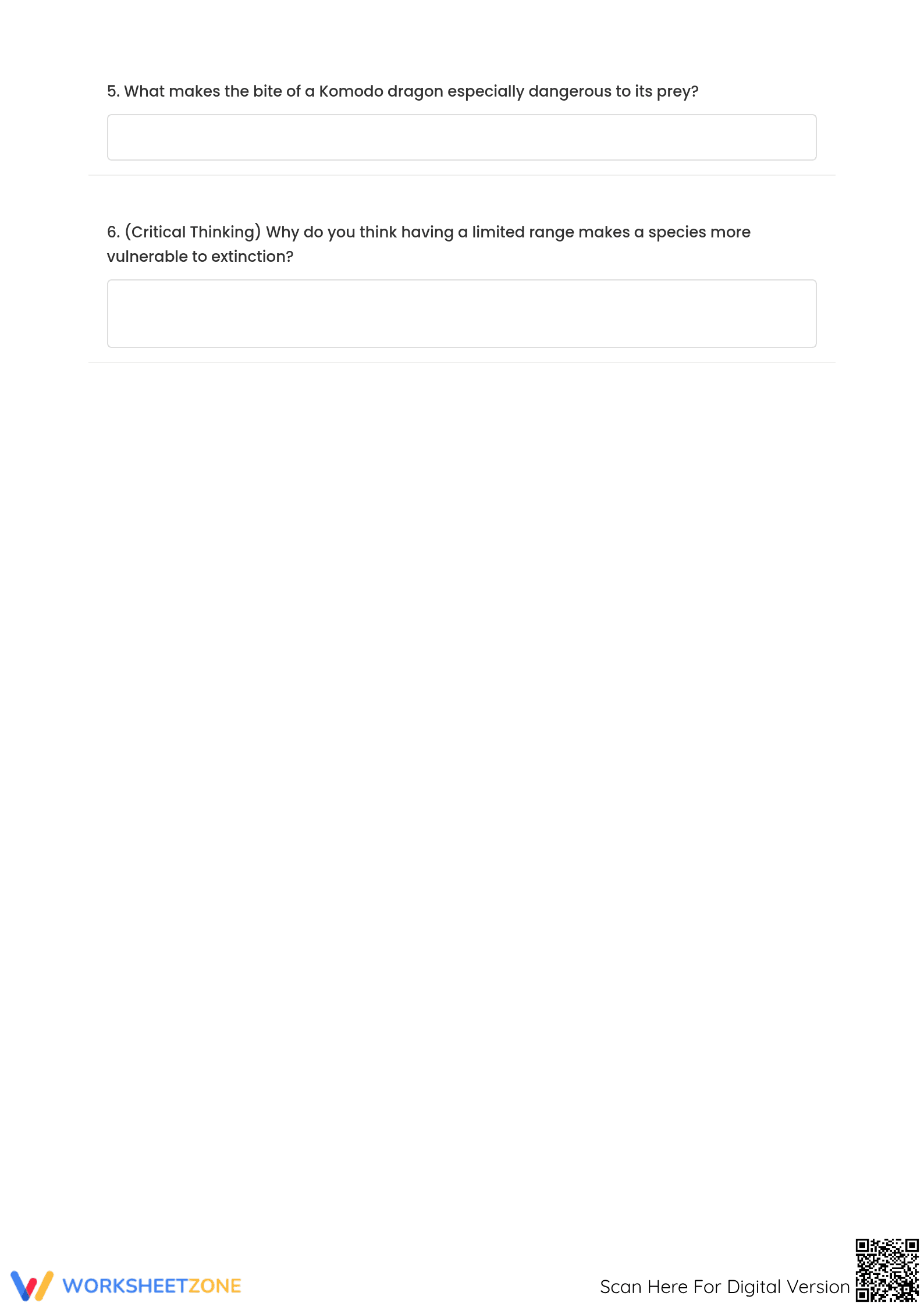
This resource consists of three pages designed for clarity and student engagement. The first page features a detailed species profile including Latin names, population estimates, and habitat descriptions. Subsequent pages provide sections on diet, behavior, and a specific fact about toxic saliva, followed by six targeted comprehension questions, including a critical thinking prompt. A full answer key is included for grading.
Skill Progression
The worksheet follows a logical instructional flow. It begins with guided observation where students identify explicit facts like Latin names and population stats. Next, it moves to supported analysis as students explain complex biological interactions like scent detection and hunting styles. Finally, students engage in independent synthesis by answering a critical thinking question regarding range limitations and extinction vulnerability, mirroring the gradual release of responsibility model.
Standards Alignment
The primary focus is `CCSS.ELA-LITERACY.RI.7.1`, which requires students to cite several pieces of textual evidence to support an analysis of what the text says explicitly as well as inferences drawn from the text. Additionally, the content supports science standards by examining how specific traits and behaviors influence survival. Both standard codes can be copied directly into lesson plans, IEP goals, or district curriculum mapping tools.
How to Use It
Use this during a direct instruction unit on endangered species or as a standalone literacy block activity. For formative assessment, observe students during question four; their ability to accurately describe the Indonesian habitat indicates mastery of detail extraction. This activity typically takes 30 minutes and serves as an excellent bridge between reading and science curriculum through focused text analysis.
Who It's For
This resource is tailored for seventh-grade students but is accessible for sixth graders needing a challenge or eighth graders requiring review. It provides natural differentiation through clear subheadings and bolded vocabulary. Pair this with a video of Komodo dragons in their natural habitat or an anchor chart on reptilian adaptations to deepen the learning experience for all students in the classroom.
According to the NAEP framework for reading, middle school students must be proficient in identifying the organizational structures of informational texts and using evidence to support claims. This Grade 7 Endangered Species worksheet explicitly targets these competencies by requiring students to navigate a multi-section species profile on the Komodo dragon and synthesize data from diverse biological categories. Research conducted by Fisher & Frey (2014) emphasizes the importance of close reading in the content areas, noting that students who engage with complex informational texts like this one demonstrate higher retention of scientific concepts and improved technical vocabulary. By addressing standard CCSS.ELA-LITERACY.RI.7.1, this worksheet ensures that students are not merely skimming but are instead performing the deep cognitive work required for college and career readiness. The inclusion of a critical thinking task further aligns with evidence-based practices for improving higher-order literacy skills in the science classroom.


