


























Views
Downloads

Printable 6th Grade Science Review & Comprehensive Quiz
Paste this activity's link or code into your existing LMS (Google Classroom, Canvas, Teams, Schoology, Moodle, etc.).
Students can open and work on the activity right away, with no student login required.
You'll still be able to track student progress and results from your teacher account.
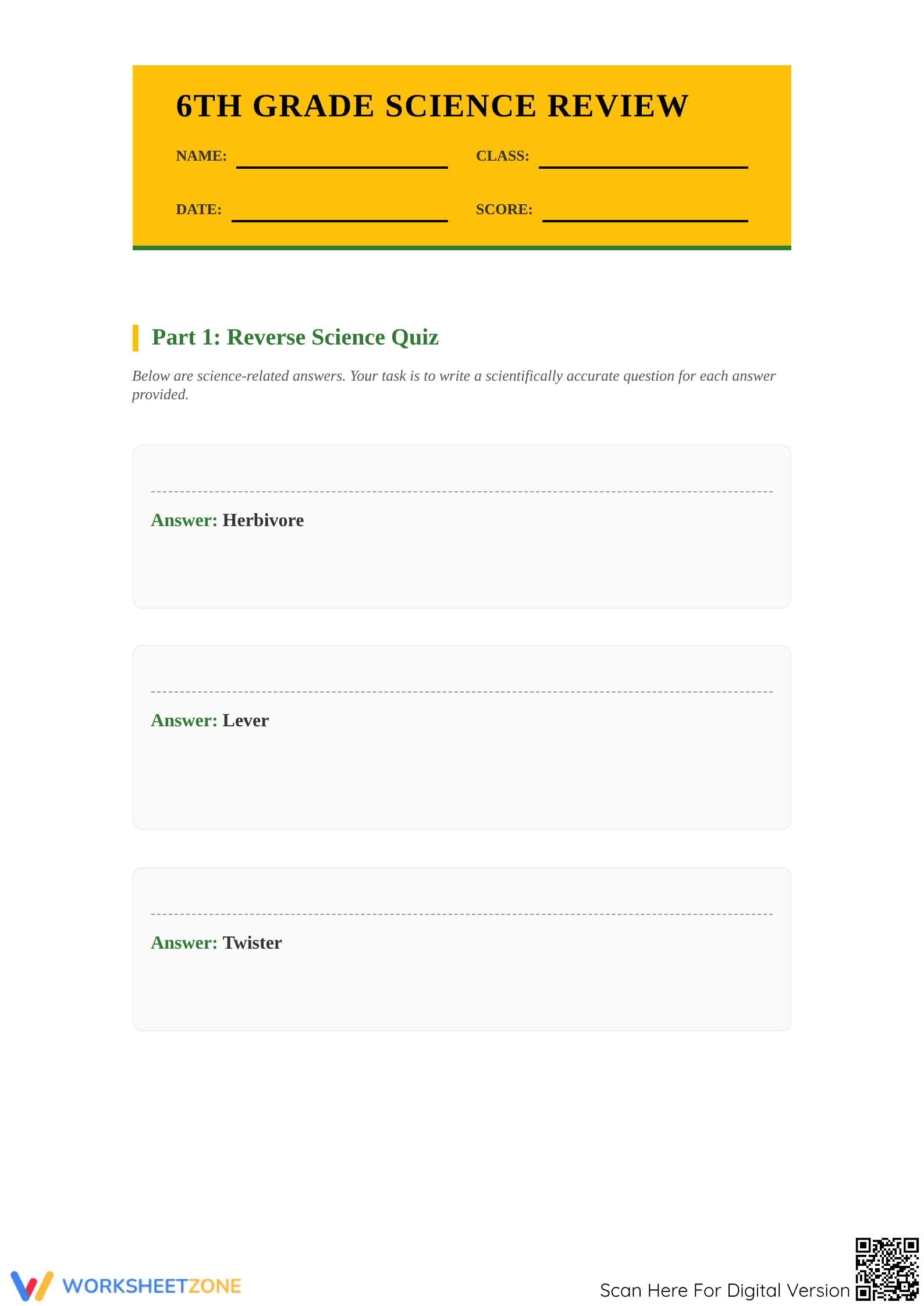
This comprehensive 6th Grade Science Review worksheet empowers students to master core scientific concepts through structured practice. By integrating physical science, biology, and earth science, students develop a holistic understanding of how various natural systems interact. The varied task formats ensure that learners remain engaged while building the critical thinking skills required for academic success.
At a Glance
- Grade: 6 · Subject: Science
- Standard:
MS-PS2-2— Evaluate forces and motion including simple machines and friction- Skill Focus: Comprehensive Science Review
- Format: 5 pages · 17 problems · Answer key included · PDF
- Best For: Cumulative end-of-unit assessment or sub plans
- Time: 45–60 minutes
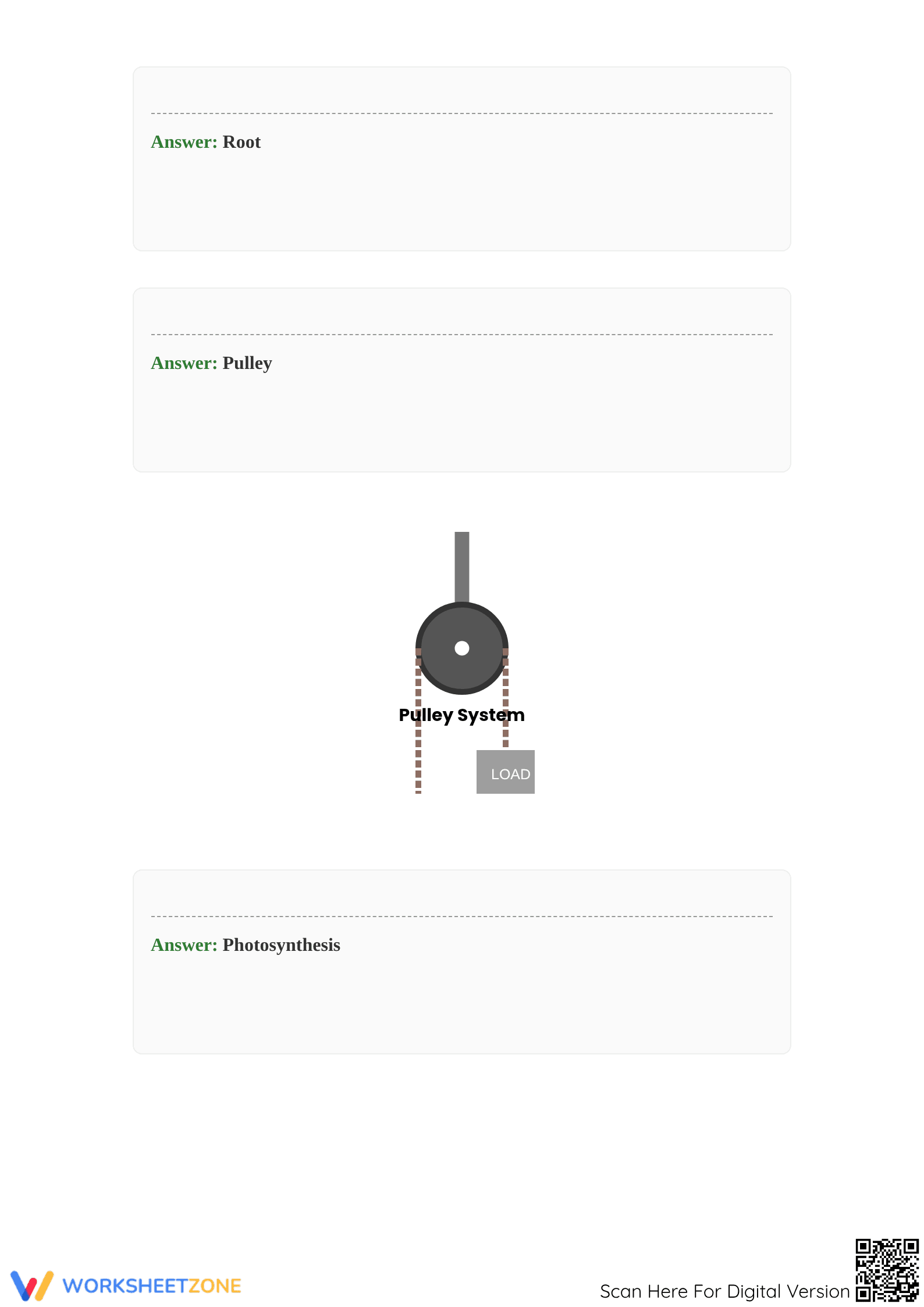
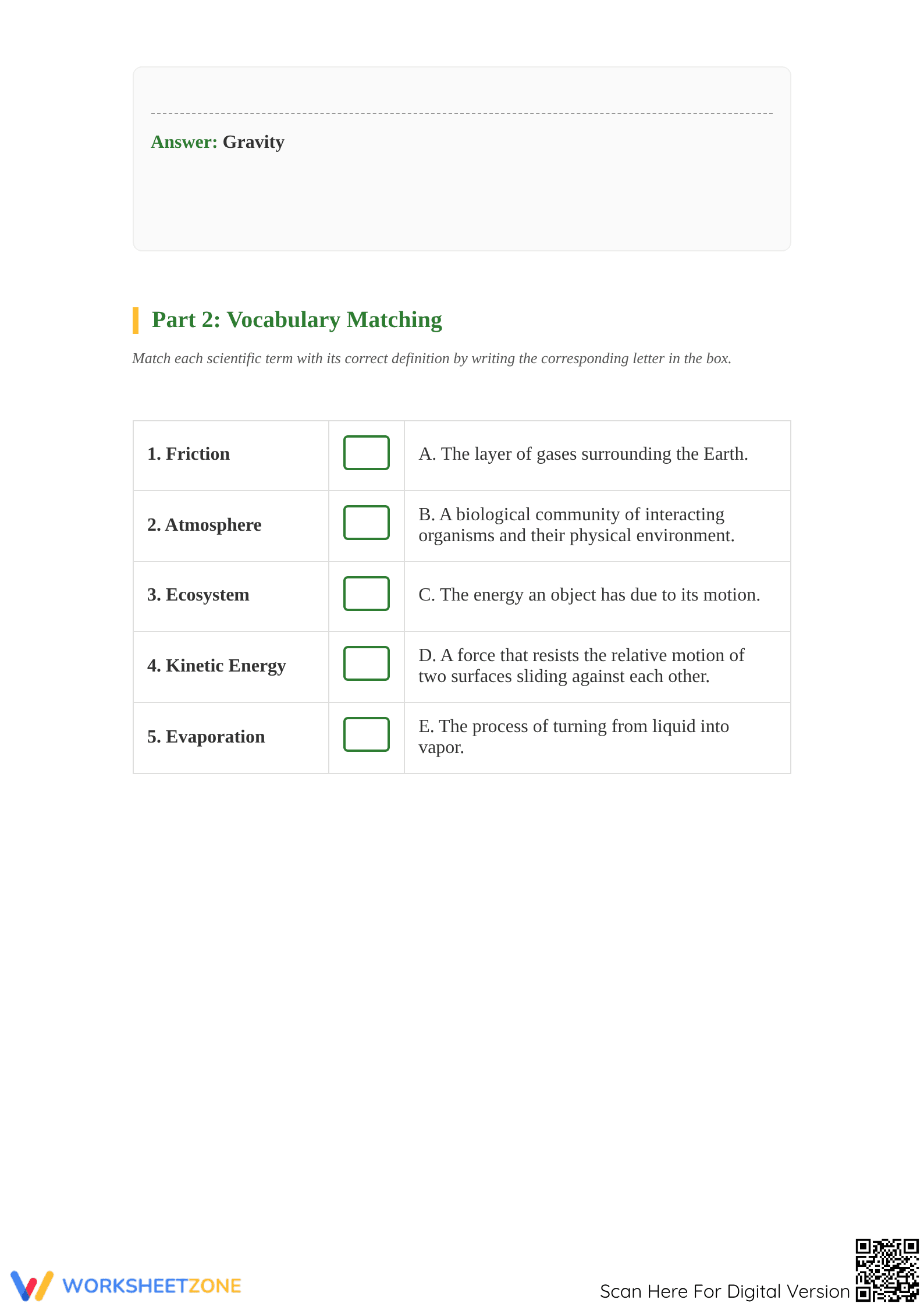
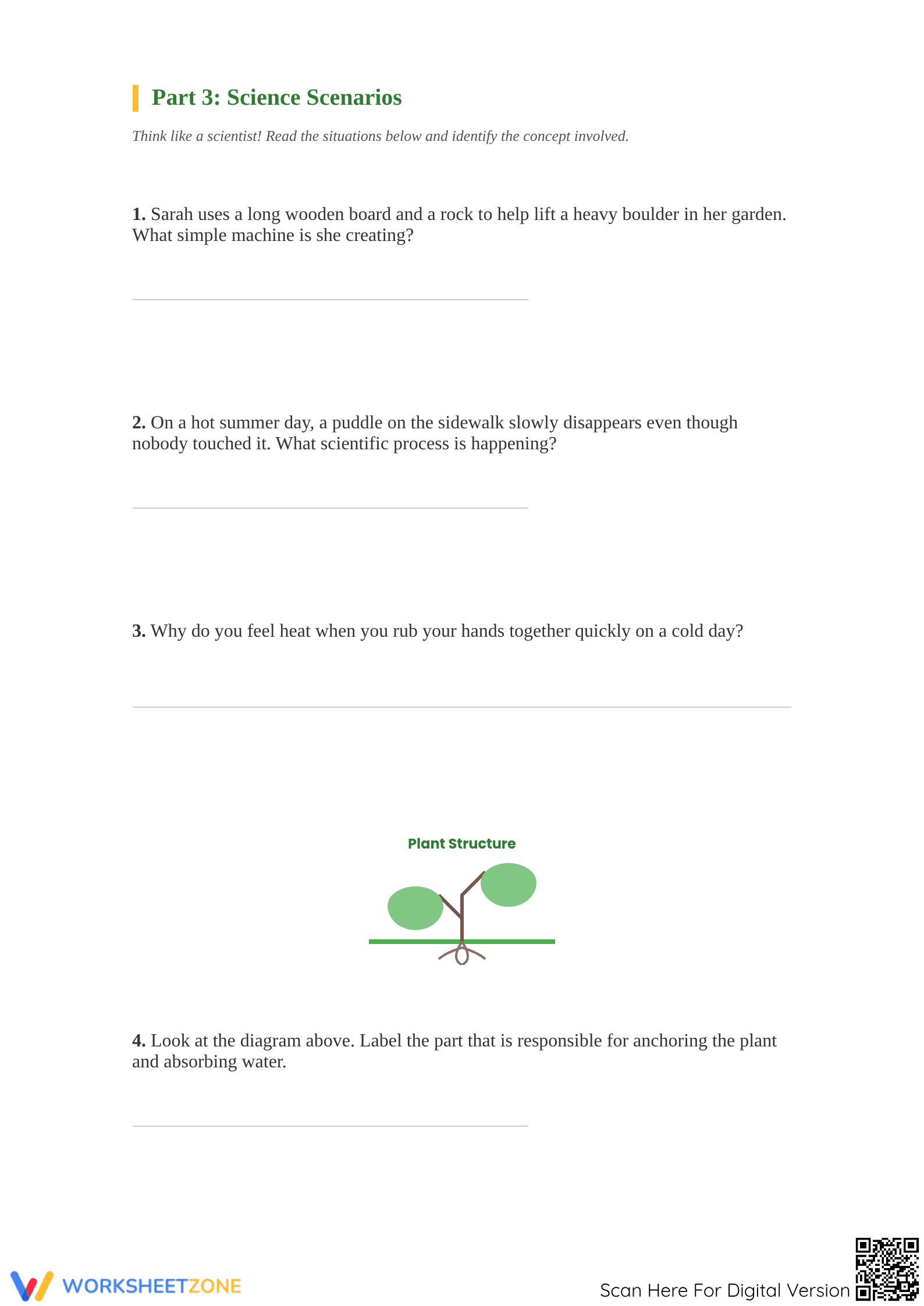
This five-page packet features 17 distinct tasks divided into three high-impact sections. Part one utilizes a unique reverse quiz format where students write questions for provided scientific answers. Part two includes a vocabulary matching table for essential terms like kinetic energy and ecosystems. Part three presents real-world science scenarios, requiring students to identify machines, processes, and structures within context.
Zero-Prep Workflow
The zero-prep design allows teachers to implement this review in under two minutes. First, print the five-page packet for each student, ensuring all sections are legible. Second, distribute the materials at the start of the period; no additional manipulatives or lab equipment are required. Finally, use the included comprehensive answer key to facilitate a quick group review or to streamline the grading process.
Standards Alignment
The primary alignment is MS-PS2-2, focusing on the interactions of forces and the function of simple machines like levers and pulleys. Additionally, the resource supports MS-LS1-6 by assessing student knowledge of photosynthesis and plant structures. Both standard codes can be copied directly into lesson plans, IEP goals, or district curriculum mapping tools for administrative compliance and tracking.
How to Use It
Use this worksheet as a summative assessment at the conclusion of a general science unit to gauge student mastery across multiple domains. During the activity, circulate the room to observe how students handle the 'Reverse Quiz' section, as this often reveals misconceptions about scientific terminology. The estimated completion time is 50 minutes, making it an ideal lesson for busy classroom schedules.
Who It's For
This resource is designed for Grade 6 science students but serves as an excellent remediation tool for Grade 7 or 8 learners. The clear formatting and included illustrations support English Language Learners (ELL) and students with IEPs by providing visual cues for complex concepts like pulley systems. It pairs naturally with a digital passage or an interactive anchor chart for a complete lesson.
The Grade 6 Science Review provides a robust framework for cumulative assessment, directly supporting MS-PS2-2 and integrated life science standards. Research by Fisher & Frey (2014) emphasizes that the gradual release of responsibility model is most effective when paired with frequent retrieval practice and vocabulary synthesis. This worksheet leverages a 'Reverse Quiz' format to challenge students to formulate scientifically accurate questions from provided answers, a higher-order thinking skill that reinforces conceptual depth rather than rote memorization. By covering disparate domains—including simple machines, ecosystems, and plant biology—the resource facilitates long-term retention of core disciplinary ideas. Consistent with current pedagogical standards, providing students with structured scenarios to apply their knowledge of friction, gravity, and photosynthesis ensures that they can bridge the gap between abstract definitions and real-world observations. This approach builds the scientific literacy necessary for success in subsequent middle school science coursework and standardized state assessments.


