


























Views
Downloads


Printable Antonyms Worksheet | Grade 1 Opposite Words
Paste this activity's link or code into your existing LMS (Google Classroom, Canvas, Teams, Schoology, Moodle, etc.).
Students can open and work on the activity right away, with no student login required.
You'll still be able to track student progress and results from your teacher account.
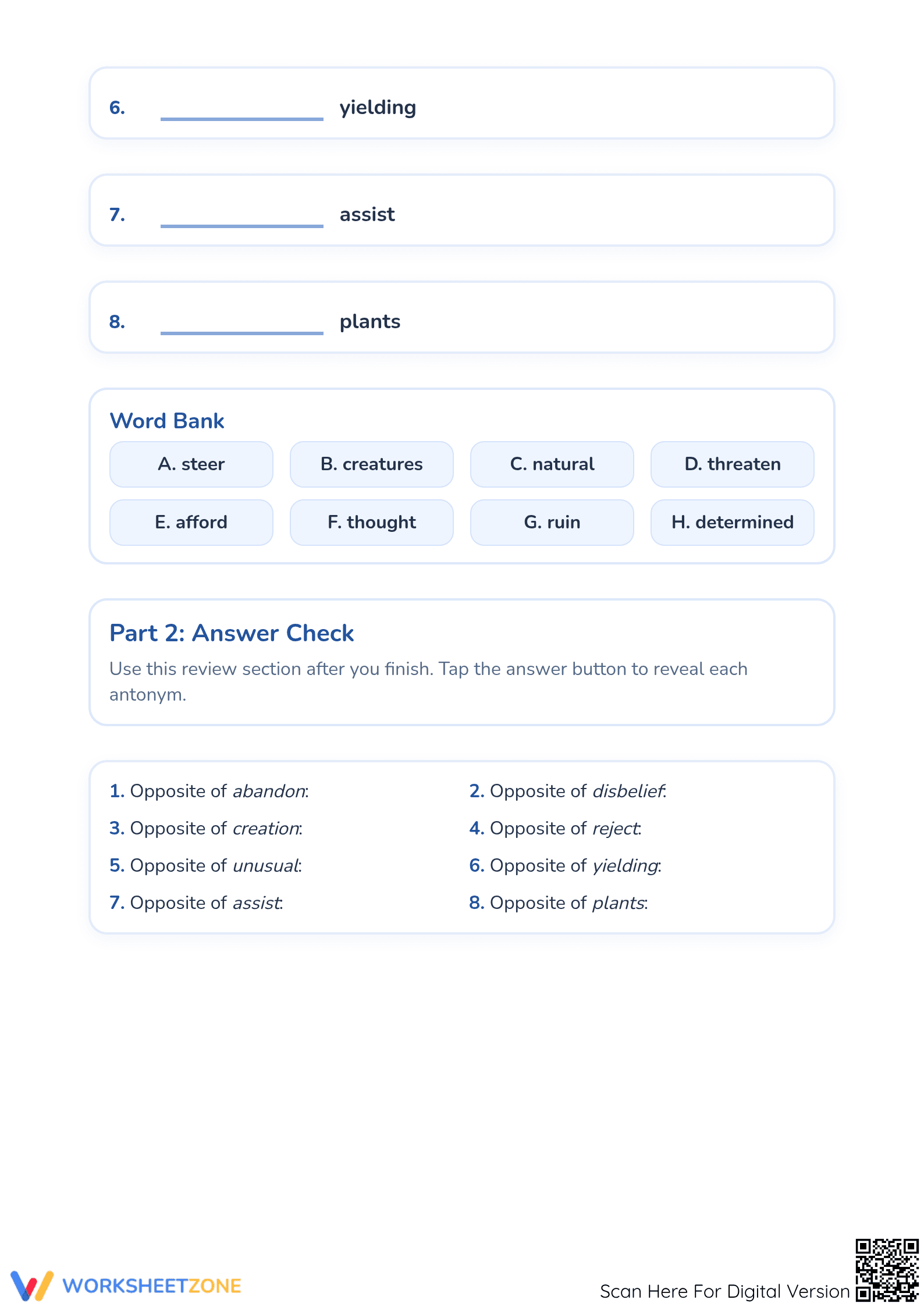
This Grade 1 antonyms worksheet helps students master vocabulary by identifying words with contrasting meanings. Students use a provided word bank to match complex terms with their opposites, improving linguistic precision. It provides a structured environment for practice, ensuring students can recognize and use lexical opposites in various reading contexts.
At a Glance
- Grade: 1 · Subject: ELA
- Standard:
CCSS.ELA-LITERACY.L.1.5— Identify real-life connections between words and their use to build vocabulary- Skill Focus: Identifying High-Frequency Opposite Words and Antonyms
- Format: 2 pages · 8 problems · Answer key included · PDF
- Best For: Independent vocabulary practice, literacy centers, and quick review
- Time: 10–15 minutes
This two-page PDF includes a focused matching activity where students write the correct antonym next to target words. The worksheet features eight vocabulary challenges, a clear word bank for support, and a built-in "Answer Check" section on the second page. Its clean layout and straightforward instructions make it an ideal resource for reinforcing word relationships without any teacher setup.
Zero-Prep Workflow
The zero-prep design allows teachers to implement this activity in under two minutes. First, print the document (30 seconds). Next, distribute the sheets to students or upload the PDF to a digital platform (30 seconds). Finally, students complete the matching tasks and use the included self-check key to review their work (60 seconds). This process is perfect for sub plans or as a quick morning warm-up.
Standards Alignment
Aligned to CCSS.ELA-LITERACY.L.1.5, this resource focuses on demonstrating understanding of word relationships. By matching opposites, students build foundational skills necessary for vocabulary acquisition and linguistic development. This alignment ensures the worksheet meets core curriculum requirements for first-grade literacy. Both standard codes can be copied directly into lesson plans, IEP goals, or district curriculum mapping tools.
How to Use It
Use this worksheet as a formative assessment during a unit on word relationships to gauge mastery. It works well as a silent starter or a transition activity between lessons. While students work, observe if they use the word bank strategically or identify opposites from memory, which serves as a great check for vocabulary retention and informs future instructional grouping needs.
Who It's For
This worksheet is designed for first-grade students but serves as an excellent second-grade review for struggling readers. It pairs naturally with a classroom anchor chart or a short reading passage highlighting descriptive language. The word bank provides necessary scaffolding for students building their sight word recognition, making it an accessible tool for diverse learners and English language support groups.
Research from the RAND AIRS 2024 report emphasizes that explicit vocabulary instruction focusing on word relationships like antonyms is critical for early literacy success. This worksheet targets the CCSS.ELA-LITERACY.L.1.5 standard by providing structured practice in identifying opposite words, a skill correlating with improved reading fluency and text interpretation. By engaging with terms such as "abandon" and "creation," students broaden their lexical range and develop the cognitive flexibility required to understand linguistic nuances. The inclusion of a word bank supports the gradual release of responsibility model, allowing movement from supported recognition to independent application. Utilizing standards-aligned tools ensures that instructional time is maximized for mastery. Educators can rely on this resource as a proven method for reinforcing vocabulary foundations within a classroom-ready framework that supports both formative assessment and student-led review of opposite word pairs.


