


























Views
Downloads
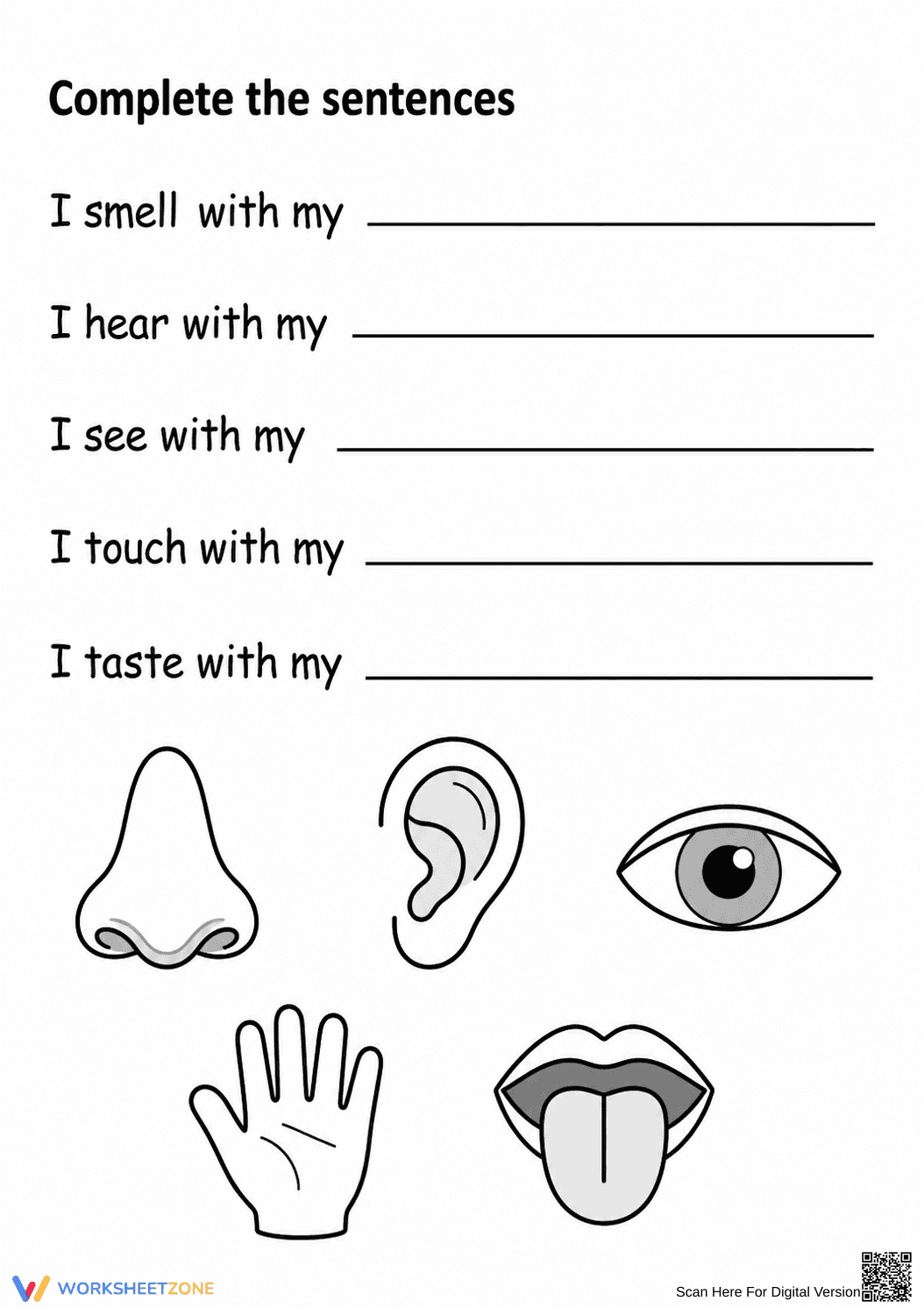

Grade 5 Five Senses — Printable No-Prep Worksheet
Paste this activity's link or code into your existing LMS (Google Classroom, Canvas, Teams, Schoology, Moodle, etc.).
Students can open and work on the activity right away, with no student login required.
You'll still be able to track student progress and results from your teacher account.
This Grade 5 science and ELA worksheet helps students connect sensory actions with their corresponding anatomical structures. By completing five structured sentences using visual cues, learners reinforce domain-specific vocabulary and basic syntax. It serves as an effective, accessible tool to build foundational biological science concepts and English language proficiency.
At a Glance
- Grade: 5 · Subject: Science
- Standard:
CCSS.ELA-LITERACY.L.5.6— Use domain-specific words and phrases accurately- Skill Focus: Sensory Vocabulary
- Format: 1 page · 5 problems · Answer key included · PDF
- Best For: Quick review or morning work
- Time: 5–10 minutes
What's Inside
The worksheet contains a single-page layout featuring five sentence completion prompts. Each prompt pairs a sensory verb—smell, hear, see, touch, and taste—with a blank line for the student to write the correct body part. To support visual learners and English Language Learners, high-contrast illustrations of a nose, ear, eye, mouth, and hand are provided at the bottom of the page as a visual word bank.
Zero-Prep Workflow
- Print (1 minute): Simply print the single-page PDF directly from your device.
- Distribute (1 minute): Hand out to students as a morning warm-up, exit ticket, or independent station activity.
- Review (3 minutes): Go over the answers collectively using the included answer key.
With a total teacher prep time of under 2 minutes, this straightforward design makes it an ideal candidate for emergency sub plans or quick transitions.
Standards Alignment
The primary alignment is CCSS.ELA-LITERACY.L.5.6, which requires students to acquire and use accurately grade-appropriate general academic and domain-specific words. Additionally, it supports foundational science skills by identifying the structures that allow humans to receive and process information. Both standard codes can be copied directly into lesson plans, IEP goals, or district curriculum mapping tools.
How to Use It
Use this worksheet during the introductory phase of a human body unit to assess prior knowledge of sensory organs. Alternatively, assign it as a formative assessment after a lesson on descriptive writing to ensure students can correctly identify the tools of observation. Watch to see if students can independently match the visual icon to the written sensory verb. Completion typically takes 5 to 10 minutes.
Who It's For
This worksheet is tailored for Grade 5 students, particularly English Language Learners (ELL) or students needing foundational review, who benefit from visual cues and repetitive sentence frames. It pairs naturally with an anchor chart on the nervous system or a short informational passage about how the brain interprets sensory signals.
According to the RAND AIRS 2024 report, structured vocabulary practice that links visual icons with domain-specific terms significantly improves retention for intermediate elementary students. This worksheet targets the CCSS.ELA-LITERACY.L.5.6 standard by requiring students to use domain-specific words and phrases accurately in context. By focusing on the five senses, the activity reinforces the foundational biological concepts necessary for meeting upper-elementary science benchmarks. Scaffolded sentence completion tasks are vital for students transitioning from basic conversational English to academic language proficiency. This 5-task resource provides the necessary repetition to ensure that the relationship between sensory input and physical organs is solidified before moving into more complex neurological studies. It offers a clear, measurable way to track student mastery of essential life science and language arts terminology in a single, efficient session.


