


























Views
Downloads



Printable Antonyms Worksheet | Grade 1 Opposite Words
Paste this activity's link or code into your existing LMS (Google Classroom, Canvas, Teams, Schoology, Moodle, etc.).
Students can open and work on the activity right away, with no student login required.
You'll still be able to track student progress and results from your teacher account.
This Grade 1 ELA worksheet provides a structured approach to identifying and using opposite words, commonly known as antonyms. By engaging with 24 distinct problems, students develop a stronger grasp of word relationships and lexical nuances. This comprehensive practice set ensures learners can accurately categorize and apply vocabulary in various academic and real-world contexts.
At a Glance
- Grade: 1 · Subject: ELA
- Standard:
CCSS.ELA-LITERACY.L.1.5— Identify opposite word pairs to understand connections between word meanings- Skill Focus: Antonyms (Opposite Words)
- Format: 4 pages · 24 problems · Answer key included · PDF
- Best For: Independent vocabulary reinforcement and center work
- Time: 20–30 minutes
What's Inside
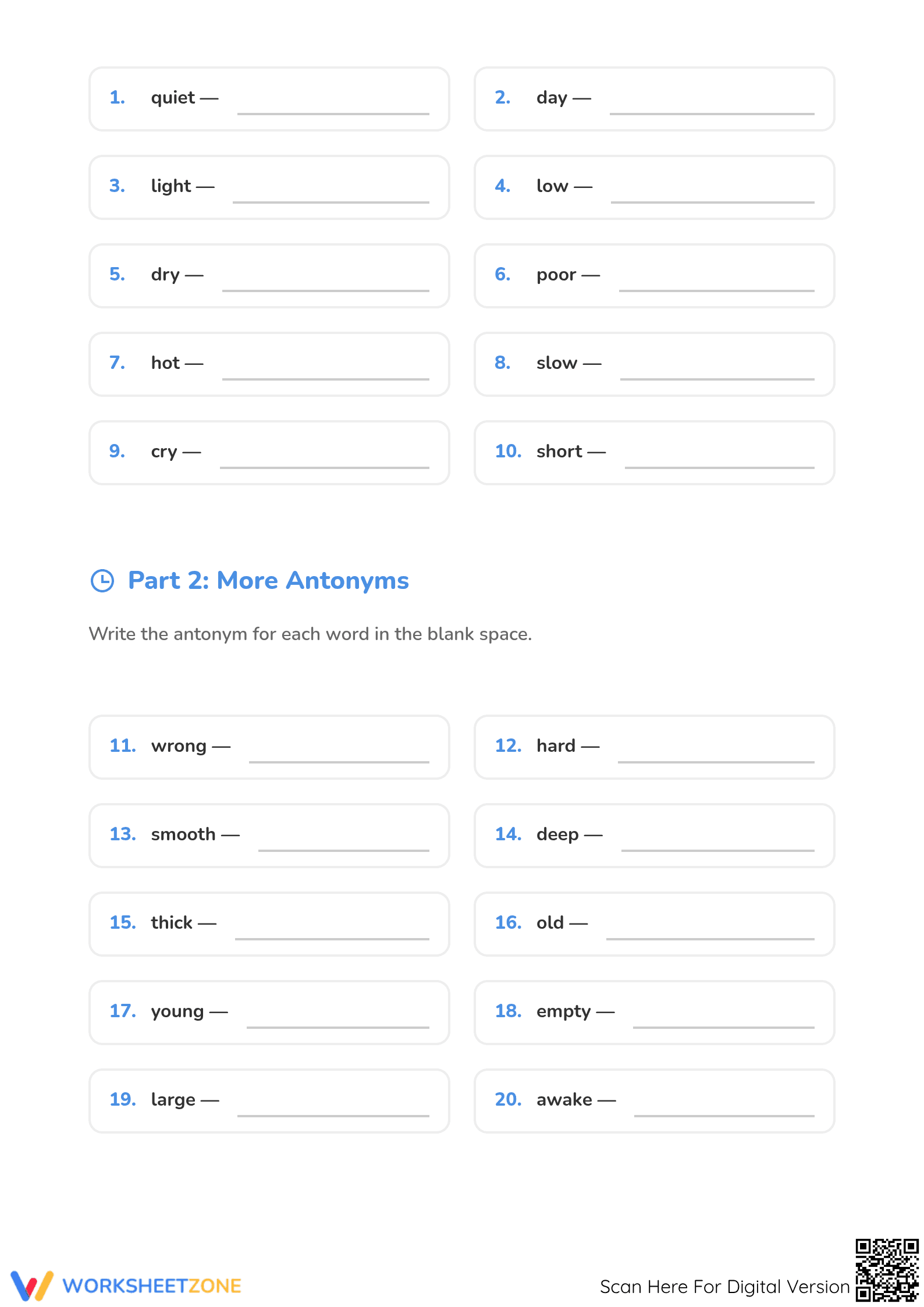
This extensive four-page packet contains four distinct parts designed to build mastery. Students begin with a word bank of ten basic opposites before moving into more challenging fill-in-the-blank pairs. The third section utilizes a visual matching format, while the final page challenges students to identify antonyms within the context of full sentences. A complete answer key is provided for quick grading.
Skill Progression
The worksheet follows a careful instructional sequence using a gradual-release model:
- Guided Practice: Students use a word bank to match ten high-frequency antonym pairs like "dry/wet," providing high support for recognition.
- Supported Practice: Learners recall 10 additional pairs without a word bank, increasing the cognitive demand for retrieval and spelling.
- Independent Practice: Four sentence-based problems challenge students to identify opposites in context, demonstrating authentic mastery.
This transition from recognition to application mirrors the proven "I Do, We Do, You Do" instructional strategy.
Standards Alignment
This resource is explicitly aligned with CCSS.ELA-LITERACY.L.1.5, focusing on word relationships and nuances. The activities support the identification of real-life connections between words, a critical component of first-grade development. These standard codes can be copied directly into lesson plans, IEP goals, or district curriculum mapping tools.
How to Use It
Use this worksheet as a summative assessment after a direct instruction lesson on word pairs to gauge individual student mastery. During the activity, circulate the room to observe if students are using the sentence context in Part 4 to verify their choices, which serves as a vital formative check. Completion takes 20 to 30 minutes.
Who It's For
This resource is designed for first-grade students but is also highly effective for second-grade review or English Language Learners (ELL) building foundational vocabulary. For students needing more support, pair this worksheet with a visual anchor chart displaying common antonym pairs. Advanced learners can be challenged to write their own sentences for each word in the Part 1 word bank.
The development of lexical depth through the study of antonyms is a cornerstone of early literacy. Research from Fisher & Frey (2014) emphasizes that understanding word relationships like CCSS.ELA-LITERACY.L.1.5 is essential for transitioning from decoding to meaningful reading comprehension. This worksheet targets the specific skill of identifying opposite meanings across 24 tasks. According to ScienceDirect TpT Analysis, structured vocabulary practice significantly improves semantic processing speeds in primary learners. By providing multiple modes of engagement—including matching and contextual analysis—this resource provides the repetition necessary for long-term retention. This printable PDF serves as a robust tool for meeting core language standards while building the linguistic flexibility required for higher-order literacy tasks in elementary education settings.


