


























Views
Plays

Reading Strategy Vocabulary Quiz | Grade 1 Essential
Paste this activity's link or code into your existing LMS (Google Classroom, Canvas, Teams, Schoology, Moodle, etc.).
Students can open and work on the activity right away, with no student login required.
You'll still be able to track student progress and results from your teacher account.
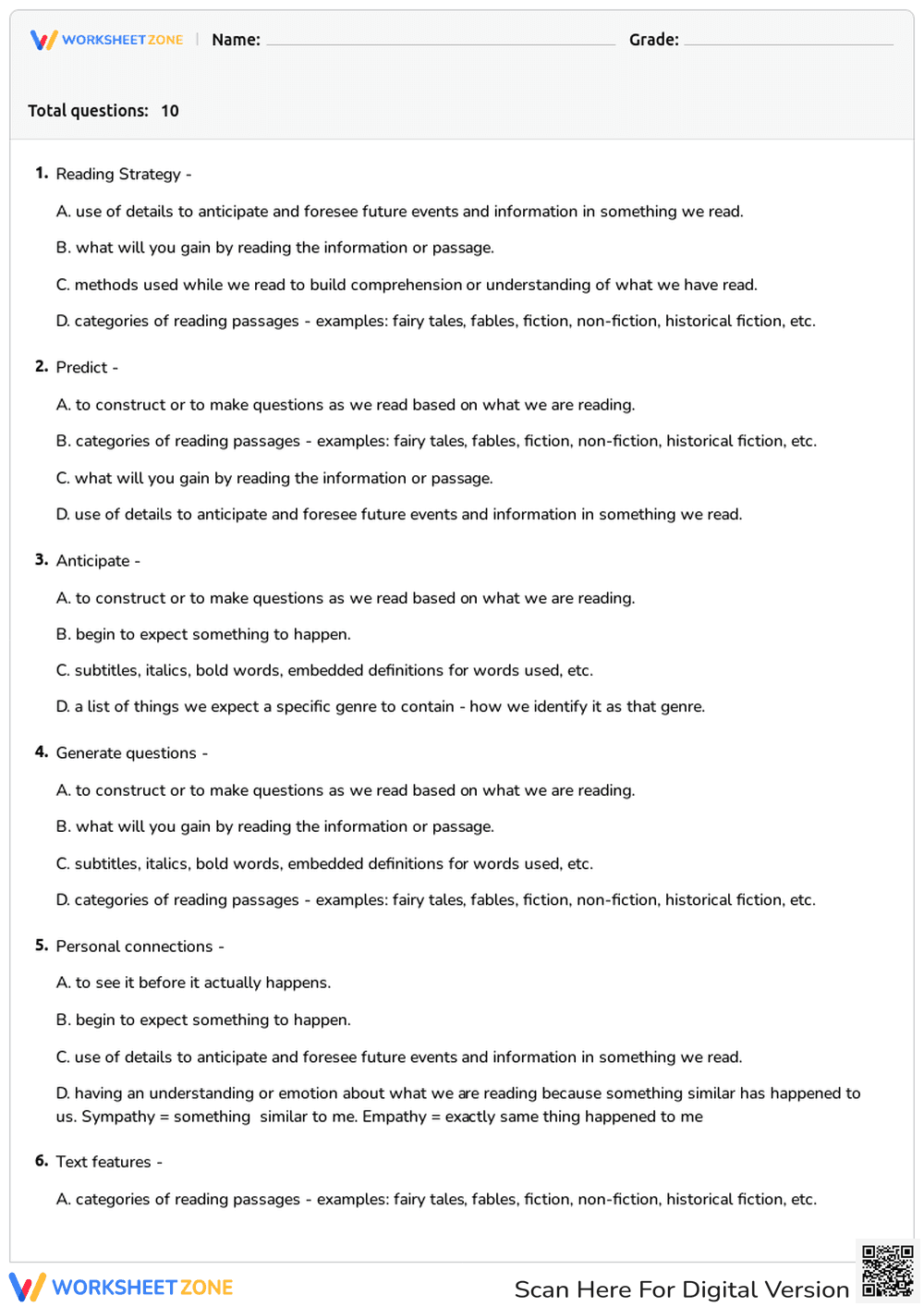
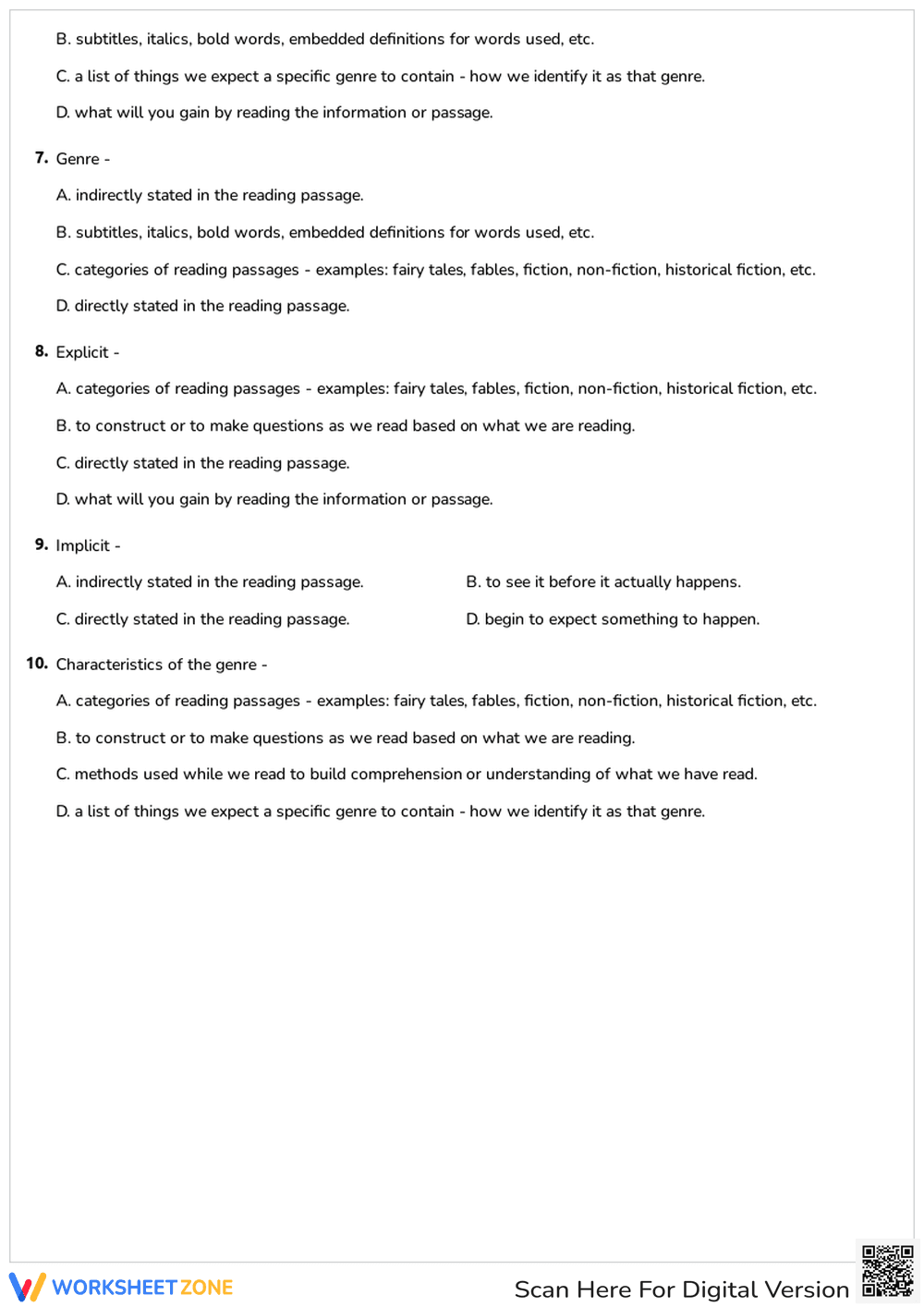
This Grade 1 reading strategy worksheet provides students with a structured assessment to master essential literacy terminology. By matching terms like predict, genre, and explicit to their definitions, learners build the foundational vocabulary necessary for deep comprehension. This resource ensures students can articulate the specific methods they use to understand complex texts.
At a Glance
- Grade: 1 · Subject: ELA
- Standard:
CCSS.ELA-LITERACY.L.1.6— Use words and phrases acquired through conversations, reading and being read to- Skill Focus: Reading Strategy Vocabulary
- Format: 2 pages · 10 problems · Answer key included · PDF
- Best For: Weekly vocabulary assessment or guided notes review
- Time: 15–20 minutes
This two-page PDF contains 10 carefully crafted multiple-choice questions designed to test a student's grasp of academic language. Each question presents a core reading term followed by four distinct definitions, requiring students to distinguish between similar concepts like anticipate and predict. A full answer key is provided to facilitate rapid grading or student self-correction.
- Guided Practice: The initial questions focus on concrete terms like Reading Strategy and Predict, providing clear, distinct options to build student confidence.
- Supported Practice: Middle questions introduce nuanced concepts such as Personal Connections and Text Features, using descriptive examples within the answer choices to scaffold understanding.
- Independent Practice: The final set of problems challenges students to differentiate between Explicit and Implicit information, requiring higher-order thinking to identify the correct application of abstract terms.
This gradual-release approach moves students from basic recognition to the precise application of literacy terminology.
This resource is directly aligned with `CCSS.ELA-LITERACY.L.1.6`, which requires students to use words and phrases acquired through conversations, reading and being read to, and responding to texts. Additionally, it supports RI.1.4 by helping students ask and answer questions about unknown words. Both standard codes can be copied directly into lesson plans, IEP goals, or district curriculum mapping tools.
Use this worksheet as a summative assessment at the end of a unit on reading comprehension strategies. It serves as an excellent formative tool when administered mid-week to identify which students struggle with the distinction between genre and characteristics of the genre. During the activity, observe if students use elimination strategies to narrow down definitions. Expected completion time is 15 to 20 minutes.
This quiz is ideal for Grade 1 students who are beginning to use meta-cognitive strategies during independent reading. It is also highly effective for English Language Learners (ELL) who need explicit instruction in academic Tier 2 vocabulary. Pair this resource with a Reading Strategies anchor chart or a guided reading passage to reinforce the terms in a real-world context.
According to the RAND AIRS 2024 report on literacy development, explicit vocabulary instruction is a critical component of early reading success, particularly when students are taught to define the strategies they use to process text. This worksheet addresses that need by isolating 10 key terms, including genre, explicit, and implicit, which are often barriers to comprehension if not explicitly defined. By using a multiple-choice format, the assessment provides a low-stakes environment for students to demonstrate mastery of CCSS.ELA-LITERACY.L.1.6. Research from Fisher & Frey (2014) suggests that academic language acquisition is most effective when students are required to distinguish between related concepts, a task this worksheet facilitates through its structured definition matching. This resource provides the measurable data points necessary for tracking student progress toward grade-level literacy benchmarks and informing future instructional interventions.


