


























Views
Downloads


Essential Descriptive Adjectives Starting with B
Paste this activity's link or code into your existing LMS (Google Classroom, Canvas, Teams, Schoology, Moodle, etc.).
Students can open and work on the activity right away, with no student login required.
You'll still be able to track student progress and results from your teacher account.
Enhance student writing and expand descriptive vocabulary with this comprehensive Grade 4 grammar worksheet focused on adjectives starting with the letter B. Students move from visual recognition to contextual application, mastering words like blazing, brittle, and bashful. This resource ensures learners can precisely describe objects and emotions in their daily compositions.
At a Glance
- Grade: 4 · Subject: ELA
- Standard:
L.4.6— Acquire and use accurately grade-appropriate general academic and domain-specific words- Skill Focus: Adjectives starting with B
- Format: 3 pages · 17 problems · Answer key included · PDF
- Best For: Vocabulary expansion and descriptive writing practice
- Time: 20–30 minutes
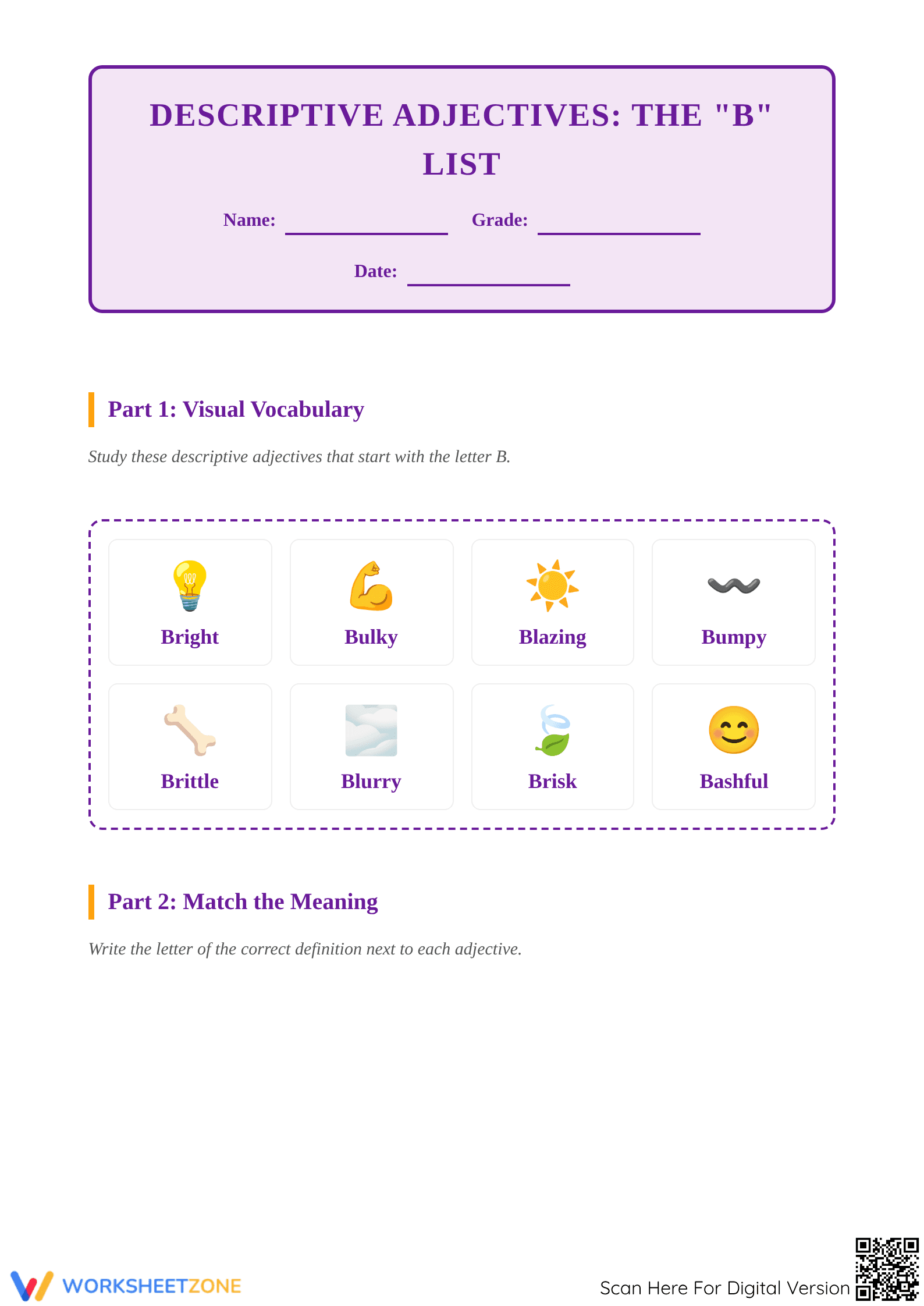
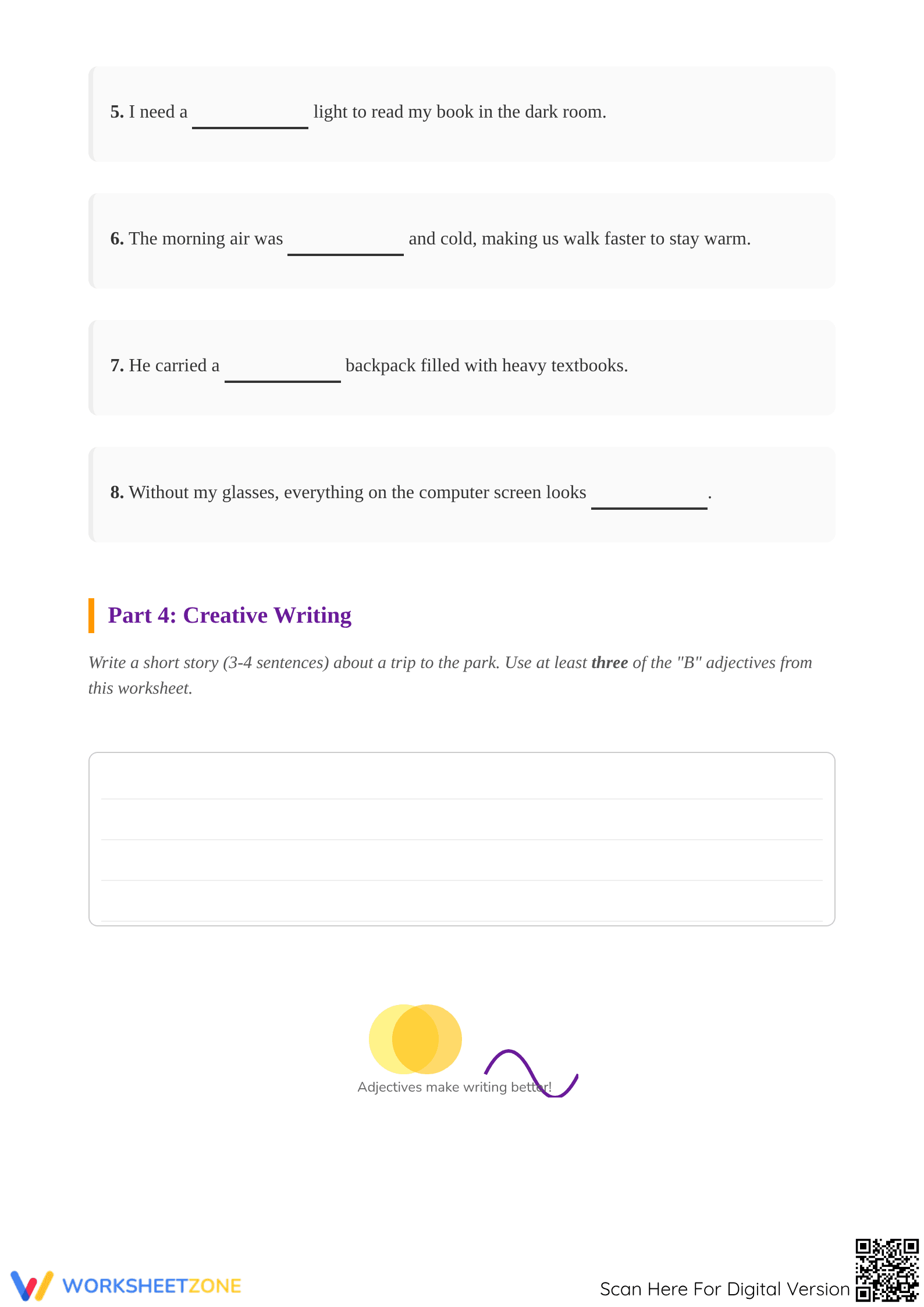
This three-page PDF includes 17 instructional tasks designed for maximum engagement. It begins with a Visual Vocabulary section featuring eight target adjectives paired with clear icons to support dual coding. Following this, students complete a matching activity to solidify definitions and eight fill-in-the-blank sentences to practice contextual usage. The final page provides a creative writing prompt and a full answer key.
The worksheet follows a structured skill progression to ensure student success. First, students engage in guided practice by studying eight visual icons that define the target adjectives. Next, supported practice occurs through eight matching definitions and eight sentence-completion tasks that provide syntactic clues. Finally, students reach independent practice in the creative writing section, where they synthesize learning by drafting a short story using at least three target words.
This resource is primarily aligned with CCSS.ELA-LITERACY.L.4.6, focusing on the acquisition and use of grade-appropriate general academic words. By requiring students to choose the best adjective for a specific context, it also supports CCSS.ELA-LITERACY.L.4.3.A, which involves choosing words to convey ideas precisely. Both standard codes can be copied directly into lesson plans, IEP goals, or district curriculum mapping tools.
Use this worksheet as a focused vocabulary builder during your writing workshop. It is particularly effective after a mini-lesson on descriptive language to provide immediate application. For formative assessment, observe students during the matching phase to identify which definitions cause confusion. Expect students to complete the full three-page set in approximately 20 to 30 minutes, depending on the depth of their creative writing response.
This resource is ideal for Grade 3 and Grade 4 students, as well as English Language Learners who benefit from the visual scaffolding. It serves as an excellent companion to a descriptive writing unit or a mentor text analysis. Pair this worksheet with a B-word anchor chart or a picture book rich in alliteration to reinforce the phonics and grammar connection.
This educational resource is specifically designed to address CCSS.ELA-LITERACY.L.4.6, which requires students to acquire and use accurately grade-appropriate general academic and domain-specific words and phrases. By focusing on descriptive adjectives starting with the letter B, the worksheet provides a targeted approach to vocabulary acquisition. Research by Fisher & Frey (2014) emphasizes the importance of a gradual release of responsibility model in literacy instruction, which this worksheet mirrors through its progression from visual recognition to independent creative application. Systematic vocabulary instruction, particularly when paired with visual cues and contextual practice, has been shown to significantly improve student writing quality and reading comprehension. This resource provides the necessary scaffolding for Grade 4 students to move beyond basic descriptors toward more nuanced language. Educators can utilize these 17 structured tasks to ensure students not only memorize definitions but also internalize the usage of complex adjectives in their own original compositions.


