


























Views
Downloads
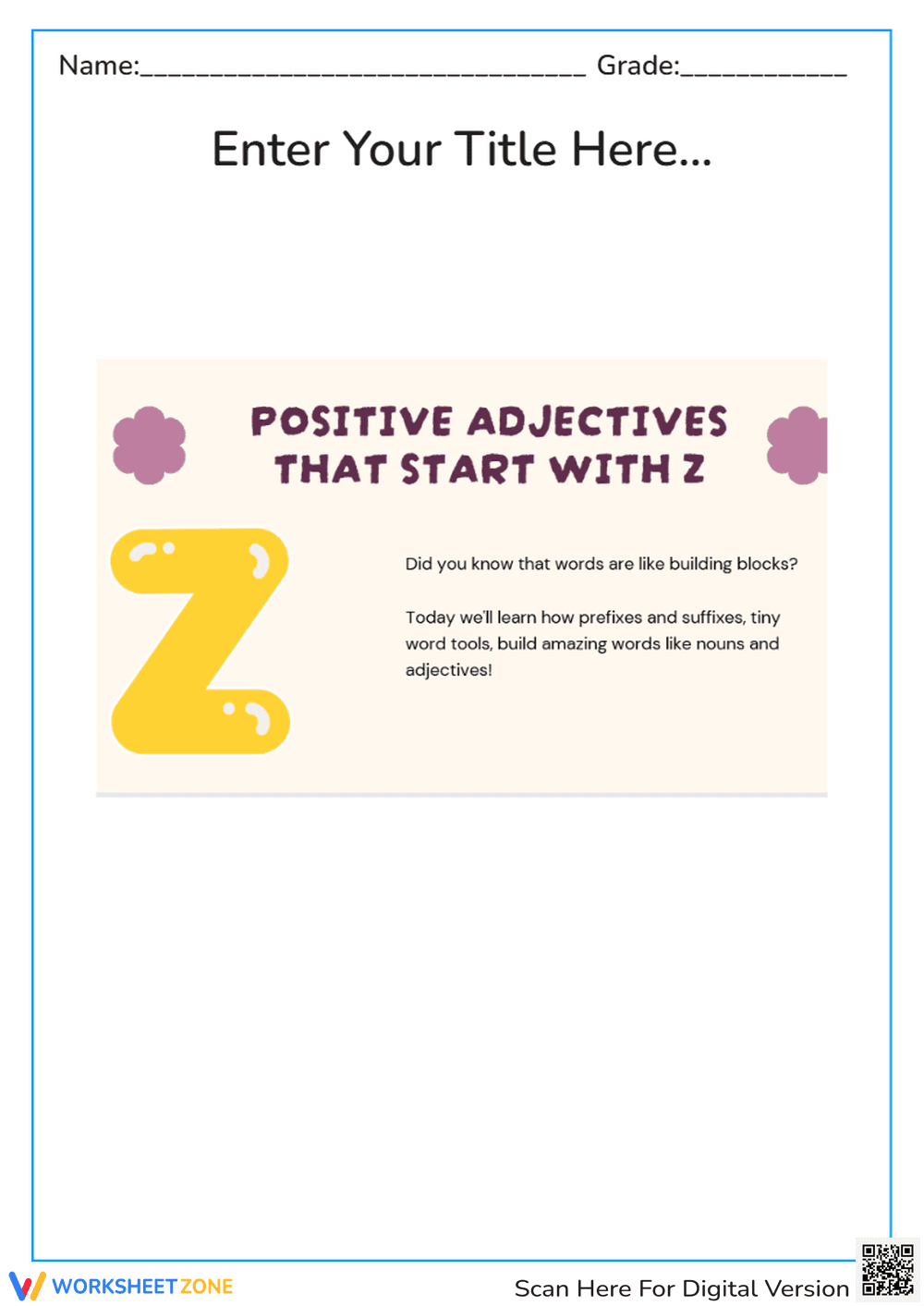

Grade 3 Z Adjectives — Printable No-Prep Worksheet
Paste this activity's link or code into your existing LMS (Google Classroom, Canvas, Teams, Schoology, Moodle, etc.).
Students can open and work on the activity right away, with no student login required.
You'll still be able to track student progress and results from your teacher account.
This Grade 3 ELA worksheet introduces students to positive adjectives starting with the letter Z, focusing on how prefixes and suffixes function as building blocks for language. By reading this introductory text, learners will understand how tiny word tools create amazing new nouns and descriptive words.
At a Glance
- Grade: 3 · Subject: ELA
- Standard:
CCSS.ELA-LITERACY.L.3.4.B— Determine word meanings using affixes- Skill Focus: Prefixes, suffixes, and adjectives
- Format: 1 page · 1 task · No answer key · PDF
- Best For: Vocabulary introduction
- Time: 5–10 minutes
What's Inside
Inside this single-page resource, educators will find a visually engaging introductory text that explains the concept of morphology in student-friendly terms. The page features a brief reading task that compares words to building blocks, specifically highlighting how prefixes and suffixes modify base words. While it does not include a traditional problem set or answer key, its clear layout and inviting design make it an excellent cover page or anchor text for a broader vocabulary unit.
Zero-Prep Workflow
Implementing this resource requires minimal effort, following a simple three-step workflow. First, print the PDF document (under one minute). Next, distribute the page to students as they transition into their language arts block (one minute). Finally, review the text together as a class to spark a discussion about word formation (three minutes). Total teacher preparation time is under two minutes, making this an ideal, self-explanatory addition to any emergency sub plan or quick morning work routine.
Standards Alignment
This material aligns directly with CCSS.ELA-LITERACY.L.3.4.B, which requires students to determine the meaning of the new word formed when a known affix is added to a known word. It also supports broader vocabulary acquisition goals by encouraging morphological awareness. Both standard codes can be copied directly into lesson plans, IEP goals, or district curriculum mapping tools.
How to Use It
Teachers can utilize this page before direct instruction to activate prior knowledge about word parts and descriptive language. Alternatively, it serves well during a whole-group mini-lesson where the teacher models how to identify prefixes and suffixes in familiar words. As a formative assessment observation tip, listen to student discussions after reading the text to gauge their initial understanding of how affixes change a word's meaning. Expected completion time ranges from five to ten minutes.
Who It's For
This resource is primarily designed for third-grade students beginning their study of morphology and advanced vocabulary. It offers natural differentiation for visual learners through its clean, colorful design and straightforward analogies. For a complete lesson experience, pair this introductory page with a direct instruction lesson on specific prefixes, or display it alongside a classroom anchor chart detailing common suffixes.
Developing morphological awareness is a critical component of early literacy and vocabulary acquisition. This resource targets CCSS.ELA-LITERACY.L.3.4.B, helping students determine word meanings using affixes. According to Fisher & Frey (2014), explicit instruction in word parts, including prefixes and suffixes, significantly improves reading comprehension and equips students with the tools necessary to decode unfamiliar academic vocabulary. By framing these word parts as building blocks, this material provides a concrete analogy for abstract linguistic concepts. When learners understand how to manipulate these tiny word tools, they gain confidence in their ability to read and write complex texts. This foundational knowledge not only supports immediate grade-level standards but also fosters long-term linguistic competence across all subject areas, ensuring students are prepared for increasingly rigorous reading demands.


