


























Views
Downloads

Solar System Worksheet | Grade 5 Essential Science
Paste this activity's link or code into your existing LMS (Google Classroom, Canvas, Teams, Schoology, Moodle, etc.).
Students can open and work on the activity right away, with no student login required.
You'll still be able to track student progress and results from your teacher account.
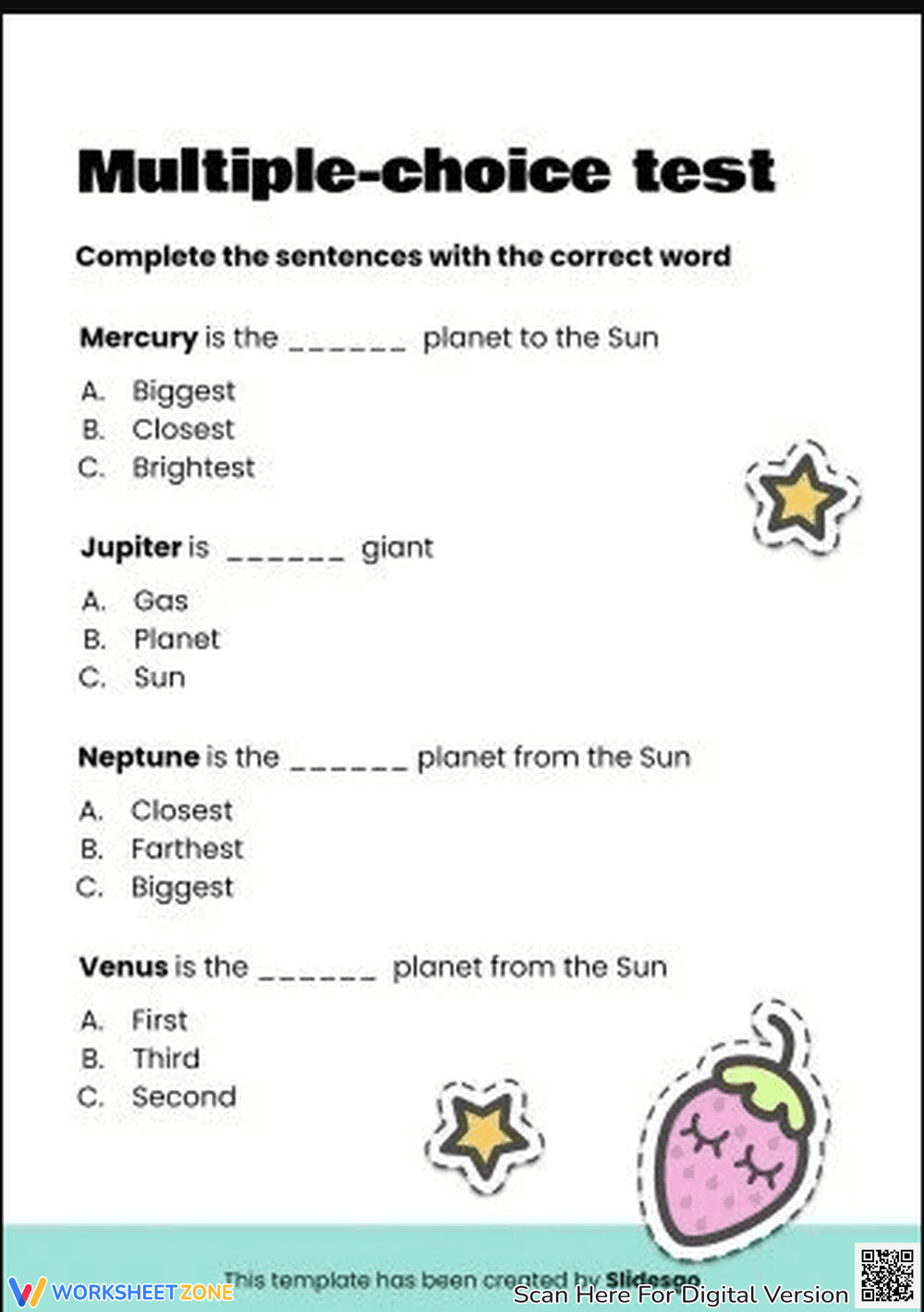
This Grade 5 solar system worksheet helps students identify key characteristics of planets through targeted multiple-choice questions. Students demonstrate their understanding of planetary order, composition, and relative distance from the sun. It provides a quick check for mastery during an Earth and Space Science unit, ensuring students grasp fundamental astronomical concepts before moving to complex orbital mechanics.
At a Glance
- Grade: 5 · Subject: Science
- Standard:
5-ESS1-1— Identify and compare the physical characteristics and locations of planets in the solar system- Skill Focus: Planetary Characteristics
- Format: 1 page · 4 problems · Answer key included · PDF
- Best For: Quick formative assessment or exit ticket
- Time: 5–10 minutes
What's Inside
This single-page PDF features four clear multiple-choice questions focusing on Mercury, Jupiter, Neptune, and Venus. Each question includes three distinct options to challenge common misconceptions about planetary size, composition, and location. The layout is clean and student-friendly, featuring simple graphics to maintain engagement without distraction. A comprehensive answer key is provided to facilitate rapid grading and immediate student feedback.
Zero-Prep Workflow
This resource is designed for maximum efficiency. Follow these three simple steps: First, print the single-page PDF (20 seconds). Second, distribute the worksheets as a quiet "Do Now" or exit ticket (30 seconds). Finally, review the answers using the provided key (1 minute). Total teacher preparation time is under 2 minutes, making it an ideal choice for sub plans.
Standards Alignment
The primary standard `5-ESS1-1` involves supporting arguments about Earth's place in the universe and the characteristics of celestial bodies. This worksheet specifically targets the foundational knowledge of planetary properties required to meet this standard. By identifying gas giants and planetary proximity to the sun, students build the prerequisite knowledge for more complex astronomical modeling. Both standard codes can be copied directly into lesson plans, IEP goals, or district curriculum mapping tools.
How to Use It
Use this as a formative assessment after a lesson on the inner and outer planets. It works well as a "Do Now" activity to activate prior knowledge or as a check for understanding mid-unit. Teachers should observe if students confuse the order of Venus and Mercury, providing an immediate opportunity for corrective feedback. The expected completion time range is 5 to 10 minutes, allowing it to fit into any instructional block.
Who It's For
This resource is designed for fifth-grade students but is also suitable for fourth-grade enrichment or sixth-grade review. It pairs naturally with a solar system anchor chart or a direct instruction lesson on the Milky Way. It is particularly effective for English Language Learners due to the concise sentence structures and clear vocabulary. Special education teachers can also use this for progress monitoring on science-related IEP goals.
According to the RAND AIRS 2024 report, high-quality science instruction requires frequent, low-stakes assessments to bridge the gap between direct instruction and long-term retention. This worksheet addresses the specific need for retrieval practice by asking students to recall specific planetary facts like the composition of Jupiter or the distance of Neptune. By focusing on 4 high-impact questions, the resource avoids cognitive overload while reinforcing the 5-ESS1-1 standard. Research from Fisher & Frey (2014) suggests that such targeted checks allow teachers to identify misconceptions early in the instructional cycle. This printable format ensures that all students, regardless of device access, can participate in the assessment. The inclusion of an answer key further streamlines the feedback loop, which is critical for student mastery in elementary science. This approach aligns with evidence-based practices for science literacy.


