


























Views
Downloads
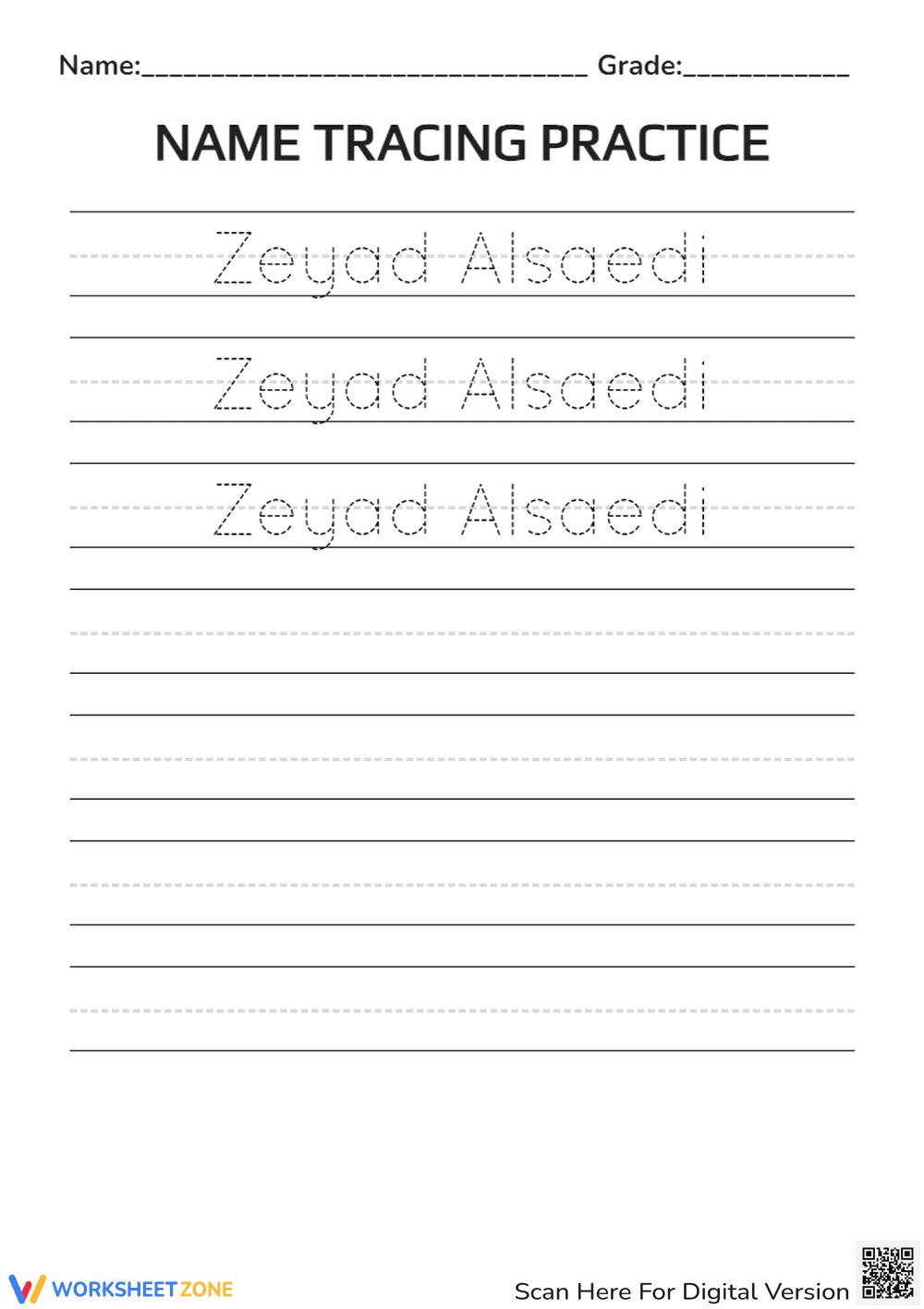

Essential Name Tracing Worksheet | Grade 1 Handwriting
Paste this activity's link or code into your existing LMS (Google Classroom, Canvas, Teams, Schoology, Moodle, etc.).
Students can open and work on the activity right away, with no student login required.
You'll still be able to track student progress and results from your teacher account.
Handwriting mastery begins with personal identification. This Grade 1 name tracing worksheet helps students master the specific letter formations in the name "Zeyad Alsaedi." By combining guided tracing with independent practice lines, students develop the muscle memory and pen control necessary for legible, confident handwriting in daily classroom assignments and literacy activities.
At a Glance
- Grade: 1 · Subject: Handwriting
- Standard:
CCSS.ELA-LITERACY.L.1.1.A— Print all upper- and lowercase letters with proper formation and spacing- Skill Focus: Name tracing and letter formation
- Format: 1 page · 10 tasks · No answer key needed · PDF
- Best For: Morning work and fine motor practice
- Time: 5–10 minutes
This single-page PDF features a clean, distraction-free layout designed for early learners. It includes three lines of dotted-line tracing for the name "Zeyad Alsaedi," followed by seven empty primary-ruled lines for independent repetition. The worksheet includes a header for the student's name and grade, facilitating easy organization and portfolio collection for progress monitoring throughout the school year.
Zero-Prep Workflow
- Print (30 seconds): Select the page and print enough copies for your small group or entire class.
- Distribute (30 seconds): Hand out the sheets during morning arrival or as a transition activity between subjects.
- Review (1 minute): Walk the room to check for proper pencil grip and stroke direction as students complete the tracing.
Total teacher preparation time is under two minutes, making this an ideal resource for substitute folders or unexpected schedule changes.
This resource is aligned with CCSS.ELA-LITERACY.L.1.1.A: "Print all upper- and lowercase letters." While the primary focus is on the specific letters within the name, the practice reinforces general letter formation rules applicable across the curriculum. This standard code can be copied directly into lesson plans, IEP goals, or district curriculum mapping tools to document handwriting intervention.
Use this worksheet as a "bell-ringer" activity to settle students at the start of the day. It also serves as an effective formative assessment tool; observe if the student maintains consistent letter height on the blank lines compared to the traced lines. Completion typically takes between 5 and 10 minutes depending on the student's fine motor development level.
This worksheet is designed for Grade 1 and Grade 2 students who are refining their print handwriting. It is particularly helpful for students requiring Tier 2 fine motor support or English Language Learners (ELLs) practicing English script. Pair this resource with a letter formation anchor chart or a tactile sand-tracing activity for a multi-sensory instructional approach.
Handwriting remains a foundational literacy skill, as research from Fisher & Frey (2014) indicates that the physical act of letter formation reinforces orthographic mapping and word recognition. This worksheet targets CCSS.ELA-LITERACY.L.1.1.A by providing a structured environment for students to practice printing upper- and lowercase letters within the context of a personal name. The transition from 3 guided tracing lines to 7 independent practice lines follows the gradual release of responsibility model, ensuring students move from scaffolded support to autonomous mastery. By focusing on the specific name "Zeyad Alsaedi," the resource increases student engagement through personalization while simultaneously building the fine motor control required for more complex writing tasks. Educators can utilize this 1-page PDF to monitor grip, stroke order, and letter sizing, providing immediate feedback that prevents the habituation of incorrect writing techniques during the critical early elementary years.


