


























Views
Downloads
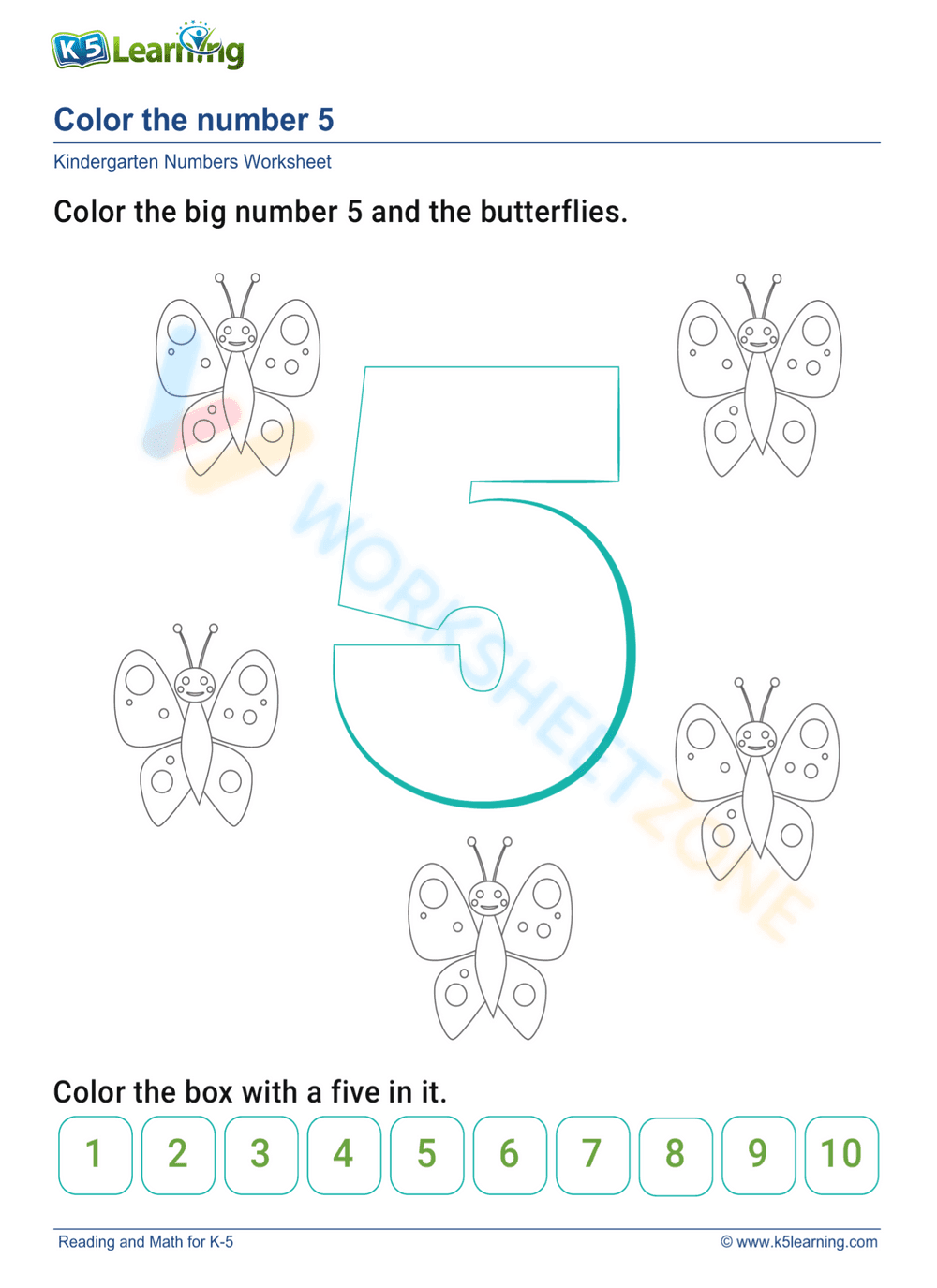


Printable Number 5 & Counting Worksheet | Preschool Math
Paste this activity's link or code into your existing LMS (Google Classroom, Canvas, Teams, Schoology, Moodle, etc.).
Students can open and work on the activity right away, with no student login required.
You'll still be able to track student progress and results from your teacher account.
This foundational math worksheet helps early learners master number recognition and basic counting skills. By focusing on the number five and counting scattered objects up to ten, students build essential cardinality concepts. The engaging visual format ensures young children stay focused while developing their quantitative reasoning abilities.
At a Glance
- Grade: Preschool · Subject: Math
- Standard:
CCSS.MATH.CONTENT.K.CC.B.5— Count to answer how many objects are in a group- Skill Focus: Number recognition and counting
- Format: 2 pages · 6 problems · No answer key · PDF
- Best For: Independent practice or morning work
- Time: 10–15 minutes
This two-page resource features six tasks for early math development. Page one centers on number recognition, asking students to color a large five, decorate butterflies, and identify the number five from a sequential number line. Page two transitions to applied counting, presenting four groups of toys (bears, a horse, boats, tops) where students count the items and write the numeral.
This resource requires zero teacher setup:
- Print (1 minute): Simply download the PDF and print the two pages double-sided or as separate sheets.
- Distribute (1 minute): Hand out the worksheets along with basic coloring supplies and pencils.
- Review (3 minutes): Quickly check student responses visually, as the large graphics make assessment instantaneous.
With prep time under two minutes, this activity suits sub plans or math centers.
This worksheet is strictly aligned to CCSS.MATH.CONTENT.K.CC.B.5: Count to answer how many questions about as many as 10 things in a scattered configuration. It also supports early number identification skills by isolating specific numerals for visual recognition. Both standard codes can be copied directly into lesson plans, IEP goals, or district curriculum mapping tools.
Deploy this worksheet during morning arrival to focus students on math concepts. Alternatively, it serves as an excellent independent station during guided math blocks. While students are working, teachers can use this as a formative assessment opportunity by observing one-to-one correspondence—watching to see if the child touches each object exactly once while counting aloud. The expected completion time ranges from ten to fifteen minutes depending on the student's fine motor coloring speed.
This resource is primarily designed for preschool and kindergarten students who are building foundational number sense. It is easily differentiated for students needing extra support by providing physical manipulatives (like counting bears or blocks) to place over the printed objects before writing the number. For a complete lesson experience, pair this worksheet with a whole-group read-aloud of a counting book or a physical number line anchor chart displayed on the classroom board.
Developing early numeracy skills through targeted counting and number recognition activities is a critical predictor of later mathematical achievement. This resource directly addresses CCSS.MATH.CONTENT.K.CC.B.5 by requiring students to count to answer how many objects are in a group. According to an EdReports 2024 analysis of early childhood math curricula, students who engage in repeated, visually supported counting exercises demonstrate significantly higher mastery of cardinality and one-to-one correspondence. By combining fine motor tasks with quantitative reasoning, this worksheet provides a multi-sensory approach to learning numbers. The structured layout minimizes cognitive overload, allowing young learners to focus entirely on the mathematical task. Consistent practice with these foundational concepts ensures students build the cognitive framework to tackle more complex operations in subsequent grades.


